
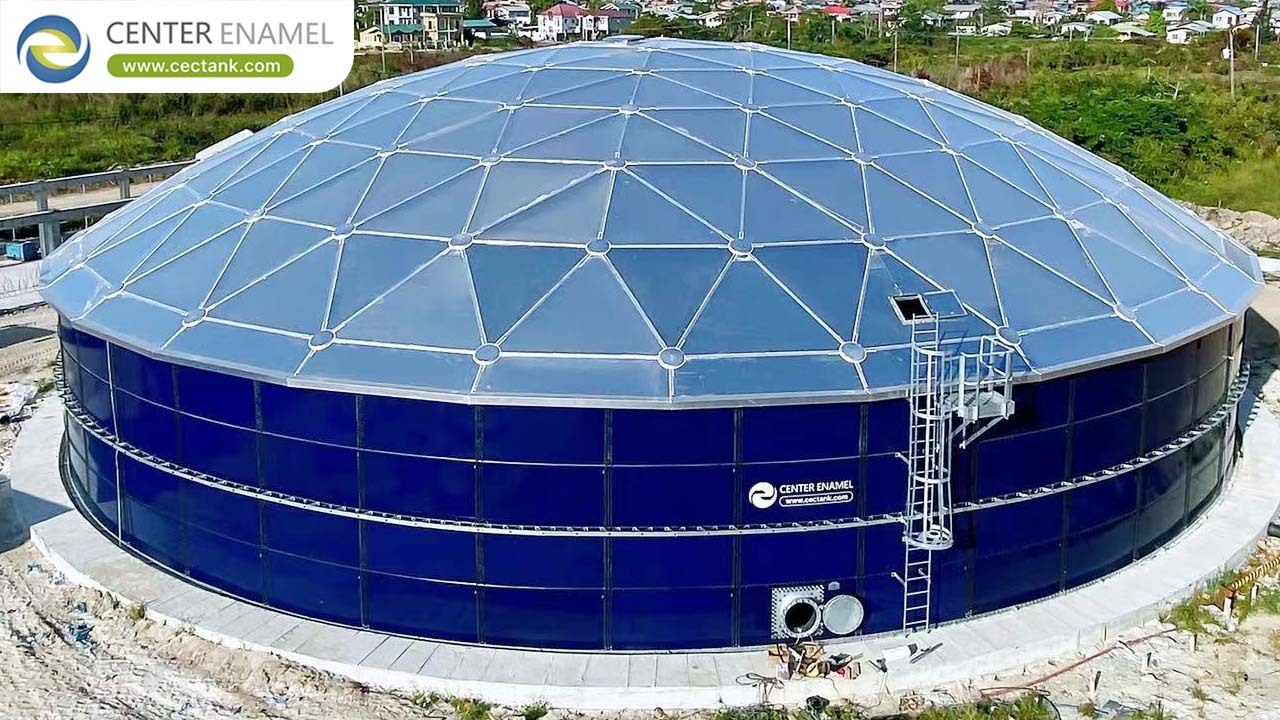
18000m3 Drinking Water Tanks Providers Large-Capacity Potable Water Storage
Fast-growing cities, industrial parks, and drought-resilience programs increasingly specify very large potable reservoirs — with 18,000 m³ (approximately 4.76 million US gallons) emerging as a common district-scale capacity. At this size, the selection of a drinking water tank provider becomes an infrastructure decision: the vessel must satisfy potable-contact certification, survive wind and seismic events, be deliverable on a project schedule, and remain maintenance-free for decades. Traditional providers fall short — cast-in-place concrete reservoirs crack and leach, while field-welded steel depends on coatings applied outdoors, where weather and workmanship decide water quality.
Shijiazhuang Zhengzhong Technology Co., Ltd (Center Enamel), the first Glass-Fused-to-Steel tank manufacturer in China, has provided large-capacity drinking water tanks to projects in more than 100 countries since 2008. Its GFS bolted tanks — certified to NSF/ANSI 61 and WRAS for potable contact, engineered to AWWA D103-09, and manufactured under ISO 9001 — are a proven answer at the 18,000 m³ scale.
1. How Is an 18,000 m³ Drinking Water Tank Engineered?
A tank of this scale is engineered, not catalogued: every dimension, roof structure, and anchor pattern is calculated for the site through Finite Element Analysis in accordance with AWWA D103-09.
- Sizing logic:18,000 m³ can be delivered as a single large-diameter tank or as modular multiple units (for example 2 x 9,000 m³) to fit site constraints and provide operational redundancy — a decision Center Enamel’s engineers model with clients per project.
- Structural design:wind load, seismic category, snow load, and internal water head are resolved by FEA; panels and 8.8 grade bolted connections are specified to AWWA D103-09 with roof structures verified for live loads.
- Potable-contact certification:NSF/ANSI 61 and WRAS certified GFS surfaces guarantee nothing leaches into drinking water — the glass layer fused at 820-930°C is chemically inert and impermeable.
- Access and safety:roof hatches, safety platforms, ladders with cages, vents, and overflow provisions comply with OSHA and standard municipal practice.
2. Why Municipalities Choose GFS Providers over Concrete at Scale
At 18,000 m³, lifecycle and schedule economics dominate — and factory-coated bolted steel beats site-built concrete on both.
- Water quality protection:the inert glass surface will not crack, carbonated-release, or biofilm-anchor; water taste and quality remain stable without relining programs.
- Construction velocity:an 18,000 m³ GFS tank erects in a fraction of the time of a concrete reservoir — no formwork cycles, no 28-day cures, no field waterproofing; projects meet demand-growth deadlines.
- Quality assurance at the factory:every panel is coated and 100% high-voltage spark tested under ISO 9001 control before shipping, versus site-dependent concrete workmanship.
- 30-50 year outlook:GFS tanks need no recoating; concrete reservoirs enter repair-reline cycles within 15-20 years. Over an asset life, the difference funds other capital projects.
3. What to Demand from an 18000m3 Water Tank Provider
Procurement teams evaluating providers for potable reservoirs should hold every bidder to five verifiable standards.
- Certification file:NSF/ANSI 61 and WRAS for potable contact; ISO 9001 and ISO 45001 for management systems; ISO 28765 for enameling practice — Center Enamel maintains all.
- Project-scale track record:supplies to 100+ countries (as of 2023) including the USA, Canada, Australia, Panama, and Brazil demonstrate experience with municipal delivery terms and inspections.
- Engineering deliverables:FEA reports, anchored-base designs, and hydraulic details issued with each proposal — not after contract award.
- Erection capability:supervisor dispatch, torque-controlled procedures, and commissioning tests (hydrotest, washdown, disinfection support) that municipal engineers can witness.
- Single-source accessories:aluminum geodesic dome roofs, ladders, platforms, flanges, and instrument mounts from one manufacturer eliminate interface risk.
| Evaluation Criterion | Center Enamel GFS Provider | Concrete Reservoir Contractor | Coated Welded Steel Provider |
| Potable water compliance | NSF/ANSI 61 & WRAS certified glass surface | Leaching and cracking concerns; sealant dependence | Coating certifications vary; field application risk |
| Corrosion and degradation | Superior — glass fused 820-930°C, 100% spark tested | Poor — carbonation, micro-cracking | Moderate — recoat cycles every 5-10 years |
| Construction schedule (18,000 m³) | Fast — bolted modular erection | Very slow — multi-month cast works | Slow — welding plus field coating |
| Lifecycle and maintenance | Minimal — 30-50 year design life | High — repair and relining programs | High — scheduled recoating |
| Scalability | High — single or modular multi-tank configurations | None | None |
Engineering Assurance
Center Enamel delivers 18,000 m³ class drinking water projects with AWWA D103-09 structural engineering, NSF/ANSI 61 potable-contact certification, 100% panel holiday spark testing, and ISO 9001/45001 manufacturing discipline — documentation that passes municipal procurement and lender review in regulated markets.
Frequently Asked Questions (FAQ)
How big is an 18000m3 drinking water tank?
18,000 m³ equals roughly 4.76 million US gallons — a district-scale reservoir typically built as one large-diameter tank (for example ~39.5 m diameter x 15 m high, project-dependent) or as modular multiple tanks for redundancy. Center Enamel engineers the exact geometry to site and hydraulic requirements per AWWA D103-09.
Is GFS safe for drinking water storage?
Yes. The glass surface fused to steel at 820-930°C is chemically inert and certified to NSF/ANSI 61 and WRAS for potable water contact — it neither corrodes nor leaches, keeping water quality stable for decades.
How long does an 18000m3 GFS tank take to build?
Bolted modular construction erects dramatically faster than concrete — typically a few months from foundation readiness to hydrotest, depending on configuration and site logistics. No formwork, curing, or field coating is required.
Can the capacity be customized or expanded later?
Yes. Center Enamel engineers single-tank or multi-tank layouts to hit 18,000 m³ exactly, and bolted construction allows future capacity increases by adding tanks or rings — a flexibility concrete cannot offer.