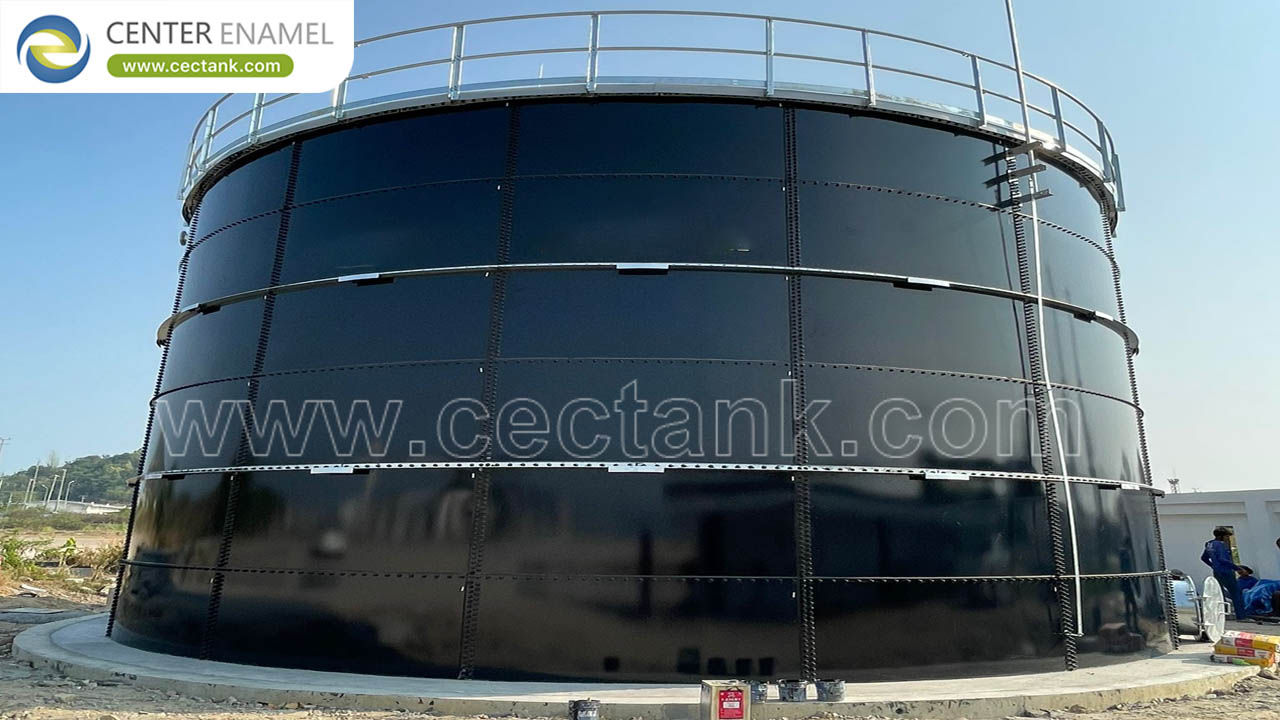
AWWA D103 Sewage Treatment Tank Supplier: Bolted Tanks for Effluent
An AWWA D103 sewage treatment tank supplier delivers bolted steel tanks built to the AWWA D103-09 standard for wastewater and effluent service. The standard governs the bolted shell; the coating decides how long it survives sewage chemistry. Engineered by Shijiazhuang Zhengzhong Technology Co., Ltd. (Center Enamel), a Glass-Fused-to-Steel (GFS) bolted tank meets D103-09 with an inert enamel that resists the harsh sewage environment.
What an AWWA D103 Sewage Tank Is
An AWWA D103 sewage treatment tank is a bolted steel vessel built to the AWWA D103-09 standard, which sets the design, fabrication, and erection rules for bolted tanks. For sewage the critical addition is the internal coating, because the standard defines the structure while the lining defines the service life in a corrosive, biological stream.
Standard: AWWA D103-09 for bolted tanks.
Duty: Sewage, effluent, and equalized wastewater.
Coating: The life-deciding internal surface.
Build: Bolted panels, gasketed joints.
Key Characteristics, Components, and Types
Sewage tanks under D103-09 use bolted panels with 8.8-grade fasteners, a sealed roof, and process nozzles for flow, return, and sampling. Glass-Fused-to-Steel (GFS) is the common coating for corrosive duty; epoxy is an alternative for milder streams. Capacities reach 40,000 m3 in a single bolted shell.
Shell: Bolted, calculated to D103-09.
Coating: GFS enamel or epoxy by chemistry.
Roof: Cone or geodesic dome, sealed.
Nozzles: Flow, return, and sample points.
Applications and Operating Conditions
AWWA D103 sewage tanks hold raw sewage equalization, clarified effluent, contact storage, and return activated sludge at municipal plants. They see pH swings, hydrogen sulfide, and abrasive grit, so the lining and the ventilation are specified together to protect both the steel and the operators.
Equalization: Buffers peak sewage flow.
Effluent: Clarified water before discharge.
RAS: Return activated sludge balance.
Hazards: H2S and grit drive the lining choice.
Technical Considerations
The shell is rated to AWWA D103-09 with the one-foot method for bolted courses, then the coating is selected from the stream pH and sulfide level. A Glass-Fused-to-Steel (GFS) enamel fused at 820-930°C resists both, and the surface is holiday-tested at 1500 V. Ventilation and access follow operator-safety codes.
Shell: D103-09 one-foot course calculation.
Coating: GFS for harsh, epoxy for mild.
Test: 1500 V holiday test per surface.
Safety: Ventilation and access per code.
Advantages and Limitations
A bolted AWWA D103 tank with GFS coating resists sewage corrosion and erects faster than welded, which shortens the construction window at a live plant. A limitation is the single-shell ceiling near 40,000 m3; above that, welded D103 or multiple bolted tanks are the call, and this boundary should be confirmed against the required volume.
Advantage: Inert enamel resists sewage chemistry.
Advantage: Bolted build is fast at live sites.
Limitation: Single shell near 40,000 m3.
Limitation: Larger duty needs welded or multiple.
Design Parameters
These values frame an AWWA D103 sewage tank spec. They let the plant confirm the shell rating, the coating, and the joints before fabrication, and they are the evidence the supplier should provide with the tank.
Typical value or range |
Why it matters |
500-40,000 m3 |
Single-tank throughput |
6-40 mm |
Hydrostatic head by elevation |
0.25-0.40 mm |
Verified before shipment |
820-930 °C |
Enamel bond to steel |
1500 V |
Every square meter checked |
8.8 |
Field joint integrity |
30-50 years |
With inspection plan |
20-60 °C |
Product and climate |
AWWA D103-09 / ISO 28765 |
Design authority |
Feed pH and abrasives |
Confirm in specification |
Comparison and Selection Guide
Against welded steel and concrete, a bolted AWWA D103 tank with GFS coating wins on corrosion resistance and build speed for the 500-40,000 m3 sewage range. The table helps match the build to site and volume.
GFS bolted tank |
Welded steel tank |
Concrete tank |
FRP tank |
Vitreous enamel, inert |
Coating-dependent |
Good but porous |
Liner-dependent |
Bolted, fast on site |
Welded, slower |
Cast in place |
Molded / shop |
Up to 40,000 m3 |
Up to 150,000 m3 |
Very large |
Limited (<5,000 m3) |
30-50 years |
30-50 years |
40-60 years |
20-30 years |
Corrosive, modular |
Very large, generic |
Heavy civil works |
Small, neat chemical |
Best Practices: How to Choose a Supplier
Require the AWWA D103-09 compliance letter, the ISO 28765 enamel calculation where GFS, and a 1500 V holiday-test report, plus a reference sewage plant of similar size. Shijiazhuang Zhengzhong Technology Co., Ltd. (Center Enamel) supplies the calculation, coating certificate, and inspection file so the tank passes both code review and plant operation.
Ask for: AWWA D103-09 compliance letter.
Require: ISO 28765 calc and 1500 V report.
Verify: Enamel DFT 0.25-0.40 mm.
Reference: A sewage plant of comparable size.
Conclusion
An AWWA D103 sewage treatment tank supplier should deliver a code-rated bolted shell and a coating proven for sewage, not just a standard compliance letter. Specify D103-09, demand the holiday test, and the tank will survive the plant’s chemistry for its 30-50 year design life.
Frequently Asked Questions (FAQ)
What does AWWA D103-09 cover?
It is the standard for the design, fabrication, and erection of bolted steel tanks, setting the shell calculation and joint rules used for sewage and water tanks.
Why coat a D103 sewage tank with GFS?
Sewage is corrosive and biological; a Glass-Fused-to-Steel (GFS) enamel fused at 820-930°C is inert to pH swings and hydrogen sulfide, far outlasting painted steel.
What capacity can a bolted D103 tank reach?
A single bolted GFS tank spans about 500-40,000 m3; larger sewage duty uses multiple bolted tanks or a welded shell.
How is the coating verified?
Plate is blasted to Sa 2.5, enamel is fused, and the surface is holiday-tested at 1500 V, with a DFT of 0.25-0.40 mm logged per tank.
Is epoxy an option instead of GFS?
Yes, for milder streams epoxy is used, but GFS is preferred where pH and sulfide are aggressive because the enamel is more durable.
What should a supplier provide?
The AWWA D103-09 compliance letter, the coating certificate, the holiday-test and DFT reports, and a reference plant of similar size.
Key Takeaways
D103-09 rates the shell; the coating sets sewage life.
Prefer GFS enamel for corrosive, sulfide-rich streams.
Require the D103-09 letter and a 1500 V report.
Above 40,000 m3, use welded or multiple bolted tanks.
