
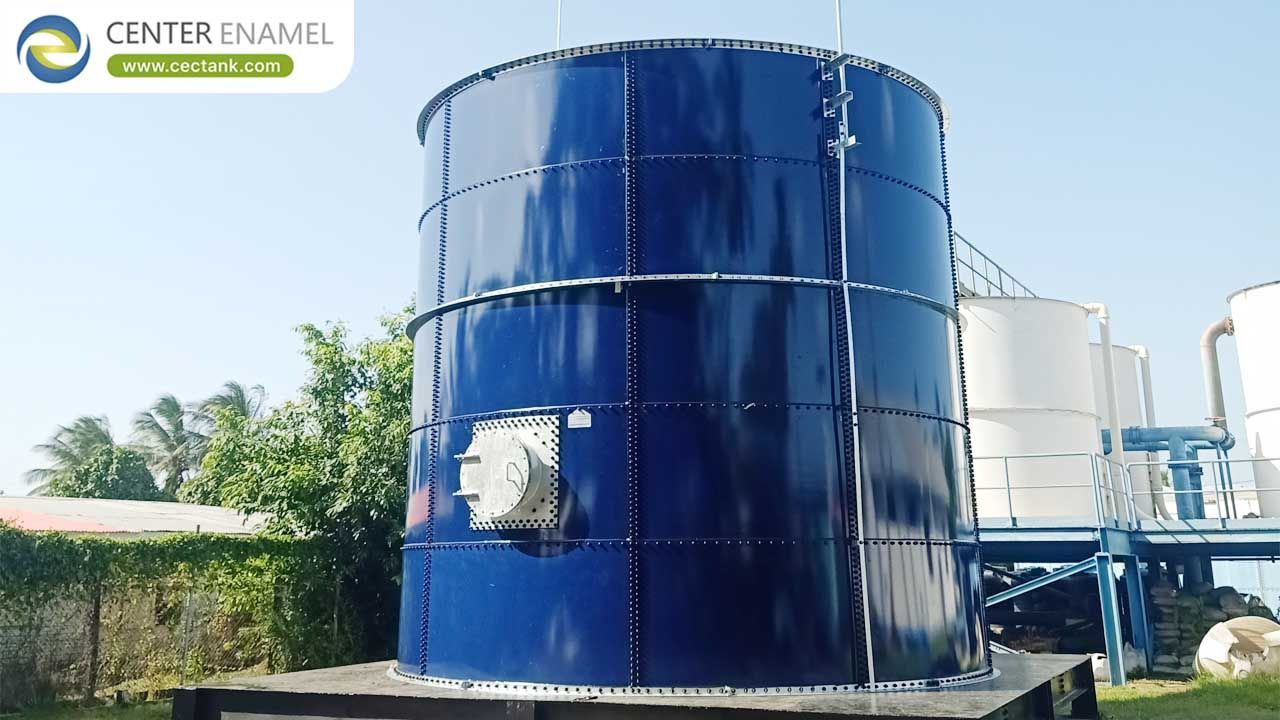
20000 m3 Steel Water Storage Tanks: Engineering Very Large Bolted Reservoirs
How large can a bolted steel water tank be built?
What diameter and height suits a 20000 m3 tank?
How are very large tanks transported and erected?
What foundation does a 20000 m3 steel tank need?
At around 20,000 m³, a water storage tank stops being a procurement item and becomes a civil and logistical project. The volume is large enough that geometry decisions interact with foundation design, wind and seismic loading become governing rather than routine, and the number of panels, bolts, and seals turns site management into the critical path. Across municipal bulk supply schemes, industrial raw water storage, and strategic fire and emergency reserves, the difficulties that appear at this scale are rarely about the tank itself: they concern access for delivery vehicles, crane positioning, panel sequencing, seal handling in adverse weather, and the foundation tolerances that a bolted structure will not forgive.
A 20,000 m³ bolted steel water tank is well within proven capability when the engineering is approached systematically — geometry selected against site and hydraulic constraints, shell designed for the actual wind and seismic case, foundation built to the tolerances bolted assembly demands, and panel logistics planned as carefully as the structure. Shijiazhuang Zhengzhong Technology Co., Ltd. (Center Enamel) has delivered tanks of this class and beyond, including a 21,094 m³ unit in 2020, a 32,000 m³ installation in 2024, and a 34.8 m tall tank in 2018, with systems supplied to more than 100 countries.
1. What Geometry Suits a 20000 m3 Tank?
Geometry is a trade-off between footprint, height, and hydraulics. A 20,000 m³ vessel might be configured around 40 m diameter by 16 m height or 32 m by 25 m, and the choice is governed by available land, the operating level range required by the distribution system, and the cost of the foundation, which rises with height.
Footprint Versus Height: A larger diameter reduces height and foundation load concentration but requires more land and a wider roof span.
Hydraulic Level Range: The usable level band is set by the distribution system, so the tank should be proportioned so the operating range sits within an efficient shell height.
Roof Span: Wide diameters may favour an aluminium geodesic dome, which spans without internal columns and keeps the interior clear for inspection and cleaning.
Wind Exposure: Taller, narrower shells are more wind sensitive, so exposed coastal or open sites often favour a lower profile.
Foundation Economy: Bearing capacity and settlement limits frequently decide the geometry, since foundation cost often exceeds the marginal cost of extra shell steel.
2. What Governs the Structural Design at This Scale?
At 20,000 m³ the governing design cases shift. Wind and seismic loading, shell stability, and foundation settlement tolerance become dominant, and the bolted joint — not the plate — is usually the critical element. Design is therefore validated by finite element analysis rather than by a thickness table, to AWWA D103-09.
Wind and Seismic: Lateral loading and seismic sloshing govern shell and anchorage design, and both must be assessed against the actual site exposure category and seismic zone.
Shell Stability: Thin-walled shells in this size range are stability-governed, making ring design, stiffeners, and wind girders part of the structural solution.
Bolted Joint Design: Grade 8.8 fasteners with engineered sealing are the critical interface; joint design and bolt layout carry the same weight as plate thickness.
Settlement Tolerance: Bolted structures tolerate far less differential settlement than monolithic ones, making foundation design and construction quality decisive.
Finite Element Validation: Shell, roof, and anchorage are modelled rather than sized by table, so the design is defensible and documented for review.
3. How Are Panel Logistics and Erection Managed?
Large bolted tanks succeed or fail on site management. Every panel travels as a factory-finished unit, so the critical path is sequencing: panels must arrive in erection order, be handled without coating damage, be sealed under conditions that suit the sealant, and be assembled to a tolerance the foundation has already achieved.
Factory-Finished Panels: Panels arrive coated, tested, and numbered, so no field coating is required and quality does not depend on site weather.
Erection Sequencing: Panels are packed and shipped in assembly order, which is what keeps the crane productive rather than waiting on the right part.
Protected Handling: Lifting and storage procedures protect the fused coating, because damage on site is the most avoidable source of future corrosion.
Sealant Discipline: Seams are assembled under controlled conditions with the specified sealant, following the manufacturer’s temperature and surface requirements.
Access and Laydown: Vehicle routing, crane positions, and laydown area must be planned before delivery, since a 20,000 m³ tank arrives as many container loads.
| Evaluation Criterion | Center Enamel Large Bolted Steel Tanks | Welded Field-Erected Steel Tanks | Cast-in-Place Concrete Reservoirs |
|---|---|---|---|
| Delivery & programme | Fast — factory panels, 30-day schedule | Slow — field welding and coating | Very slow — formwork, cure, weather |
| Coating quality | High — factory fused, 100% spark tested | Variable — field coating dependent | Variable — applied lining on site |
| Design validation | High — FEA to AWWA D103-09 | High — but site-executed | Moderate — conventional design |
| Lifecycle & maintenance | Minimal — 30-50 year design life | High — periodic recoating | High — crack repair and relining |
Center Enamel engineers large bolted steel reservoirs with documented reference scale: a 21,094 m³ tank delivered in 2020, a 34.8 m tall unit in 2018, and a 32,000 m³ installation in 2024. Panels are glass-fused at 820-930 °C with 2C2F coverage verified by 100% high-voltage holiday spark testing at 1500 V, joined with grade 8.8 bolting, and validated by finite element analysis to AWWA D103-09. Production runs to ISO 9001 with NSF/ANSI 61, WRAS, and CE/EN 1090 coverage, delivered to more than 100 countries on a standard 30-day schedule with a three-year warranty.
At 20,000 m³ the tank is the easy part. The project is decided by foundation tolerance, panel sequencing, and whether the crane is waiting on the right part. — Center Enamel Structural Engineering Team
Häufig gestellte Fragen (FAQ)
How large can a bolted steel water tank be built?
Bolted steel tanks are routinely built well beyond 20,000 m³, and Center Enamel has delivered a 21,094 m³ unit in 2020, a 34.8 m tall tank in 2018, and a 32,000 m³ installation in 2024. Because each tank is assembled from factory panels, total capacity is not limited by transport dimensions in the way a shop-built vessel would be.
What diameter and height suits a 20000 m3 tank?
Common configurations sit around 40 m diameter by 16 m height or 32 m by 25 m, selected against available land, the operating level range required by the distribution system, foundation bearing capacity, and wind exposure rather than chosen from a standard table.
What foundation does a 20000 m3 steel tank need?
A foundation designed for the shell load and, critically, for very tight differential settlement tolerance, because a bolted structure is far less forgiving than a monolithic one. Foundation design should precede final geometry selection, since it frequently governs the diameter-to-height decision.
Can large tanks be customized to our site?
Yes. Center Enamel configures capacity, diameter and height, roof type including GFS self-supporting roofs and aluminium geodesic domes, wind and seismic design to the site case, insulation, and all manways, flanges, ladders, platforms, and instrumentation.
Key Takeaways
At 20,000 m³, geometry is decided by land, hydraulic level range, foundation capacity, and wind exposure — not by a standard sizing table.
Wind, seismic sloshing, shell stability, and bolted joint design govern the structure; validate by finite element analysis to AWWA D103-09.
Bolted structures tolerate very little differential settlement, so foundation design should come before final geometry selection.
Project success depends on panel sequencing, protected handling, sealant discipline, and planned site access as much as on the tank design.