
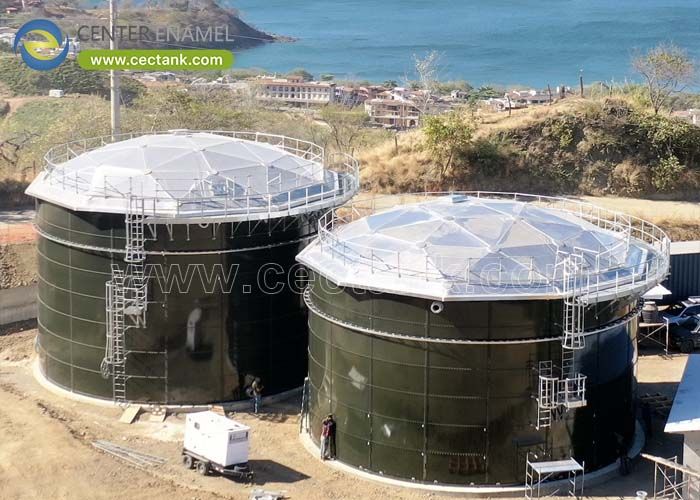
FBE Digesters in Industrial Processes: Engineering Standards for Anaerobic Systems and Pulp & Paper Applications (2026)
Bei großen industriellen Infrastrukturprojekten entscheidet die Auswahl des richtigen Behälters zur Einschließung und Verarbeitung sowohl über die langfristige Betriebsfähigkeit als auch über die Effizienz der Investitionsausgaben (CAPEX). In Branchen wie der Bioenergieerzeugung und der chemischen Zellstoffherstellung werden robuste Verarbeitungsbehälter – gemeinsam bezeichnet als Fermenterextremen thermischen Belastungen, physikalischer Abnutzung sowie stark korrosiven chemischen Umgebungen ausgesetzt.
Stand 2026, Fusion Bonded Epoxy (FBE)-verschraubte Stahltanks have become an industry baseline for advanced anaerobic digestion (AD) plants. Additionally, the unique high-adhesion and anti-corrosive properties of FBE chemical coatings are widely used to protect critical pipeline infrastructures, chemical transport networks, and localized storage cells within pulp processing facilities.
1. Core Manufacturing Technology and FBE Coating Standards
The reliability of an FBE-coated vessel or pipeline component depends entirely on the automation and climate control of its manufacturing facility. Field-applied liquid paints are vulnerable to ambient humidity and inconsistent dry film thickness (DFT), whereas the factory-controlled Schmelzgebundenes Epoxid workflow ensures a uniform, high-performance protective barrier:
Automatisierte Oberflächenvorbereitung: Das rohe Kohlenstoffstahlsubstrat wird mittels automatisiertem Strahlen mit hoher Geschwindigkeit behandelt, um Walzoxidschichten und oberflächliche Oxide zu entfernen. Nach industriellen Spezifikationen muss die Stahloberfläche bis nahezu weißen Zustand entsprechend den Sa 2.5 (ISO 8501-1) oder SSPC-SP10 standards, creating an optimized anchor profile (typically 50µm to 112µm).
Thermal Powder Application: The blasted steel elements are pre-heated using induction furnaces to a precise temperature range between 180°C and 240°C. A thermosetting industrial epoxy powder is electrostatically sprayed onto the hot substrate.
Cross-Linked Polymer Fusion: Upon contact, the powder melts, flows, and chemically cross-links inside an automated curing oven. This creates an inseparable, dense, glass-smooth protective matrix permanently bonded to the steel substrate at thicknesses ranging from 150 to over 450 microns depending on the specific application.
2. FBE in Waste-to-Energy: High-Rate Anaerobic Digesters
In utility-scale biogas plants, FBE bolted steel reactors are heavily deployed in specialized configurations such as Continuous Stirred-Tank Reactors (CSTR), Aufstrom-Anaerobes Schlammdeckel-System (UASB) sowie Aufstrom-Feststoffreaktoren (USR).
Biogenic Acid Defense ($\text{H}_2\text{S}$ and VFAs)
Während der Anfangsphase des Abbaus organischer Abfälle führt die rasche Anreicherung flüchtiger Fettsäuren (VFAs) zu einem starken Absinken des inneren Flüssigkeits-pH-Werts auf aggressive Bereiche (pH-Wert 4,0 bis 5,5). Simultaneously, the biochemical breakdown of organic matter releases high concentrations of hydrogen sulfide gas. In the reactor’s enclosed headspace, this gas condenses to form highly corrosive sulfuric acid . While these biogenic acids induce rapid carbonation, calcium leaching, and spalling in reinforced concrete, the cross-linked polymer matrix of FBE remains completely inert across a wide chemical spectrum (pH 3.0 to 11.0).
Flexibility Under Dynamic Mixing Shocks
To maximize gas production, anaerobic digesters rely on powerful high-torque internal mixing paddles to prevent floating scum layers. This continuous agitation transmits severe dynamic vibrations and physical impacts throughout the steel shell. While vitreous glass linings (Glass-Fused-to-Steel) offer high surface hardness, they are inherently brittle and prone to chipping or micro-fracturing under intense physical shock. FBE is a flexible thermoset polymer that flexes dynamically alongside the steel panel, providing superior chip, shatter, and impact resistance (up to 160 in-lbs direct and reverse).
100% – Lochfreie Qualitätssicherung
Da organisches Gärgut als hochleitfähiges Elektrolyt wirkt, können mikroskopisch kleine Beschichtungsfehler schnell zu lokalen galvanischen Lochfraßschäden führen. Hochwertige Hersteller wenden strenge Qualitätssicherung (QA) protocols, subjecting every individual panel to a high-voltage electronic **Holiday Test ** to isolate and eliminate microscopic pinholes before shipping.
3. FBE in the Pulp & Paper Sector: Process Equipment & Pipeline Protection
Beim chemischen Zellstoffaufschluss – wie zum Beispiel beim weit verbreiteten Kraftverfahren—Industrielle Faulbehälter fungieren als große, unter hohem Druck stehende Kochkessel. Holzschnitzel, Bambus oder landwirtschaftliche Reststoffe wie Pennisetum Purpureum (king grass) are cooked with highly alkaline chemical mixtures (sodium hydroxide and sodium sulfide, known as Weißer Alkohol) bei maximalen Temperaturen von 160°C bis 180°C um das Lignin-Bindemittel des Holzes aufzulösen.
Because of the extreme temperatures , high pressures, and heavy concentrations of aggressive caustic liquors involved inside the primary pulp cooking vessel, the main pressure hull requires heavy composite steels or duplex stainless steels. However, FBE coatings serve as an essential defense mechanism throughout the broader mill infrastructure, handling secondary lines, chemical transport, and waste processing:
Transport von Schwarz-, Grün- und Weißlauge: FBE single- and dual-layer powder coatings are extensively applied to the interiors of carbon steel transport piping networks. The smooth, hard polymer lining exhibits outstanding chemical resistance against corrosive alkaline streams, while significantly lowering fluid friction coefficients compared to unlined steel or cement-mortar linings.
Zellstoff-Wasch- und Bleichsysteme: After leaving the primary cooking zone, the residual pulp matrix (“Brown Stock”) and spent chemicals are conveyed to wash stages and bleaching towers. FBE-coated fittings, valves, and auxiliary containment elements provide an inert shield against the corrosive carryover fluids and chemical vapors found in these environments.
Prozesswasser- und Abwasserinfrastruktur der Papierfabrik: Pulp and paper mills are among the largest industrial users of process water. FBE bolted steel storage assets are widely deployed as raw source-water buffering units, condensate receiver storage tanks, and municipal-grade effluent treatment digesters, offering an economical, long-life containment solution.
4. Ingenieurstandards und globale zivile Compliance
To satisfy international engineering criteria and successfully clear strict project bidding screens, high-performance FBE bolted vessels and industrial coatings comply with the following global standards:
AWWA D103-19 (Section 12.6): The premier global benchmark standard governing factory-coated bolted carbon steel liquid storage systems, validating structural calculations and epoxy coating application profiles.
ISO 28765:2016: Die spezifische internationale Norm, die die Qualität leistungsfähiger Beschichtungen, Dicken-Toleranzen sowie Prüfprofile für Leckagen bei Wasser-, Abwasser- und Bioenergie‑Containment-Anwendungen regelt.
ANSI/AWWA C550 & C213: Regulating protective fusion-bonded epoxy internal and external coatings for valves, hydrants, and steel water pipelines to ensure long-term corrosion prevention.
ASCE 7-22 / Eurocode 3: Konstruktionsparameter der Statik, die sicherstellen, dass modulare Schraubentanks präzise berechnet werden und eine hohe seismische Widerstandsfähigkeit sowie extreme Windlasten bis zu 250 km/h.
Securing Plant Longevity and Lowering TCO
Whether deployed as a primary modular anaerobic reactor in a utility-scale biogas project or used to protect critical secondary chemical transport lines within a pulp processing facility, factory-fused FBE technology delivers exceptional long-term value. By eliminating the cracking and gas-loss risks associated with reinforced concrete, and providing a flexible, fracture-resistant alternative to brittle glass linings, premium FBE assets dramatically lower the Gesamtbetriebskosten (TCO), und gewährleisten einen sicheren, kontinuierlichen Betrieb mit geringem Wartungsaufwand über eine Infrastrukturlebensdauer von mehr als 30 Jahre.
Projektieren Sie derzeit ein industrielles Abwasserprojekt, konzipieren eine Hochleistungs‑Anaerobreaktionsanlage oder modernisieren eine kommerzielle Verarbeitungsanlage und wünschen sich ein detailliertes technisches Angebot inklusive struktureller Dimensionierung, chemischer Kompatibilitätskennwerten sowie technischer Zeichnungen entsprechend Ihren spezifischen Betriebsparametern?