
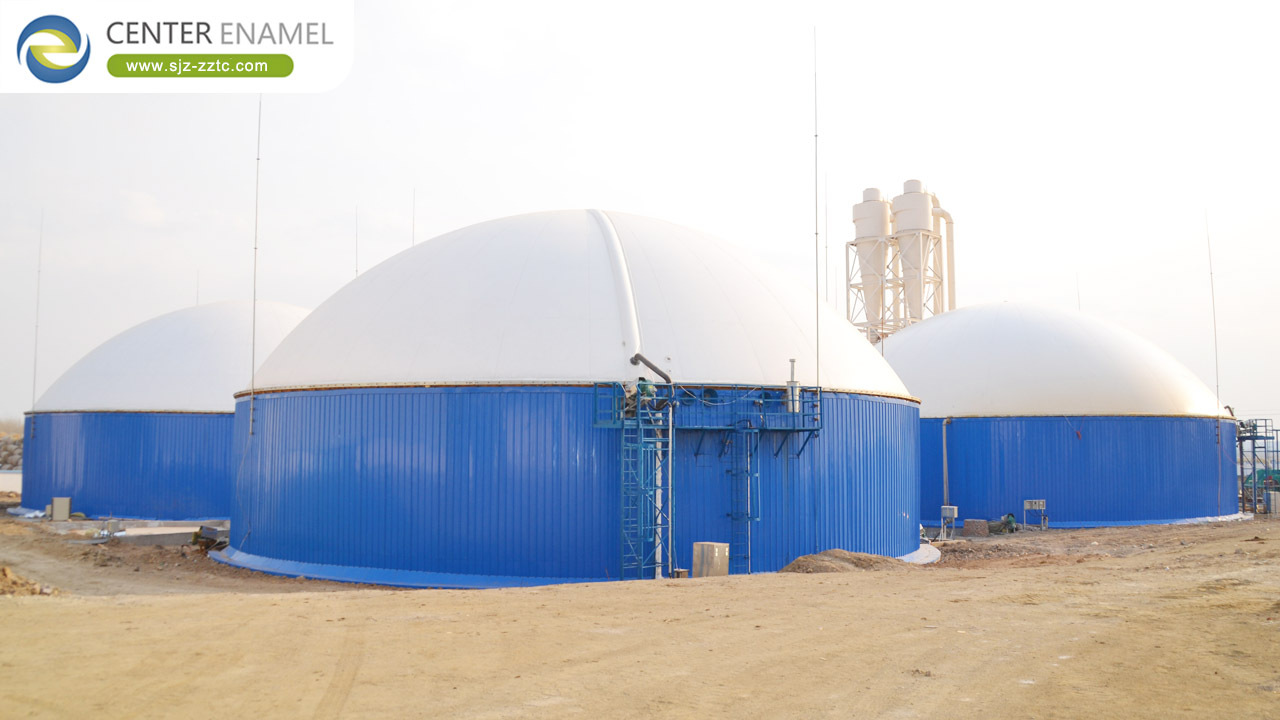
Hochwertiger korrosionsbeständiger glasfusierte Stahltank als anaerobes Reaktor
Im Bereich der modernen Bioenergieerzeugung und der fortschrittlichen industriellen Abwasserbehandlung stellt die anaerobischer Reaktor den zentralen biologischen Antrieb dar. Die Umwandlung hochkonzentrierter organischer Abfälle, landwirtschaftlicher Gülle, Lebensmittelverarbeitungsabfälle sowie kommunaler Klärschlämme in erneuerbares Methan‑Biogas erfordert ein streng kontrolliertes biochemisches Milieu. Allerdings erzeugen genau jene biologischen Prozesse, die die Energierückgewinnung vorantreiben – insbesondere die anaerobe Fermentation – aggressive chemische Nebenprodukte, darunter flüchtige Fettsäuren (VFAs), Kohlendioxid sowie hohe Konzentrationen von Schwefelwasserstoff ($H_2S$).
Diese Bestandteile verbinden sich zu einer äußerst korrosiven Innenatmosphäre, die in der Lage ist, herkömmliche Kohlenstoffstahlplatten zu zerstören und traditionelle Betonbehälter durch mikrobiell induzierte Korrosion (MIC) zu degradieren. Um eine unterbrechungsfreie strukturelle Langlebigkeit sowie absolute Gasdichtheit zu gewährleisten, setzen moderne Biogasanlagen auf überlegene korrosionsbeständige Glas‑auf‑Stahl‑(GFS‑)Behälter, die als hocheffiziente anaerobe Reaktoren konfiguriert sind. Entwickelt von Shijiazhuang Zhengzhong Technology Co., Ltd. (Zentrum-Emaille), liefern diese fortschrittlichen modularen Reaktoren weltweit Benchmark‑Standards in puncto Haltbarkeit und Betriebssicherheit.
Die schweren korrosiven Anforderungen der anaeroben Vergärung
Der Betrieb eines anaeroben Reaktors bedeutet, eines der chemisch aggressivsten Umgebungen im industriellen Ingenieurwesen zu beherrschen:
Biogenes Schwefelsäure und H2S Angriff: Im Kopfraum eines anaeroben Faulbehälters reagieren schwefelreduzierende Bakterien mit Feuchtigkeit und bilden Schwefelwasserstoffgas, das an oberen Wänden und Dachkonstruktionen zu Schwefelsäure oxidiert und ungeschützte Metalle rasch anlaufen lässt.
Anreicherung flüchtiger Fettsäuren: In säurebildenden Phasen entstehen lokalisierte saure Bedingungen (niedrige pH‑Werte), die herkömmliche Beschichtungen angreifen und Kalzium aus Betongitterwerken herauslösen.
Zyklischer Druck und Schlammabrieb: Durch ständiges mechanisches oder hydraulisches Rühren (wie etwa in CSTR‑Systemen) gelangen abrasive Feststoffpartikel an die Innenwände und beanspruchen eine außergewöhnlich harte, verschleißfeste Innenauskleidung.
Technische Überlegenheit der GFS‑Anaerobreaktoren von Center Enamel
Center Enamel kombiniert modernste Materialwissenschaft mit robustem modularem Engineering, um den zerstörerischen chemischen Realitäten der anaeroben Vergärung zu begegnen:
Hochtemperaturmetallurgische Schmelze: Anorganisches Glasemail‑Frit wird auf hochfesten Baustahlplatten aufgetragen und in speziellen Öfen bei extremen Temperaturen zwischen 820 °C und 930 °C thermisch eingebrannt. Dadurch entsteht eine untrennbare molekulare Verbindung, die die Zugfestigkeit des Stahls mit der absoluten chemischen Inertheit des Glases vereint.
Absolute Immunität gegen mikrobiell bedingte Korrosion (MIC): Im Gegensatz zu organischen Flüssigbeschichtungen oder Epoxidfarben, die unter chemischer Einwirkung blähen und sich ablösen, bietet die glatte, porenfreie Glasoberfläche Bakterien keinerlei Angriffsfläche und verhindert die Korrosion bereits auf molekularer Ebene.
Modulares gasdichtes Schraubendesign: Vorgefertigt unter strengen, ISO-zertifizierten Fabrikbedingungen werden Reaktorpaneele vor Ort mithilfe spezieller hochfesten Befestigungselemente und fortschrittlicher flexibler Dichtstoffe montiert, wodurch eine 100% gasdichte Einschlusskonstruktion für eine optimale Methangewinnung gewährleistet wird.
Vergleichsmatrix: Anaerobe Reaktortechnologien
| Bewertungskriterium | Zentrales emailliertes GFS-anaerobes Reaktor | Vor Ort gegossener Betonreaktorbehälter | Traditioneller geschweißter Kohlenstoffstahlbehälter |
| Korrosions- und Säurebeständigkeit | Überlegen (Inertes Glas, das mit Stahl verschmolzen ist, widersteht vollständig VFAs, H2S, und niedrige pH-Werte) | Mäßig (Anfällig für Betonkarbonatisierung, Sulfatangriff und saure Abplatzungen) | Niedrig (Abhängig von vor Ort aufgebrachten Epoxidbeschichtungen, die schnell pocken, blasen und abblättern) |
| Mikrobielle Resistenz (MIC) | Totale Immunität (Die Inertglasoberfläche verhindert bakterielle Besiedelung und säurebedingte Lochfraßbildung) | Niedrig (Anfällig für bakterielle Schwefelumwandlung und strukturelle Wandverdünnung) | Niedrig (Anfällig, sobald mikroskopische Defekte in der Beschichtung auftreten) |
| Montagegeschwindigkeit | Schnell (Vorgefertigte modulare Paneele werden vor Ort rasch verschraubt, ohne Wartezeiten für das Aushärten) | Sehr langsam (Monate an Bauarbeiten wie Schalung, Betonieren sowie mehrwöchige Aushärtephasen) | Mäßig (Erfordert aufwändiges Walzen, Schweißen und Röntgenprüfungen der Platten vor Ort) |
| Lebenszyklus und Wartung | Minimal (30 bis über 50 Jahre Lebensdauer ohne jegliche Innenraumneulackierung) | Hoch (Erfordert häufige strukturelle Rissabdichtungen und gefährliche Reparaturarbeiten) | Hoch (Kontinuierliche Wartungskosten zur Vermeidung von Durchrostungen und Leckagen) |
Technische Sicherheit: Alle von Center Enamel konstruierten anaeroben Reaktoren aus glasfused-to-steel entsprechen strikt international anerkannten Normen, einschließlich ISO 28765, AWWA D103-09, ISO 9001 sowie strengen Qualitätsprüfungen wie dem 100%-Hochspannungs-Fehlerstromprüfverfahren vor dem Versand.
Häufig gestellte Fragen (FAQ)
F: Warum ist Glas-fused-to-Steel (GFS) gegenüber herkömmlicher Epoxidbeschichtung bei anaeroben Reaktoren überlegen?
A: Epoxidbeschichtungen beruhen auf physikalischer Haftung am Stahlsubstrat und neigen bei Kontakt mit aggressiven flüchtigen Fettsäuren sowie Schwefelwasserstoff zu Blasenbildung, Abblättern und chemischem Untergraben ($H_2S$). Die GFS‑Technologie hingegen zeichnet sich durch eine untrennbare molekulare thermische Verbindung zwischen Glas und Stahl aus, wodurch eine dauerhafte, inerte Barriere entsteht, die sich nicht ablösen kann.
F: Wie bewältigen GFS‑anaerobe Reaktoren den inneren Gasdruck und die Mischkräfte?
A: Die GFS‑Reaktoren von Center Enamel werden mithilfe fortschrittlicher Finite-Elemente-Analyse (FEA) konstruiert und erfüllen entsprechende Bauvorschriften wie AWWA D103 oder ISO 28765. So gewährleisten sie einen sicheren Umgang mit hydrostatischem Flüssigkeitsdruck, mechanischen Mischbelastungen sowie Druck‑Vakuum‑Zyklen im Gasraum.
F: Können GFS‑anaerobe Reaktoren für hochtemperaturige thermophile Vergärung eingesetzt werden?
A: Ja. GFS‑Materialien verfügen über außergewöhnliche thermische Stabilität und Beständigkeit gegen Temperaturschwankungen, sodass sie sowohl für mesophile (35 °C bis 38 °C) als auch für thermophile (50 °C bis 55 °C) anaerobe Vergärungsprozesse vollständig geeignet sind.
F: Welche Lebensdauer ist bei einem GFS‑anaeroben Reaktor von Center Enamel zu erwarten?
A: Bei ordnungsgemäßer Wartung und Betrieb innerhalb der vorgesehenen pH‑ und Temperaturparameter bieten die GFS‑anaeroben Reaktoren von Center Enamel eine langlebige Betriebsdauer von über 30 bis 50 Jahre mit nahezu null Innenwartungsaufwand.