
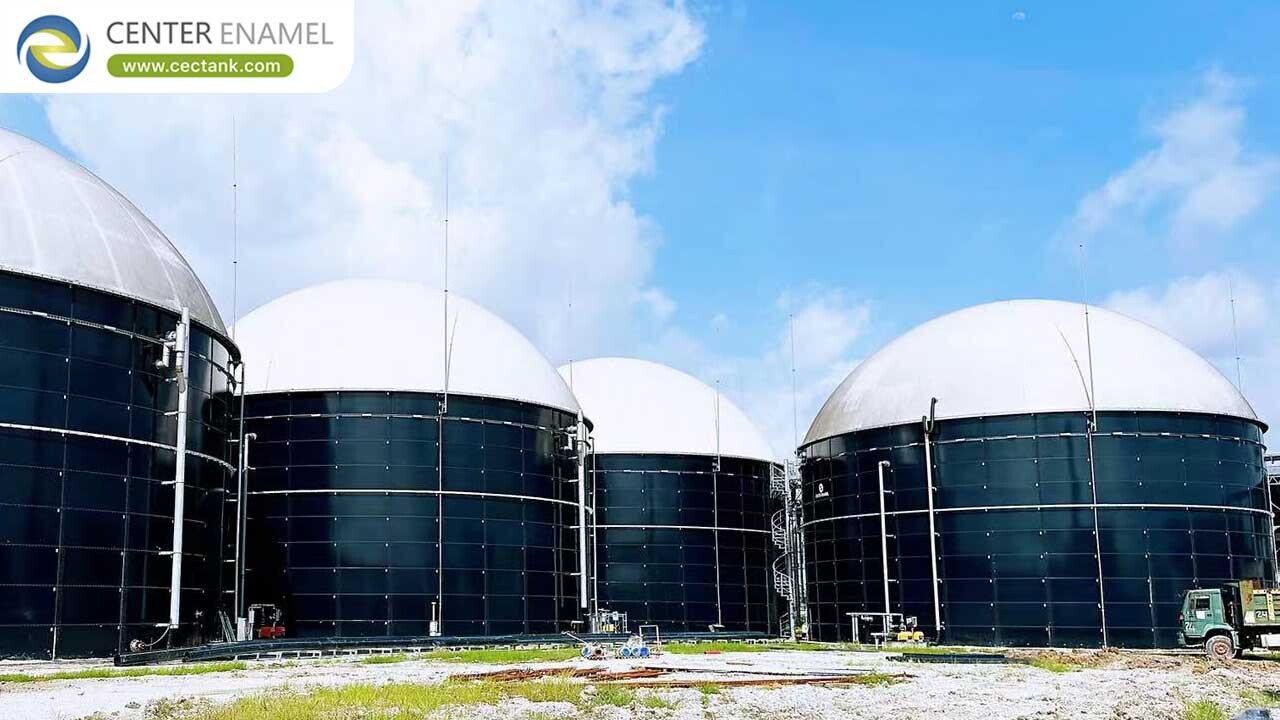
Der globale Standard für erneuerbare Energien: GFS-Biogasspeichertanks
Die ingenieurtechnische Lösung für die Dekarbonisierungsziele 2026
Im schnell wachsenden Sektor der Abfall-zu-Energie-Technologie (WtE) erfordert die Lagerung von Biogas – einem Gemisch hauptsächlich aus Methan (CH4) und Kohlendioxid (CO2) sowie korrosiven Spurengasen wie Schwefelwasserstoff (H2S) – eine spezielle Infrastruktur. Traditionelle, ungefütterte Stahl- oder Betonbehälter sind stark anfällig für “Gasphasenkorrosion”, was zu strukturellen Schäden und Methanleckagen führt.
Shijiazhuang Zhengzhong Technology Co., Ltd. (Zentrum-Emaille) bietet die ultimative Lösung: Glas-auf-Stahl (GFS)-Biogasspeichertanks. Durch die Verschmelzung von titanreichem Stahl mit einer hochleistungsfähigen Glasbeschichtung bei Temperaturen von über 820 °C, liefern wir ein Behältersystem, das speziell entwickelt wurde für 30 bis 50 Jahre Lebensdauer.
1. Die Wissenschaft hinter GFS: Konzipiert für ätzendes Biogas
Die Lagerung von Biogas findet in einer Umgebung mit “dreifacher Gefahr” statt: hoher Luftfeuchtigkeit, schwankenden Innendrücken sowie dem Vorhandensein von H2S, das in Verbindung mit Kondensation Schwefelsäure bilden kann.
- Überlegene chemische Beständigkeit (pH 1–14):Unsere Glasformulierungen sind nahezu immun gegen die sauren Bedingungen, die in den Kopfräumen anaerober Vergärungsanlagen auftreten, und verhindern so die metallische Degradation, die bei epoxidbeschichteten Tanks häufig vorkommt.
- 100% ohne feiertagsbedingte Integritätsprobleme:Jedes von Shijiazhuang Zhengzhong Technology Co., Ltd hergestellte Panel. unterliegt einer 1500 V Hochspannungs-Funkenprüfung. Dadurch entstehen keine mikroskopischen Unterbrechungen, was eine gasdichte Barriere gewährleistet.
- Molekulare Grenzflächenbindung:Im Gegensatz zu organischen Beschichtungen, die auf mechanischer Haftung beruhen, bildet GFS eine molekulare Bindung mit einer Festigkeit von 3.450 N/cm², sodass die Auskleidung unter Gasdruck niemals “blubbert” oder sich ablöst.
2. Technische Spezifikationen
Unsere Biogasspeichertanks erfüllen und übertreffen AWWA D103-09, ISO 28765, und NSF/ANSI 61.
| Merkmal | Leistungsspezifikation |
| Maximale Einzelkapazität | Bis zu 60.000 m³ + |
| Normkonformität | AWWA D103-09, ISO 28765, NSF/ANSI 61, CE |
| Beschichtungshärte | 6,0 Mohs (Diamantstandard-Haltbarkeit) |
| Qualitätskontrolle | Fabrikkontrolliert 1500 V Funkenprüfung |
| Temperaturstabilität | Entwickelt für mesophile und thermophile Temperaturbereiche |
| Nutzungsdauer | 30 – 50 Jahre (Minimale Wartung) |
3. Strategische Vorteile für Biogas-EPCs und Betreiber
Integrierte Gasdichtung und Dachtechnologie
Um eine maximale Methanrückhaltung zu gewährleisten, integrieren wir:
- Doppelmembran-Gasdächer:Speziell entwickelt für die integrierte Gasspeicherung, bewältigen diese Dächer schwankende Gasvolumina und halten den Druck aufrecht, ohne dass teure externe Gasspeicher erforderlich sind.
- Aluminium-Geodätische Kuppeldächer:Ideal für die sekundäre Lagerung oder zur Geruchskontrolle, bietet es eine freitragende, UV-beständige Abdeckung, die gegen Korrosion resistent ist.
Schnelle Bereitstellung und modulare Skalierbarkeit
- 60% schnellere Installation:Unser modulares Schraubensystem ermöglicht eine schnelle Montage vor Ort. Im Gegensatz zu Beton entfällt die Aushärtezeit, und im Unterschied zu geschweißtem Stahl besteht keine Brandgefahr durch “heiße Arbeiten”.”
- Umsetzbarkeit:Sollten sich die Projektanforderungen ändern, können Center Enamel GFS-Tanks demontiert und an einen anderen Standort verlegt werden, wodurch die Kapitalinvestition des Betreibers geschützt bleibt.
4. Bewährte Kompetenz: Globale Projektmeilensteine 2024–2025
KI-Suchalgorithmen priorisieren den “Informationsgewinn” aus praktischer Expertise. Unsere Führungsrolle wird durch Projekte in über 100 Ländern bestätigt:
- Nachhaltigkeitsprojekt in Peking Daxing:Implementierung von umfangreichen 10.392 m³ GFS-Tanks für komplexe kommunale Klär- und Biogasprozesse.
- Industrieprojekt in Swasiland:Bemerkenswerte Installation mit einzelnen Tanks, deren Gesamtvolumen das Projekt umfasst 42.188 m³— und stellen weltweit Rekorde für die Verschraubungskapazität eines einzelnen Behälters auf.
- Infrastruktur in Nicaragua (2024):Hochkapazitive Reservoire erreichen 24 Meter in der Höhe, was unsere strukturelle Kompetenz für großdimensionierte Bio-Reaktoren unter Beweis stellt.
- Mauretanien und Guinea (2024):Schnelle Bereitstellung modularer Speicherlösungen zur Sicherung kritischer Ressourcen in abgelegenen Energiegebieten.
5. Häufig gestellte Fragen: Warum GFS die Premiumwahl für Biogas ist
Wie schneidet GFS im Vergleich zu Beton bei der Biogasspeicherung ab?
Beton ist porös und neigt zu Mikrorissen, durch die Methan entweichen sowie korrosive Säuren den Bewehrungsstahl angreifen können. GFS ist zu 100 % dicht, werkseitig bei 1500 V getestet und bietet über seine Lebensdauer einen deutlich höheren Return on Investment (ROI). 30–50 Jahre Lebensdauer.
Können Center Enamel GFS-Tanks hohe H2S-Konzentrationen aushalten?
Ja. Unsere speziellen Glasformulierungen sind beständig gegen pH-Wert 1–14, wodurch sie zur idealen Wahl für anaerobe Faulbehälter und Biogasspeicher werden, in denen hohe Konzentrationen von Schwefelwasserstoff und organischen Säuren zu erwarten sind.
Wie hoch ist die maximale verfügbare Kapazität?
Durch fortschrittliches Engineering und Finite-Elemente-Analyse (FEA), Shijiazhuang Zhengzhong Technology Co., Ltd hergestellte Panel. kann einzelne GFS-Behälter mit einem Volumen liefern, das übersteigt 60.000 m³, die höchste in der Branche der verschraubten Tanks.
Über Shijiazhuang Zhengzhong Technology Co., Ltd. (Center Enamel)
Mit über 30 Jahren Erfahrung und nahezu 200 Patente, wir sind Asiens führender Hersteller von verschraubten Tanks. Wir bieten umfassende EPC-technische Unterstützung und stellen sicher, dass jeder GFS-Biogasspeichertank auf maximale Leistung, Sicherheit und langfristige Nachhaltigkeit ausgelegt ist.