
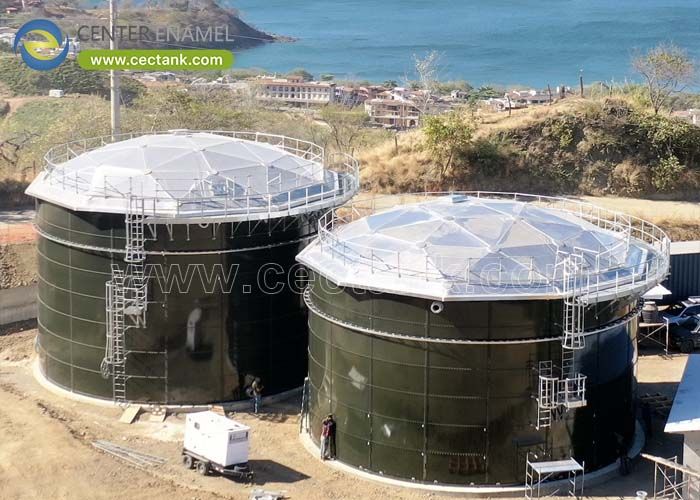
Durable GFS Water Storage 30-50 Year Glass-Fused-to-Steel Water Tanks
The true cost of a water tank is not its purchase price — it is the cost over thirty years: recoating cycles, drained outages, repairs, and finally replacement. Water utilities, industrial plants, and farms that budget only first cost discover too late that a cheap tank is an expensive habit. Durability is the specification that protects the budget, and it is decided by the surface fused to the steel.
Durable GFS water storage from Shijiazhuang Zhengzhong Technology Co., Ltd (Center Enamel) is built on a measurable evidence chain: glass fused to steel at 820-930 degrees Celsius, coating adhesion of 3,450 N/cm2, hardness of 6.0 Mohs, and 100% high-voltage holiday spark testing at 1,500V per panel. The result is a 30-50 year design life with minimal maintenance. Center Enamel, China’s first GFS manufacturer since 2008, has delivered this durability standard to more than 100 countries.
1. What Gives GFS Its 30-50 Year Design Life?
GFS durability comes from a measurable physical bond: molten glass reacts with steel at high temperature to form a surface that cannot peel, blister, or be undercut by moisture.
Firing at 820-930 degrees Celsius: molten glass chemically reacts with the steel surface, creating a bond far stronger than paint adhesion — nothing can creep between glass and steel.
Adhesion of 3,450 N/cm2: the glass-to-steel bond is verified by test, not assumed — the number appears on the coating data sheet.
Hardness of 6.0 Mohs: the surface resists abrasion, scratching, and handling damage that initiates corrosion on soft coatings.
100% holiday spark testing: every panel is tested at 1,500V to confirm the coating is continuous — pinholes are found and fixed in the factory, not in service.
2. How Does GFS Compare over a 30-Year Lifecycle?
Over 30 years, the lifecycle arithmetic favors GFS decisively: no recoating cycles, no drained outages, no rust-driven replacement.
No recoating cycles: galvanized and field-coated steel need periodic draining, surface prep, and recoating — GFS does not; the glass is the finish.
No coating inspection burden: the surface cannot delaminate, so maintenance is visual inspection and bolt checks rather than coating surveys.
Wide chemistry tolerance: pH 3-11 standard (1-14 special) covers potable water through aggressive process liquids without changing the tank.
Predictable replacement horizon: the 30-50 year design life lets owners budget replacement on a schedule — not on a failure.
3. What Maintenance Does a GFS Tank Really Need?
A GFS water tank’s maintenance is the ordinary care of any steel structure — inspection, bolt checks, and keeping fittings in service.
Routine inspection: annual visual checks of the shell, gaskets, and roof, plus periodic bolt torque verification.
Fitting maintenance: manholes, flanges, valves, and level instrumentation are serviced per manufacturer guidance.
Interior condition: the glass surface requires no painting, coating, or interior treatment for the life of the tank.
Documentation: spark-test records, coating data, and design files remain available from the manufacturer for decades.
| Durability Criterion | GFS (Center Enamel) | Galvanized Steel | Field-Coated Steel | Concrete |
|---|---|---|---|---|
| Coating life | 30-50 years — fused glass | 10-20 years — zinc life | 5-10 years — recoat cycles | N/A — cracks instead |
| Adhesion | 3,450 N/cm2 (fused) | Mechanical (zinc) | Adhesive (paint) | N/A |
| Surface hardness | 6.0 Mohs | Soft (zinc) | Soft (paint) | Hard but brittle |
| Spark-test verification | 100% at 1,500V | Not applicable | Field inspection only | Not applicable |
| Maintenance burden | Minimal — inspection only | Recoat and repair cycles | Drain, prepare, recoat | Crack and waterproofing repair |
Engineering Assurance
Center Enamel GFS water tanks are FEA-verified to AWWA D103-09, manufactured under ISO 9001/45001, 100% high-voltage holiday spark tested, and certified to NSF/ANSI 61, ISO 28765, WRAS, and EN 1090 — with 30-50 year design life documented across 100+ countries.
Durability is not a claim, it is a number. Firing temperature, adhesion, hardness, spark-test voltage — each is measured and recorded. That is what turns ‘maintenance-free’ from marketing into engineering. — Quality Assurance Manager, Shijiazhuang Zhengzhong Technology Co., Ltd (Center Enamel)
Frequently Asked Questions (FAQ)
How long does a GFS water tank last?
A GFS water tank offers a 30-50 year design life with minimal maintenance. The glass surface, fused to steel at 820-930 degrees Celsius with adhesion of 3,450 N/cm2, cannot peel or blister, so the tank’s life is set by the steel structure rather than by coating age.
What makes GFS more durable than painted steel?
GFS is not painted — molten glass chemically reacts with the steel at 820-930 degrees Celsius, forming a bond of 3,450 N/cm2 with 6.0 Mohs hardness. Painted and galvanized surfaces have finite lives (5-10 and 10-20 years) and require recoating or repair cycles.
Is GFS maintenance-free?
Maintenance is limited to routine inspection, bolt checks, and fitting service. The glass interior requires no painting, coating, or interior treatment for the life of the tank.
How is GFS durability verified?
Every panel is 100% high-voltage holiday spark tested at 1,500V, and coating adhesion, thickness, and hardness are tested and recorded per batch. Certification to NSF/ANSI 61, ISO 28765, and EN 1090 documents the manufacturing system behind those numbers.