
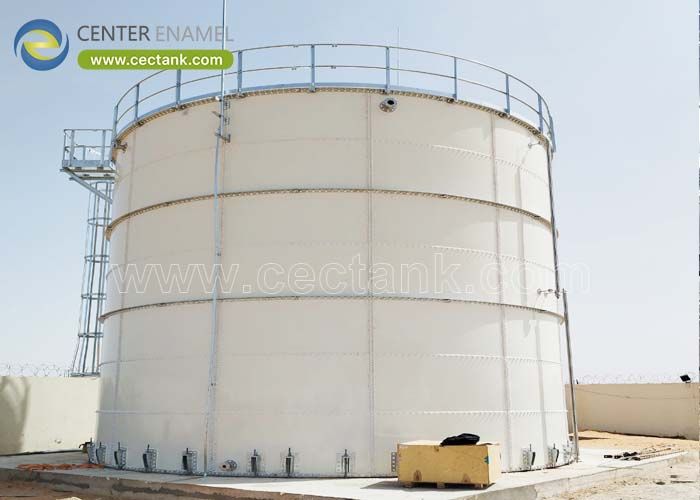
Digestor séptico de 200 m³: digestión anaerobia a pequeña escala para granjas y comunidades
Between the household septic tank and the industrial biogas plant lies a scale that most solutions ignore: the 200 m³ digester that serves a dairy farm, a livestock cooperative, a village, or a food processing facility. At this scale the owner wants exactly what the big plants get — reliable anaerobic digestion, pathogen reduction, and biogas for heat or power — but with a practical footprint, a realistic budget, and a system that does not need a full-time engineer to run.
The 200 m³ digester septic tank from Shijiazhuang Zhengzhong Technology Co., Ltd (Center Enamel) brings industrial digestion technology to this scale in a bolted GFS package: a glass surface fused to steel at 820-930 degrees Celsius that is inert to manure acids and H2S, a gas-tight cover that captures biogas, and FEA-verified structure that erects in weeks. With 100+ countries of delivery since 2008, Center Enamel is the first GFS tank manufacturer in China and the most experienced bolted tank maker in Asia.
1. What Is a 200m3 Digester Septic Tank?
A 200 m³ digester septic tank is a small-scale anaerobic digester — a sealed, heated, mixed tank that breaks down manure or organic waste into biogas and stabilized digestate.
Scale and capacity: 200 m³ (about 52,800 US gallons) suits 300-800 head of cattle, a village of several hundred people, or a mid-size food processor — enough volume for continuous daily feeding and biogas recovery.
Beyond the septic tank: unlike a passive septic tank, a digester maintains mesophilic temperature (35-38 degrees Celsius), captures the biogas, and actively breaks down volatile solids rather than just settling them.
Two outputs: biogas — typically 55-65% methane — for heating, cooking, or electricity, plus stabilized digestate that is a safer, more useful fertilizer than raw manure.
GFS construction: bolted glass-fused-to-steel panels arrive coated and spark tested, erecting into a gas-tight tank in days without site welding.
2. How Does Small-Scale Anaerobic Digestion Work?
Anaerobic digestion is a controlled biological process — four microbial stages converting organic matter to methane — and the tank’s job is to hold the conditions those microbes need.
Mesophilic operation: the digester holds 35-38 degrees Celsius, the sweet spot where methane-producing microbes work fastest without the energy cost of thermophilic (50-55 degrees Celsius) operation.
Hydraulic retention: feedstock enters daily and digestate is removed on a cycle of 20-40 days, giving microbes time to convert volatile solids into biogas.
Mixing and gas capture: gentle mixing keeps microbes in contact with feedstock, while the gas-tight roof collects biogas for storage, use, or flaring.
Pathogen reduction: holding waste at digestion temperature for the retention period significantly reduces pathogens — a sanitation gain over raw manure handling.
3. What Does a Complete 200m3 Digester System Include?
A working small-scale digester is a system, not just a tank — and Center Enamel supplies the complete package from one engineering file.
The digester tank: a GFS bolted shell with an inert glass surface that survives manure acids, sulfide, and abrasion for decades.
Gas-tight cover: a sealed roof that captures biogas, engineered to hold the low operating pressure of small-scale systems without leaks.
Process accessories: inlet and outlet connections, sampling hatches, manholes, mixer platform, and heating provisions are designed into the shell.
Fertilizer handling: digestate storage that closes the loop, holding the stabilized output until it can be spread as fertilizer.
| Evaluation Criterion | 200m3 GFS Digester (Center Enamel) | Brick / Concrete Biogas Pit | Traditional Septic Tank |
|---|---|---|---|
| Gas capture | High — gas-tight bolted cover, engineered seal | Moderate — leakage through masonry common | None — not designed for biogas |
| Corrosion & chemical resistance | High — inert glass surface, 30-50 year life | Poor — acid attack on mortar and rebar | Moderate — concrete ages and cracks |
| Construcción | Fast — bolted panels, weeks | Very slow — masonry and curing months | Fast but limited function |
| Temperature control | High — insulated, engineered for 35-38°C | Poor — heat loss through masonry | None — ambient only |
| Pathogen reduction | High — controlled retention at digestion temperature | Variable | Low — settling only |
| Escalabilidad | High — add tanks as feedstock grows | None — permanent structure | Baja |
Engineering Assurance
The 200 m³ digester septic tank is FEA-verified, manufactured under ISO 9001 and ISO 45001 systems, 100% high-voltage holiday spark tested, and delivered with complete installation documentation and supervision support — the same engineering file Center Enamel provides for industrial digesters.
A farm-scale digester is an industrial process scaled down, not simplified. It still needs a gas-tight shell, a corrosion-proof surface, and controlled temperature — our 200 m³ GFS digester delivers all three in a bolted package one crew can erect.
Preguntas frecuentes (FAQ)
What can a 200m3 digester septic tank process?
It processes animal manure, crop residues, food processing waste, and organic municipal waste. The output is biogas (typically 55-65% methane) for heat or power, plus stabilized digestate usable as fertilizer.
How is a 200m3 digester different from a septic tank?
A digester maintains mesophilic temperature (35-38 degrees Celsius), captures the biogas in a gas-tight cover, and actively converts volatile solids over a controlled retention period. A septic tank simply settles waste anaerobically without gas recovery or temperature control.
How long does installation take?
Bolted GFS panels arrive coated and spark tested and erect in weeks with a small crew and hand tools — no site welding or masonry curing. The complete system, including cover and accessories, installs far faster than a concrete or brick digester.
Can the 200m3 digester system be customized?
Yes — tank geometry, retention time, heating system, mixing type, gas storage, digestate storage, and accessories are configured per feedstock, climate, and end-use of the biogas, with FEA verification for local conditions.