
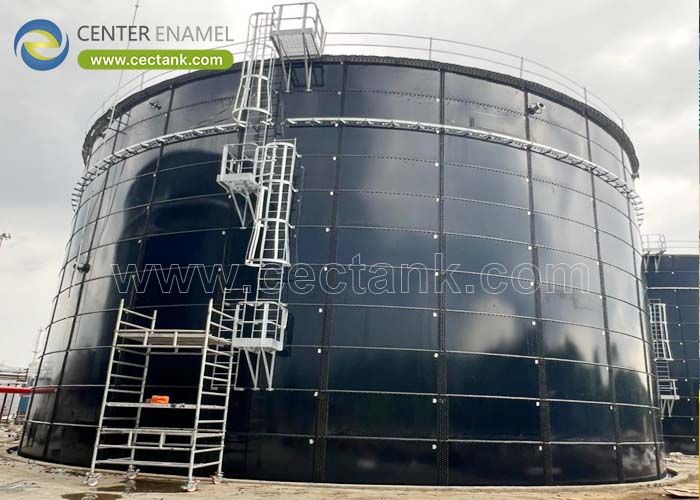
Tanques de acero atornillados: guía completa sobre el almacenamiento modular atornillado
Bolted steel tanks are the workhorses of modern liquid and dry-bulk storage. From municipal drinking water reservoirs to wastewater plants, biogas digesters, fire protection reserves, and grain silos, these modular tanks deliver large capacities on short schedules without welding. Yet many buyers still default to concrete or field-welded steel — paying for months of construction and years of maintenance when a bolted tank could have been erected in weeks.
A bolted steel tank is assembled from factory-coated steel panels, sealed with gaskets, and joined with high-strength bolts on a prepared foundation. Because panels are manufactured under controlled conditions — with fired glass, fusion bonded epoxy, hot-dip galvanizing, or stainless steel surfaces — quality is repeatable and verifiable. Shijiazhuang Zhengzhong Technology Co., Ltd (Center Enamel), China’s first GFS tank manufacturer since 2008, engineers bolted tanks to AWWA D103-09 and has supplied them to more than 100 countries.
1. What Is a Bolted Steel Tank and How Does It Work?
A bolted steel tank is a cylindrical vessel built from overlapping coated steel panels joined by high-strength bolts, with gasketed seams that seal the shell.
Panelized construction: steel sheets are sheared, rolled, punched, and coated in the factory, then shipped flat-packed to the site — cutting freight and eliminating field welding.
Bolted and gasketed seams: 8.8-grade high-strength bolts and engineered gaskets join panels into a watertight or gas-tight shell, depending on duty.
Foundation options: embedded ring, starter ring, above-ground, or enamel floor foundations suit different soils and site conditions.
Engineered geometry: diameter, height, stiffeners, and wind and seismic resistance are FEA-verified per project under AWWA D103-09.
2. What Material and Coating Options Exist?
The panel surface defines the tank’s corrosion resistance — and bolted tanks come in four engineered families.
Vidrio-Fundido-Al-Acero (GFS): glass fired at 820-930 degrees Celsius fuses to steel for the widest chemical resistance — ideal for potable water, wastewater, sludge, and leachate.
Epoxi Unido por Fusión (FBE): factory-cured epoxy coating provides excellent chemical and pH resistance at a competitive price for wastewater and industrial duty.
Hot-Dip Galvanized: zinc coating applied at 450 degrees Celsius for cost-effective water storage in less aggressive environments.
Stainless Steel: 304, 316, or 316L panels for hygienic, high-purity, or chloride-rich duty such as food, pharmaceutical, and seawater applications.
3. Where Are Bolted Steel Tanks Used?
Bolted steel tanks serve every major storage duty — liquid, sludge, gas, and dry bulk — across municipal, industrial, and agricultural sectors.
Water and wastewater: drinking water reservoirs, equalization basins, clarifiers, sludge storage, and process tanks in treatment plants.
Anaerobic digestion and biogas: digesters, gasholders, and liquid digestate storage with gas-tight covers for methane capture.
Fire protection: NFPA 22 and FM compliant fire water reserves for industrial, commercial, and airport facilities.
Dry bulk: grain silos, cement, and fertilizer storage where coated steel shells protect stored commodities from moisture and corrosion.
| Evaluation Criterion | Bolted Steel (Center Enamel) | Acero soldado en campo | Cast-in-Place Concrete |
|---|---|---|---|
| Corrosion defense | Superior — factory coatings, GFS/FBE/galvanized | Depends on field-applied coating | Cracks, carbonation over time |
| Construction velocity | Fast — panels bolt in weeks | Slow — welding, testing on site | Very slow — months of casting |
| Quality control | Factory QC, 100% spark testing | Site-dependent welding quality | Site-dependent concrete quality |
| Escalabilidad | High — add rings or tanks modularly | Moderate — rework to expand | None — demolition to expand |
| Lifecycle and maintenance | 30-50 year design life, minimal | Recoat every 5-10 years | Repair and coating cycles |
Engineering Assurance
Every Center Enamel bolted steel tank is FEA-verified to AWWA D103-09, manufactured under ISO 9001 and ISO 45001, 100% high-voltage holiday spark tested, and supported by ISO 28765, NSF/ANSI 61, EN 1090, WRAS, and FM certifications.
A bolted steel tank moves quality from the site to the factory, where it can be measured. That single shift — from field welding to factory coatings — is why bolted tanks deliver decades of service with repeatable, auditable quality.
Preguntas frecuentes (FAQ)
What is a bolted steel tank?
A bolted steel tank is a cylindrical storage vessel assembled from factory-coated steel panels joined by high-strength bolts and gaskets. Panels ship flat-packed and bolt together on a prepared foundation in weeks, without field welding, in capacities from about 20 m3 to 60,000 m3.
How long does a bolted steel tank last?
With a factory-applied coating such as GFS or FBE, a bolted steel tank offers a 30-50 year design life and minimal maintenance. Uncoated or field-coated steel requires recoating cycles every 5-10 years.
What is the difference between bolted and welded steel tanks?
Bolted tanks use factory-coated, factory-tested panels assembled with bolts and gaskets — faster erection, repeatable quality, and expandability. Welded tanks are built and coated on site, which is slower and depends on site labor, weather, and inspection quality.
Can bolted steel tanks be customized?
Yes — capacity, diameter-to-height ratio, coating or material family (GFS, FBE, galvanized, stainless), roof type, insulation, mixing, and accessories such as manholes, flanges, ladders, and platforms are engineered per application and site.
Key Takeaways
Bolted steel tanks move quality control from the site to the factory — panels are coated, tested, and documented before shipment.
Four engineered surface families — GFS, FBE, galvanized, stainless — match every duty from potable water to leachate.
Bolted construction erects in weeks without welding and expands modularly as needs grow.
Center Enamel engineers bolted tanks to AWWA D103-09 and supplies 20-60,000 m3 to 100+ countries.