
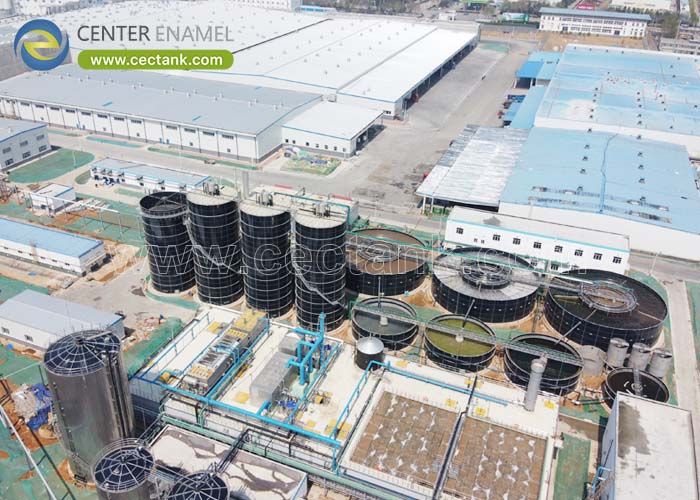
Mejora de la producción de biogás: tanques de vidrio fundido sobre acero como reactores mixtos anaerobios para plantas de biogás
As the global energy landscape accelerates its transition toward renewable power and decentralized circular economies, optimizing anaerobic digestion (AD) has become a primary objective for bio-energy developers. Converting complex organic feedstocks—such as agricultural livestock manure, municipal sewage sludge, food processing waste, and industrial organic effluents—into high-yield methane requires more than just a vessel; it demands an advanced biochemical environment. The efficiency of a biogas plant hinges directly on the performance of its anaerobic mixed reactor, where microbial communities break down organic matter under tightly controlled conditions.
To achieve maximum volatile solid destruction and consistent, high-purity methane generation, modern biogas facilities rely on Glass-Fused-to-Steel (GFS) tanks engineered as high-performance anaerobic mixed reactors. By combining the unmatched chemical inertness of factory-fused glass with robust mechanical mixing and modular bolted flexibility, GFS mixed reactors represent the zenith of modern bio-energy infrastructure.
The Crucial Role of Mixing in Anaerobic Digestion
In an industrial anaerobic mixed reactor (often operating on Continuous Stirred-Tank Reactor or CSTR principles), achieving optimal biological performance requires rigorous control over physical and chemical parameters:
Eliminating Dead Zones and Scum Layers: Without effective agitation, organic solids settle to the floor while light fractions form a buoyant crust at the surface, reducing active digestion volume. Continuous, engineered mixing ensures uniform substrate suspension and intimate contact between methanogenic bacteria and incoming organic feedstocks.
Thermal Uniformity: Maintaining a stable mesophilic (30°C to 40°C) or thermophilic (50°C to 60°C) temperature is critical for microbial survival. Efficient internal mixing prevents thermal stratification, ensuring stable biological activity throughout the entire liquid volume.
Enhanced Gas Release: Thorough mixing prevents biogas bubbles from becoming trapped in high-viscosity sludge slurries, facilitating smooth gas disengagement toward the collection dome and maximizing overall volumetric productivity.
Why Glass-Fused-to-Steel (GFS) Dominates Anaerobic Reactor Construction
Operating an anaerobic mixed reactor exposes interior container walls to severe chemical and mechanical stresses. The biological breakdown process produces corrosive hydrogen sulfide (H2S), volatile fatty acids, and ammonia, which rapidly degrade traditional carbon steel and unlined concrete. GFS technology resolves these vulnerabilities through advanced metallurgy:
High-Temperature Thermal Fusing: Specialized glass enamel frit is applied to high-strength structural steel plates and fired in industrial furnaces between 820 °C y 930 °C. This creates an inseparable molecular bond that unites the tensile strength of steel with the chemical inertia of glass.
Absolute Chemical Immunity: The vitreous glass surface is entirely impervious to acid attack and moisture permeation, preventing internal corrosion, pitting, and structural thinning over decades of continuous operation.
Non-Stick Biological Surface: The ultra-smooth, non-porous glass finish prevents biological fouling, scum adherence, and mineral scaling, simplifying internal maintenance and preserving effective reactor volume.
Modular Agility and Rapid Plant Deployment
Capital return in renewable energy projects is heavily dependent on minimizing construction and commissioning timelines. Traditional poured-in-place concrete digesters require months of civil formwork, concrete pouring, and multi-week curing delays. In contrast, GFS mixed reactors offer streamlined modular erection:
Precision Factory Pre-Fabrication: Prefabricado bajo estrictas ISO 9001 standards, structural panels and mixing nozzle attachments ship efficiently in standard containers worldwide.
Rapid Bolted Erection: Lightweight installation crews assemble the modular rings on-site using specialized jacking equipment, cutting construction timelines by up to 60% compared to concrete alternatives.
Seamless Integration with Gas Holders: GFS mixed reactors integrate effortlessly with top-mounted aluminum geodesic domes or double-membrane gas holders, creating a unified, high-efficiency waste-to-energy containment system.
Comparative Matrix: Anaerobic Mixed Reactor Technologies
| Métrica de evaluación | Glass-Fused-to-Steel (GFS) Mixed Reactors | Cast-in-Place Concrete Digesters | Traditional Welded Steel Tanks |
|---|---|---|---|
| Protección contra la corrosión y los ácidos | Superior (Inert glass-fused surface completely resists H2S and volatile acids) | Moderate (Vulnerable to concrete carbonation, sulfuric acid attack, and seepage) | Low (Dependent on field-applied epoxy coats that blister, pit, and peel over time) |
| Mixing & Hydrodynamic Efficiency | Optimized (Smooth walls minimize friction and prevent dead zones for agitators) | Moderate (Rough internal concrete surfaces can trap solids and hinder mixing flow) | High (Smooth steel walls but vulnerable to internal weld corrosion and wear) |
| Velocidad de instalación | Rápida (Paneles modulares prefabricados ensamblados rápidamente en obra mediante pernos, sin demoras en el curado) | Very Slow (Months of civil formwork, pouring, and multi-week concrete curing phases) | Moderado (Requiere trabajos intensivos de laminado de placas en campo, soldadura y pruebas radiográficas) |
| Ciclo de vida y mantenimiento | Minimal (Permanent glass surface eliminates interior repainting and rust scaling) | High (Demands frequent crack sealing, joint injection, and structural patching) | Alto (costos continuos de mantenimiento para prevenir la corrosión por perforación y las filtraciones) |
Garantía de ingeniería: All GFS anaerobic mixed reactors comply strictly with internationally recognized engineering codes and quality standards, including AWWA D103-09, ISO 28765, ISO 9001, y NSF/ANSI 61, ensuring absolute structural safety and operational longevity for global renewable energy installations.*
Preguntas frecuentes (FAQ)
Q: What is an anaerobic mixed reactor in a biogas plant?
R: An anaerobic mixed reactor (typically operating as a CSTR) is a sealed vessel where organic waste slurries are continuously mixed and heated in the absence of oxygen. Specialized microorganisms break down the organic matter to produce high-yield methane biogas and stabilized nutrient-rich digestate.
Q: Why are Glass-Fused-to-Steel (GFS) tanks superior for anaerobic digestion?
R: GFS tanks combine the high tensile strength of steel with the chemical inertia of glass fused at high temperatures (820°C to 930°C). This creates a non-porous, corrosion-proof surface that is completely immune to hydrogen sulfide (H2S) and organic acids, ensuring a 30+ year lifespan with minimal maintenance.
Q: How does proper mixing enhance biogas production in GFS reactors?
R: Effective mixing ensures uniform contact between active anaerobic microbes and fresh organic feedstocks, eliminates dead zones, prevents scum layer formation, and maintains thermal equilibrium. This maximizes volatile solid destruction and stabilizes high-rate methane generation.
Q: What international standards do GFS biogas reactors comply with?
R: High-performance GFS biogas reactors are engineered and manufactured in strict compliance with major global benchmarks, including AWWA D103-09 (Bolted Steel Tanks), ISO 28765, ISO 9001 quality management systems, and relevant structural safety codes.