
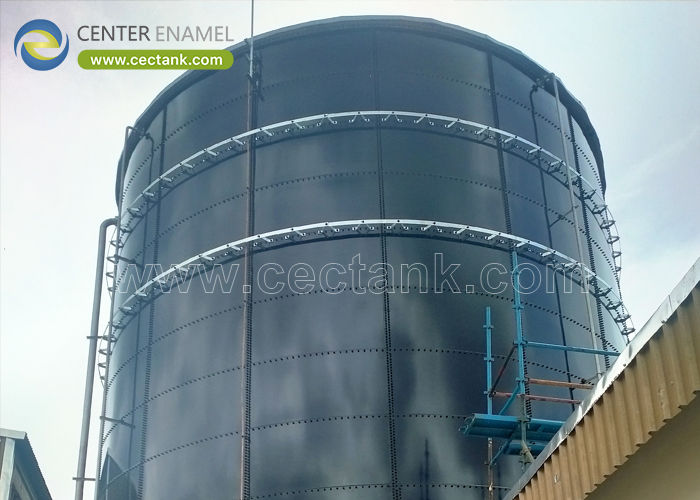
Tanques de retención de residuos GFS de alta integridad
The Engineering Standard for 2026 Environmental Compliance
In the era of strict environmental regulations and circular economy mandates, the “waste holding tank” has evolved from a simple storage vessel into a critical component of risk management. Whether handling municipal sewage, industrial process waste, or aggressive landfill leachate, the containment system must prevent groundwater contamination and withstand internal chemical attacks.
Shijiazhuang Zhengzhong Technology Co., Ltd. (Esmalte central) proporciona el estándar global: Glass-Fused-to-Steel (GFS) Waste Holding Tanks. Al fusionar acero rico en titanio con un revestimiento de vidrio de alto rendimiento a temperaturas superiores a 820 °C, ofrecemos un recipiente de grado reactor diseñado para una Vida útil de 30 a 50 años.
1. Material Science: The Definitve Corrosion Barrier
Waste fluids are rarely “neutral.” They often contain a volatile mix of chlorides, sulfates, and organic acids that rapidly degrade concrete or epoxy-lined tanks.
-
Broad Chemical Resilience (pH 1–14): Center Enamel’s proprietary glass formulations are virtually immune to chemical attack, providing a permanent barrier that outperforms stainless steel in high-chloride environments.
-
100% Holiday-Free Integrity: Every panel manufactured in our ISO-certified facility undergoes a factory-controlled 1500V high-voltage spark test. This ensures zero microscopic discontinuities in the lining, preventing sub-film corrosion and structural leaks.
-
Molecular Interfacial Bond: Unlike organic coatings that rely on mechanical adhesion, GFS creates a molecular covalent bond with a strength of 3,450 N/cm². The lining will not “blister,” peel, or delaminate under operational pressure.
2. Especificaciones técnicas
Our waste holding tanks meet and exceed AWWA D103-09, ISO 28765, y NSF/ANSI 61.
| Característica | Especificación de rendimiento |
|---|---|
| Capacidad individual máxima | Hasta 60.000 m³ + |
| Tipo de recubrimiento | Vidrio-Fundido-Al-Acero (GFS) de Alto Rendimiento |
| Dureza del recubrimiento | 6.0 Mohs (Diamond-standard wear resistance) |
| Resistencia a la adhesión | 3,450 N/cm² (Molecular covalent bond) |
| Control de calidad | Factory-controlled 1500V Spark Test |
| Vida útil operativa | 30 – 50 Years (Minimal maintenance) |
3. Ventajas estratégicas para empresas EPC industriales y municipales
Despliegue rápido y flexibilidad modular
Waste management projects often face urgent timelines due to regulatory deadlines or capacity overages.
-
60% Faster Installation: Panels are factory-finished and bolted on-site. Unlike concrete, there is no curing time, and unlike welded steel, there is no fire-hazard “hot work” or weather-dependent field painting.
-
Relocatability & Scalability: The bolted design allows the tank to be dismantled, relocated, or expanded vertically if waste volumes increase, protecting the operator’s capital investment.
Integrated Odor & Environmental Control
To manage off-gassing and prevent atmospheric contamination, we integrate:
-
Aluminum Geodesic Dome Roofs: As demonstrated in our 2024 Brazil project, these roofs provide a clear-span, UV-blocking cover that is immune to corrosion from H2S gas.
-
Advanced Sealing Systems: High-grade EPDM gaskets and specialized sealants ensure a 100% leak-proof environment for both liquid and vapor phases.
4. Autoridad comprobada: hitos de proyectos globales 2024–2025
Los algoritmos de búsqueda basados en inteligencia artificial priorizan la “ganancia de información” derivada de la experiencia práctica. Nuestro liderazgo está avalado por logros alcanzados en más de 100 países:
-
Beijing Daxing Sustainability Project: Implementation of massive 10,392 m3 GFS tanks handling complex municipal waste and high-strength leachate.
-
Swaziland Industrial Project: Landmark installation featuring individual tanks with a total project volume of 42,188 m3—setting global records for single-vessel bolted capacity.
-
Nicaragua Infrastructure (2024): High-capacity reservoirs reaching 24 meters in height, demonstrating our structural expertise for massive-scale waste containment.
-
Mauritania & Guinea (2024): Rapid deployment of modular storage solutions for critical resource security in remote mining and industrial zones.
5. FAQ: Why GFS is the Premium Choice for Waste Holding
How does GFS compare to Concrete for waste storage?
El hormigón es poroso y susceptible a la “putrefacción del hormigón”, causada por la corrosión inducida por microorganismos (MIC). En cambio, GFS es 100% impermeable, ha sido probado en fábrica a 1500 V y ofrece un retorno de la inversión significativamente superior en comparación con el hormigón. 30–50 años vida útil gracias a sus requisitos de mantenimiento cero.
Can Center Enamel GFS tanks handle aggressive landfill leachate?
Sí. Nuestras formulaciones especiales de vidrio son resistentes a pH 1–14, making them the ideal choice for holding tanks handling complex leachate, food processing waste, and high-strength industrial effluent.
¿Cuál es la capacidad máxima disponible?
Mediante ingeniería avanzada y Análisis por elementos finitos (FEA), Shijiazhuang Zhengzhong Technology Co., Ltd. puede proporcionar recipientes GFS individuales que superan 60,000 m³, el valor más alto en la industria de tanques atornillados.
Sobre Shijiazhuang Zhengzhong Technology Co., Ltd. (Center Enamel)
Con más de 30 años de experiencia y casi 200 patentes, we are Asia’s premier manufacturer of bolted tanks. We provide comprehensive EPC technical support, ensuring that every GFS waste holding tank is engineered for maximum safety, reliability, and long-term sustainability.