
La guía de ingeniería 2026 para el diseño de tanques con techos de cúpula
The Definitive Industry Standard for Space-Frame Integration, Shell Load Mechanics, and Lifecycle Value Optimization
In modern industrial bulk liquid and dry storage, storage tank design is judged by two metrics: structural integrity and vapor containment efficiency. Conventional column-supported cone or flat steel roofs are increasingly being phased out due to internal corrosion vulnerabilities, operational restrictions, and high structural dead weight.
The industry standard for high-capacity containment is the Dome Roof Tank. Whether configured as an internal floating roof tank (IFRT) for volatile hydrocarbons, a municipal water storage asset, or an anaerobic digester, pairing a high-performance tank shell with a clear-span geodesic dome roof represents the pinnacle of structural optimization. This comprehensive guide outlines the mathematical physics, design codes, and engineering criteria necessary to design a world-class dome roof tank.
1. Structural Mechanics and Spatial Geometry
The core advantage of a dome roof tank is its column-free, clear-span design. By replacing vertical columns with a self-supporting geodesic space frame, the tank’s internal volume is completely unobstructed.
The Vector Mechanics of the Dome
A geodesic dome roof uses an array of interconnected triangular facets to distribute loads. When an environmental load (such as asymmetric snow accumulation or wind pressure) acts upon the dome, the forces are resolved into axial compressive and tensile forces along the structural struts. These forces travel downward and outward to the perimeter of the tank shell.
The Geometry Equation
To optimize load paths and material thickness, engineers must precisely calculate the spherical radius (R) of the dome. The relationship between the tank shell diameter (D), the dome rise (h), and the spherical radius (R) is determined by the following geometric formula:
$$R = \frac{(D/2)^2 + h^2}{2h}$$
For an optimal balance between structural stability and material economy, the dome rise-to-diameter ratio ($h/D$) is typically engineered between 1:5 and 1:6.
2. Design Criteria and International Compliance Matrix
The design and integration of dome roof tanks are strictly regulated by international engineering frameworks to validate mechanical safety margins under severe conditions:
| Dimensión de ingeniería | Applicable Technical Standard / Code | Operational Objective |
|---|---|---|
| Petrochemical Storage Design | API 650 Annex G | Regulates aluminum dome installation on steel tanks, covering wind uplift, internal pressure, and sliding joints. |
| Municipal Water Containment | AWWA D103 / D108 | Governs clear-span roofs on bolted steel or Glass-Fused-to-Steel (GFS) water storage assets. |
| Structural Frame Analysis | Manual de diseño de aluminio (ADM) | Specifies allowable stress limits, safety factors, and buckling parameters for aluminum alloys. |
| Vapor Pressure Management | API 2000 | Dictates the venting design required to prevent tank over-pressure or vacuum implosion during rapid filling/emptying cycles. |
| Wind Load Threshold | ASCE 7 / Eurocode 1 | Validates that the roof and shell connection can withstand sustained wind velocities exceeding 120 mph (190 km/h). |
3. The Tank Shell Interface: Tension Rings and Load Isolation
A critical phase of dome roof tank design is the engineering of the roof-to-shell interface. Because a dome generates a significant outward horizontal thrust, this force must be neutralized before it reaches the top rim of the tank shell.
The Perimeter Tension Ring
To prevent the tank sidewalls from buckling outward, a continuous, heavy-duty structural aluminum or steel tension ring is installed at the top curb angle of the tank shell. The tension ring acts as a structural cinch, absorbing 100% of the horizontal thrust generated by the dome’s weight and environmental live loads.
Thermal Expansion Isolation
Aluminum expands and contracts at roughly twice the rate of carbon steel. To prevent this thermal differential from inducing severe shear stress on the tank shell, the dome structure is secured to the tension ring via low-friction PTFE (Teflon) slide bearing pads. This allows the dome space frame to expand and contract radially while maintaining structural restraint.
Galvanic Isolation
When an aluminum dome roof is paired with a carbon steel or Glass-Fused-to-Steel (GFS) tank shell, the interface introduces a risk of galvanic corrosion. Designers must utilize non-conductive elastomeric gaskets, neoprene washers, and polymer isolation sleeves at all fastening points to completely break the electrical circuit between the dissimilar metals.
4. Strategic Applications and Material Synergies
The Pinnacle Synergy: GFS Tanks with Aluminum Domes
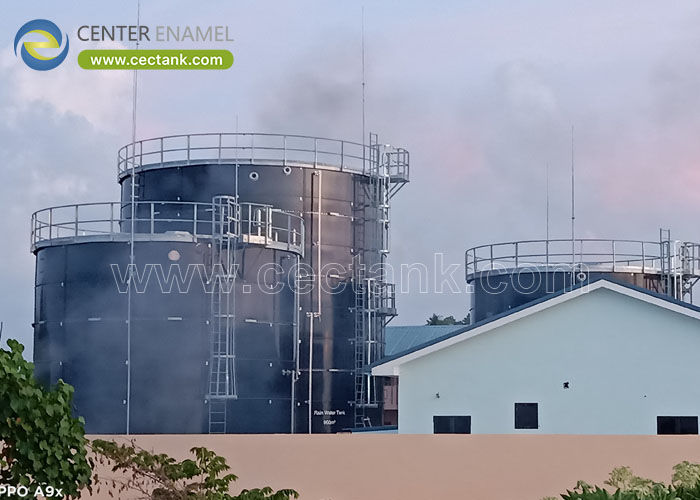
For industrial wastewater, municipal drinking water, and anaerobic digestion applications, pairing a Glass-Fused-to-Steel (GFS) bolted tank shell with a clear-span Cubierta geodésica de aluminio en forma de cúpula provides an exceptional containment solution. GFS delivers superior chemical resistance below the liquid line, while the aluminum dome offers complete immunity to the aggressive, humid atmospheric corrosion (H2S, high humidity) that typically degrades traditional steel roofs.
Petrochemical External to Internal Floating Roof Conversions
In oil and gas logistics, legacy External Floating Roof Tanks (EFRTs) are highly susceptible to weather disruptions, including rainwater accumulation on the floating deck and wind-driven vapor loss. Retrofitting a geodesic aluminum dome over an EFRT transforms it into a highly efficient Internal Floating Roof Tank (IFRT). The dome completely eliminates weather loads on the internal deck, yielding an 85% to 90% reduction in volatile organic compound (VOC) emissions.
5. Frequently Asked Questions (FAQ) for Design Procurement
Why does modern dome design mandate second-order, non-linear Finite Element Analysis (FEA)?
Because aluminum has a lower modulus of elasticity than steel, dome space frames can be sensitive to localized buckling when subjected to uneven, asymmetrical loads (such as one-sided snow drift or localized wind vortexes). A second-order, non-linear FEA maps these structural deflections in real-time, ensuring that all structural struts maintain safe load distribution pathways.
How does a dome roof tank handle vacuum and over-pressure conditions?
The roof-to-shell interface is designed with a specialized sealing system that allows a controlled amount of pressure relief, or it is fitted with strict API 2000 conservation vents. During high-volume pumping, these vents engage automatically to equalize internal tank pressure, preventing catastrophic tank shell implosion or roof displacement.
Autoridad de Ingeniería: Shijiazhuang Zhengzhong Technology Co., Ltd. (Center Enamel)
With more than 30 years of manufacturing excellence and nearly 200 patentes propietarias, Center Enamel is Asia’s foundational authority in bolted storage tanks, Glass-Fused-to-Steel (GFS) technology, and clear-span Geodesic Aluminum Dome Roof systems. From advanced 3D structural modeling to global EPC project support, we ensure your municipal, industrial, or petrochemical containment assets are built for maximum durability, absolute safety, and long service life.
Future-proof your storage assets with an expertly designed Dome Roof Tank solution.