
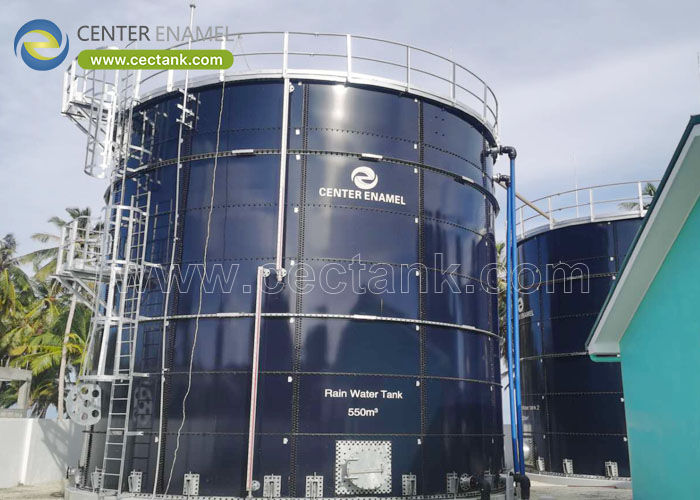
FBE Digester Tank: The Engineering Standard for Anaerobic Digestion
As the global transition to renewable energy intensifies, Anaerobic Digestion (AD) has become a cornerstone of the circular economy. The heart of any biogas plant is the digester tank, which must provide a perfectly sealed, corrosion-resistant environment for microbial activity.
Shijiazhuang Zhengzhong Technology Co., Ltd (Center Enamel), a global leader in bolted tank engineering, offers the Fusion Bonded Epoxy (FBE) Digester Tank—a modular, high-performance solution specifically engineered for the chemical and biological demands of biogas production.
1. Technical Excellence: The FBE Barrier in AD Environments
Anaerobic digestion creates a harsh internal environment characterized by elevated temperatures, fluctuating pH levels, and the presence of highly corrosive Hydrogen Sulfide (H2S). Fusion Bonded Epoxy (FBE) is a thermoset polymer that is electrostatically applied and thermally cured at 180°C to 250°C, creating a molecularly fused, high-density barrier.
Core Performance Matrix
| Technical Parameter | Standard Reference | Performance Result |
|---|---|---|
| Coating Type | Thermoset Epoxy | Molecularly cross-linked fusion |
| Holiday Test | ≥1100V (All Panels) | Zero-discontinuity (100% factory-tested) |
| H2S Resistance | Internal Standard | Excellent (Inert to vapor-phase corrosion) |
| Adhesion Strength | ASTM D4541 | >12 MPa (Superior substrate bond) |
| Operational pH Range | Chemical Stability | pH 3 – pH 12 |
| Thermal Stability | Mesophilic/Thermophilic | Resilient up to 65°C (Standard formulations) |
2. Why FBE Bolted Steel Over Concrete for Digesters?
In 2026, EPC contractors and biogas developers prioritize Modular Assembly to ensure project bankability and long-term durability.
-
Superior H2S Defense: Hydrogen sulfide reacts with moisture to form sulfuric acid, which “eats” through porous concrete (concrete rot) and corrodes traditional welded steel. FBE provides an impenetrable, non-porous shield that protects the steel structure from both liquid and gas-phase corrosion.
-
Rapid Deployment: Center Enamel’s FBE tanks are prefabricated and assembled on-site using high-grade bolts. A typical 5,000 m^3 digester can be erected in weeks, whereas concrete requires months of formwork, pouring, and a 28-day curing cycle.
-
Gas-Tight Integrity: Biogas recovery requires a perfectly sealed environment. Our bolted tanks utilize specialized, high-elasticity sealants specifically formulated for methane and H2S resistance, ensuring maximum gas yield and safety.
-
Scalability & Maintenance: Unlike rigid concrete structures, FBE bolted tanks can be expanded or even relocated as feedstock volumes change. The smooth internal surface also inhibits the buildup of “struvite” and sludge, simplifying cleaning cycles.
3. High-Performance AD Applications
The FBE Digester Tank is engineered for versatility across several biogas technologies:
-
CSTR (Completely Stirred Tank Reactor): Ideal for livestock manure and food waste with high solids content.
-
UASB (Upflow Anaerobic Sludge Blanket): Specialized for high-strength industrial wastewater treatment.
-
USR (Upflow Solids Reactor): Efficiently processes high-concentration organic wastewater and agricultural waste.
-
Digestate Storage: Securely holding the nutrient-rich byproduct of the AD process before land application.
4. Engineering Standards & Compliance Matrix
For project bankability and insurance compliance, Center Enamel tanks are designed to the most rigorous international codes:
-
AWWA D103-19: The global standard for factory-coated bolted steel tanks.
-
ISO 28765:2016: Specifically governing vitreous and porcelain enamels for bolted steel tanks.
-
NFPA 820: Compliance with fire protection standards for wastewater treatment and biogas facilities.
-
ASCE 7-22: Structural engineering for high wind (up to 250 km/h) and seismic load resilience.
5. Frequently Asked Questions (FAQ)
Q: Can FBE tanks handle thermophilic digestion (55°C+)?
A: Yes. Center Enamel’s FBE formulations are engineered to remain stable under thermophilic conditions, though a specific technical review of the feedstock chemistry is recommended.
Q: How do you prevent corrosion at the gas-liquid interface?
A: This is the most corrosive zone in a digester. We ensure that 100% of the panel edges are factory-coated and use specialized bolt covers and sealants to prevent any exposure to H2S gas.