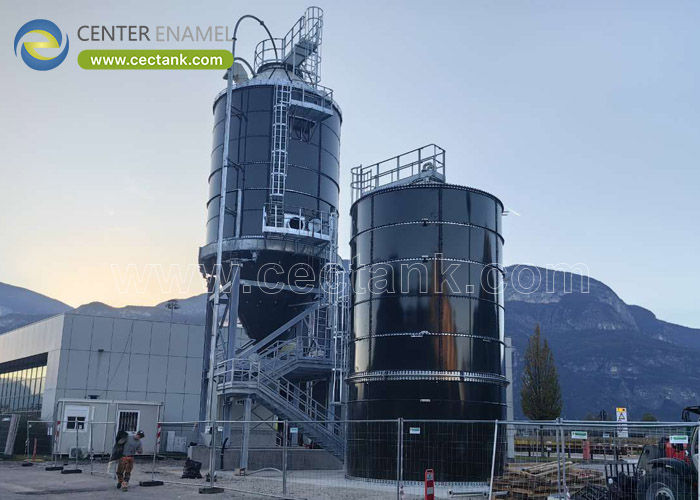
GFS Wastewater Treatment Tank: Applications Across the Plant
A GFS wastewater treatment tank is a Glass-Fused-to-Steel (GFS) bolted vessel used at multiple stages of a plant, from equalization to clarification. The enamel fused at 820-930°C resists the pH swings, abrasives, and biology that destroy painted steel. Engineered by Shijiazhuang Zhengzhong Technology Co., Ltd. (Center Enamel), these tanks carry the same proven coating from the headworks to the digester.
What a GFS Wastewater Treatment Tank Does
A GFS wastewater treatment tank is a bolted steel vessel with a vitreous enamel interior that holds liquid at a defined stage of treatment. Because the enamel is inert, the same tank type serves aggressive and mild streams alike, which simplifies specification and spare parts across the whole plant.
Role: Holds liquid at a treatment stage.
Surface: Inert enamel, one type plant-wide.
Benefit: Simpler spec and spares.
Build: Bolted, gasketed, 8.8-grade.
Key Characteristics, Components, and Types
Across the plant, GFS tanks appear as equalization basins, aeration tanks, clarification and sludge-holding vessels, each shaped by its hydraulics. All share the bolted GFS shell, a sealed roof where gas or odor matters, and nozzles for flow, return, and sampling, with the enamel holiday-tested at 1500 V.
Types: EQ, aeration, clarification, sludge.
Roof: Cone, dome, or open per duty.
Nozzles: Flow, return, sample points.
Coating: 0.25-0.40 mm DFT, 1500 V tested.
Applications Across the Plant
GFS wastewater tanks sit at the headworks for equalization, in the biology stage for aeration, after settling for clarification, and at the end for sludge holding. They tolerate pH from acidic to alkaline and the abrasives in municipal and industrial streams, which is why one material covers the whole train.
Headworks: Equalization of peak flow.
Biology: Aeration and biological stages.
Settling: Clarification and thickening.
End: Sludge holding before digester.
Technical Considerations
Each stage sizes from its process: equalization from peak-to-average flow, aeration from oxygen demand, clarification from rise rate. The shell is calculated to AWWA D103-09 and the enamel to ISO 28765; the coating is chosen for the stage chemistry, with plate blasted to Sa 2.5 before firing at 820-930°C.
Sizing: Per stage hydraulics.
Standards: D103-09 shell, ISO 28765 enamel.
Prep: Sa 2.5 blast before firing.
Test: 1500 V holiday test.
Advantages and Limitations
Using GFS plant-wide gives a uniform, corrosion-proof, long-life surface that eases maintenance and spares. A limitation is that very large single clarifiers may exceed the 40,000 m3 bolted ceiling and split into banks; this boundary should be checked per stage so the layout matches the volume, not the preference.
Advantage: One material across the plant.
Advantage: Inert, low-maintenance surface.
Limitation: Single shell near 40,000 m3.
Limitation: Larger stages use banks or welded.
Design Parameters
These values frame a GFS wastewater tank spec for any stage. They let the designer confirm the shell, the coating, and the joints, and they are the basis for the hydrostatic test and the inspection record that follows each tank.
Typical value or range |
Why it matters |
500-40,000 m3 |
Single-tank throughput |
6-40 mm |
Hydrostatic head by elevation |
0.25-0.40 mm |
Verified before shipment |
820-930 °C |
Enamel bond to steel |
1500 V |
Every square meter checked |
8.8 |
Field joint integrity |
30-50 years |
With inspection plan |
20-60 °C |
Product and climate |
AWWA D103-09 / ISO 28765 |
Design authority |
Feed pH and abrasives |
Confirm in specification |
Comparison and Selection Guide
Against painted steel, concrete, and FRP, a Glass-Fused-to-Steel (GFS) wastewater tank leads on inertness and life for corrosive duty. The table maps each stage to the best-fit material so the plant can standardize with confidence.
GFS bolted tank |
Welded steel tank |
Concrete tank |
FRP tank |
Vitreous enamel, inert |
Coating-dependent |
Good but porous |
Liner-dependent |
Bolted, fast on site |
Welded, slower |
Cast in place |
Molded / shop |
Up to 40,000 m3 |
Up to 150,000 m3 |
Very large |
Limited (<5,000 m3) |
30-50 years |
30-50 years |
40-60 years |
20-30 years |
Corrosive, modular |
Very large, generic |
Heavy civil works |
Small, neat chemical |
Best Practices: How to Apply
Standardize on GFS for the corrosive stages, require the ISO 28765 calculation and a 1500 V report per tank, and keep the inspection file plant-wide. Shijiazhuang Zhengzhong Technology Co., Ltd. (Center Enamel) supplies the calculation, coating certificate, and inspection file so every tank, from EQ to sludge, is proven.
Standardize: GFS for corrosive stages.
Require: ISO 28765 calc, 1500 V report.
Keep: Plant-wide inspection file.
Verify: DFT 0.25-0.40 mm per tank.
Conclusion
A GFS wastewater treatment tank fits from the headworks to the digester because the enamel shrugs off the plant’s chemistry. Standardize on it for the corrosive stages, prove each tank with a holiday test, and the train stays tight for its 30-50 year design life.
Frequently Asked Questions (FAQ)
Where are GFS wastewater tanks used in a plant?
At equalization, aeration, clarification, and sludge holding – any stage where the liquid is corrosive or abrasive and a painted surface would fail early.
Why use one material across the plant?
The inert Glass-Fused-to-Steel (GFS) enamel suits acidic to alkaline streams, so one tank type simplifies specification, spares, and maintenance.
What standard governs the GFS shell?
AWWA D103-09 for the bolted shell and ISO 28765 for the enamel system, with materials controlled under ISO 9001 and ISO 45001.
What capacity can a GFS wastewater tank reach?
A single Glass-Fused-to-Steel (GFS) tank spans about 500-40,000 m3; larger stages use multiple tanks or a welded shell.
How is the coating verified?
Plate is blasted to Sa 2.5, enamel is fused at 820-930°C, and the surface is holiday-tested at 1500 V, with DFT logged at 0.25-0.40 mm.
Can the tanks be customized per stage?
Yes. Roof, nozzles, mixers, and internals are matched to each stage’s hydraulics, with drawings and an inspection package issued per tank.
Key Takeaways
GFS fits EQ, aeration, clarification, and sludge.
One inert material simplifies plant spares.
Require ISO 28765 and 1500 V proof per tank.
Above 40,000 m3, use banks or welded shells.
