
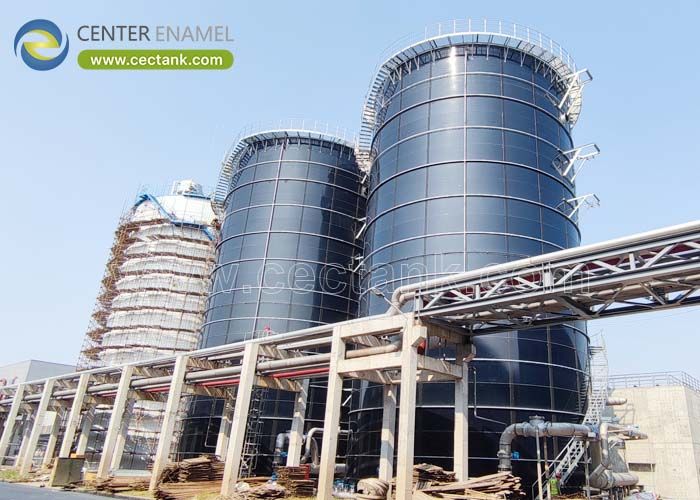
Leachate Storage Tanks Made in China Certified GFS Leachate Tanks from Center Enamel
Landfill leachate is among the most aggressive liquids in environmental engineering. High chemical oxygen demand, hydrogen sulfide gas, chlorides, and pH swings from 3 to 12 combine with warm storage conditions to defeat ordinary tanks within years. Landfills and waste-to-energy plants need storage and equalization capacity before treatment — and the tank that holds leachate must survive a chemistry that cracks concrete, pits carbon steel, and ages thin plastic liners.
Leachate storage tanks made in China by Shijiazhuang Zhengzhong Technology Co., Ltd (Center Enamel) pair an inert fired-glass surface with certified manufacturing. The glass layer, fused to steel at 820-930 degrees Celsius, resists H2S, organic acids, and chloride attack across pH 3-11 as standard. Center Enamel — China’s first GFS tank manufacturer with nearly 200 enameling patents — has delivered leachate tanks including a 10,392 m3 installation in Beijing (2023) and a multi-tank leachate system for Veolia in Hong Kong (2019), exporting to more than 100 countries since 2008.
1. Why Is Leachate So Aggressive to Tanks?
Leachate attacks tanks on every front at once: corrosive gas above the liquid, acidic and chloride-rich liquid below, and solids in suspension.
Hydrogen sulfide and ammonia: anaerobic decomposition generates H2S that condenses in the tank headspace and forms sulfuric acid, corroding unlined steel and concrete above the liquid line.
High COD and organic acids: young leachate carries high concentrations of volatile fatty acids that attack both concrete and soft coatings.
Chlorides: leachate chloride levels accelerate pitting in carbon steel and can stress stainless grades, demanding an inert barrier.
pH swings and temperature: leachate pH moves across a wide range as the fill ages, and warm storage accelerates every corrosion reaction.
2. What Makes GFS the Preferred Leachate Tank Material?
GFS wins for leachate because the glass barrier is fused into the steel, not applied on top of it — so H2S, acids, and chlorides attack a surface that cannot peel or blister.
Fused-glass inertness: the 820-930 degrees Celsius firing chemically bonds glass to steel, creating an impermeable barrier that resists H2S, organic acids, and chlorides.
Gas-tight cover options: bolted covers with gaskets contain leachate vapor and odor, protecting site workers and nearby communities.
Abrasion and solids tolerance: suspended solids and grit in leachate do not erode the 6.0 Mohs glass surface at inlet and pump zones.
Verifiable quality: 100% high-voltage holiday spark testing per panel, ISO 28765 certification, and documented project references make quality auditable — not just claimed.
3. How Do You Verify Quality from a Chinese Manufacturer?
Made in China is not a quality statement by itself — the certification and audit trail is. Verify four things before placing an order.
Third-party certifications: demand NSF/ANSI 61, ISO 28765, EN 1090, WRAS, and FM certificates — issued by accredited bodies, not self-declared.
Factory audit access: a credible manufacturer welcomes audits of its coating line, firing furnaces, and QC laboratory before you commit.
Testing records: request batch test reports: coating thickness, adhesion (3,450 N/cm2), hardness (6.0 Mohs), and holiday spark test results.
Reference installations: ask for leachate and wastewater projects with volumes, diameters, and dates — real installations are the strongest evidence of real experience.
| Evaluation Criterion | GFS Leachate Tank (Center Enamel) | HDPE / Geomembrane Lined | Field-Welded Carbon Steel |
|---|---|---|---|
| H2S and acid resistance | Superior — fused glass, inert | Moderate — liner seams are weak points | Poor — headspace corrodes rapidly |
| Abrasion and solids | High — 6.0 Mohs surface | Low — liners tear at inlet zones | Moderate — wall thinning over time |
| Odor containment | Gas-tight bolted cover options | Open basins typical | Welded but unlined headspace |
| Lifecycle and maintenance | Minimal — 30-50 year design life | Liner replacement 10-15 years | Recoating and repair cycles |
| Quality evidence | ISO 28765, spark test records, references | Manufacturer liner claims | Field inspection only |
Engineering Assurance
Center Enamel leachate tanks are FEA-verified to AWWA D103-09, manufactured under ISO 9001 and ISO 45001, 100% high-voltage holiday spark tested, and certified to ISO 28765 and NSF/ANSI 61 — with leachate and wastewater references in more than 100 countries.
Leachate is the worst-case wastewater chemistry — gas above, acid below, solids in between. The fired-glass surface is one continuous barrier that answers all three, which is why our leachate tanks carry the same spec as our largest municipal reservoirs.
Frequently Asked Questions (FAQ)
Are leachate storage tanks made in China reliable?
Yes, when the manufacturer is third-party certified and auditable. Verify ISO 28765, NSF/ANSI 61, and EN 1090 certificates, request factory audit access, review batch testing records, and check reference installations. Center Enamel has delivered leachate tanks to projects including a 10,392 m3 Beijing installation (2023) and a Veolia system in Hong Kong (2019).
Why do leachate tanks fail quickly?
Leachate combines H2S vapor, organic acids, chlorides, and pH swings that corrode unlined steel, crack concrete, and age plastic liners. The tank headspace above the liquid line is typically the first failure point because condensing H2S forms sulfuric acid.
What material is best for leachate storage tanks?
Glass-Fused-to-Steel (GFS) is the reference solution for landfill leachate: a glass layer fused to steel at 820-930 degrees Celsius creates an inert, abrasion-resistant, impermeable surface with 30-50 year design life and optional gas-tight covers.
Can leachate tanks be customized?
Yes — capacity, cover type (open, sealed, or gas-tight with collection), mixing, level and safety instrumentation, insulation, and accessories such as manholes, flanges, and platforms are engineered per site, climate, and treatment process.