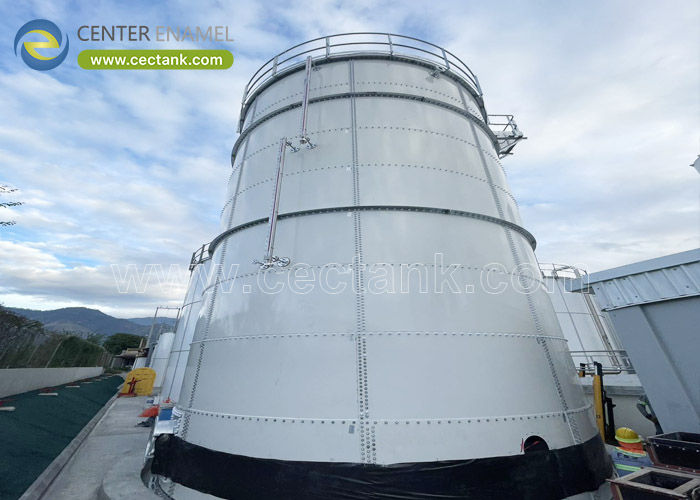
Membrane Roof Biogas Storage Tank Cost: A Realistic Breakdown
A membrane roof biogas tank combines a corrosion-resistant digester with a double-membrane gas holder that stores biogas of 55-65% methane at 5-30 mbar. Its cost is driven by volume, coating grade, and holder size. Engineered by Shijiazhuang Zhengzhong Technology Co., Ltd. (Center Enamel), the Glass-Fused-to-Steel (GFS) shell is calculated to AWWA D103-09 and ISO 28765 with a holiday-tested enamel surface.
What a Membrane Roof Biogas Tank Is
A membrane roof biogas tank is an anaerobic digester whose top carries a double-membrane gas holder: an inner membrane holds biogas, an outer membrane is air-pressurized to maintain 5-30 mbar. The tank shell is often Glass-Fused-to-Steel (GFS), with enamel fused at 820-930°C for a 0.25-0.40 mm acid-resistant surface. Capacity spans 500 to 50,000 m3 in a single bolted vessel.
Holder: double membrane.
Pressure: 5-30 mbar.
Shell: GFS enamel.
Range: 500-50,000 m3.
Key Characteristics, Components, and Types
The system pairs a GFS digester (CSTR or UASB) with a membrane roof, against alternatives like a fixed cone roof or an aluminum geodesic dome with an external holder. GFS shells use 8.8-grade bolts and a 1500 V holiday test; the membrane is UV-stabilized PVC or TPO. Heaters, mixers, and desulfurization complete the supply and drive the final cost.
Pairs: GFS digester + membrane.
Alt: cone roof or dome.
Membrane: PVC or TPO.
Extras: heater, mixer, desulf.
Applications and Operating Conditions
Farms, food processors, and municipalities use membrane roof tanks to store biogas on the tank itself, saving a separate holder. They suit continuous digestion at 35-38°C with 20-40 day retention. Because the GFS enamel resists pH 3-11, the same tank handles corrosive digestate that would attack painted steel and shorten a cheaper shell’s life.
Users: farms, food, cities.
On-tank: saves holder.
Temp: 35-38°C.
pH: enamel resists 3-11.
Technical Considerations
Cost tracks volume (500-50,000 m3), coating grade, holder volume as a fraction of tank volume, and site works. Design fixes retention at 20-40 days, temperature at 35-38°C, and methane at 55-65%. The shell is calculated to AWWA D103-09 and ISO 28765, plates blasted to Sa 2.5 and holiday-tested at 1500 V; membrane area and pressure set the holder price.
Cost: volume, grade, holder.
Retention: 20-40 days.
Temp: 35-38°C.
Holder: area and pressure.
Advantages and Limitations
A membrane roof tank stores biogas cheaply on the digester and keeps the shell gas-tight. The limitation is the membrane: it is a wear item with a shorter life than the steel and must be inspected and replaced, adding lifecycle cost. This boundary should be budgeted up front, because ignoring membrane maintenance turns a low capital cost into a recurring expense.
Advantage: cheap on-tank storage.
Advantage: gas-tight shell.
Limitation: membrane is a wear item.
Boundary: budget replacement.
Design Parameters
The figures below are the load-bearing values a provider should quote per membrane roof tank. They let an engineer confirm the digester shell, coating, and gas system before steel is ordered.
Typical value or range |
Why it matters |
500-50,000 m3 |
Single-tank throughput |
20-40 days |
Digestion stability |
35-38 °C |
Mesophilic default |
55-65 % |
Calorific value |
5-30 mbar |
Holder and seal design |
5-15 W/m3 |
Solids suspension |
0.25-0.40 mm |
Acid resistance |
1500 V |
Every panel checked |
AWWA D103-09 / ISO 28765 |
Design authority |
Feed pH below 5.5 |
Add correction step |
Comparison and Selection Guide
Against fixed-cone and geodesic-dome options, a membrane roof GFS tank wins on compact on-tank gas storage for 500-50,000 m3. Use the table to match the option to capital cost, holder life, and site needs.
Capital cost |
Gas storage |
Membrane life |
Best fit |
Moderate |
On-tank, 5-30 mbar |
10-15 years |
Compact biogas sites |
Higher |
Separate holder |
Steel, long |
Large plants |
Higher |
Separate holder |
Steel, long |
High vapor sites |
Lowest |
External bag |
Short |
Seasonal / low duty |
Best Practices: Cost Control
Size the holder to gas yield, specify the enamel DFT and 1500 V test, and budget membrane replacement at 10-15 years. Require the ISO 28765 calculation and references. Shijiazhuang Zhengzhong Technology Co., Ltd. (Center Enamel) issues drawings, NDE records, and inspection packages so the cost estimate is auditable and the tank warranty-backed.
Holder: size to yield.
Enamel: DFT and 1500 V.
Budget: membrane 10-15 yr.
Require: ISO 28765.
Conclusion
Membrane roof biogas tank cost is volume plus coating plus holder, with membrane replacement as the recurring item. Engineer all three, demand the coating and code proof, and the tank pays back across a 30-50 year shell life.
Frequently Asked Questions (FAQ)
What is a membrane roof biogas tank?
A digester with a double-membrane holder storing biogas of 55-65% methane at 5-30 mbar, built from 500 to 50,000 m3 as a single GFS vessel.
What drives the cost?
Volume, enamel grade, the holder volume as a fraction of tank volume, site works, and membrane area are the main cost drivers.
Which standard applies?
The shell is designed to AWWA D103-09 and ISO 28765, with plant control under ISO 9001 and ISO 45001.
How long does the membrane last?
Typically 10-15 years; budget for inspection and replacement as a recurring lifecycle cost.
Why choose a GFS shell?
The enamel resists pH 3-11, is holiday-tested at 1500 V, and gives a 30-50 year life that outlasts the membrane by decades.
Can it be customized?
Yes. Holder volume, mixer, heater, insulation, and instrumentation are engineered per feed and climate.
Key Takeaways
Cost = volume + coating grade + holder fraction + site works.
Budget membrane replacement every 10-15 years.
Require ISO 28765 plus a 1500 V holiday test.
GFS shell outlasts the membrane by decades.
