
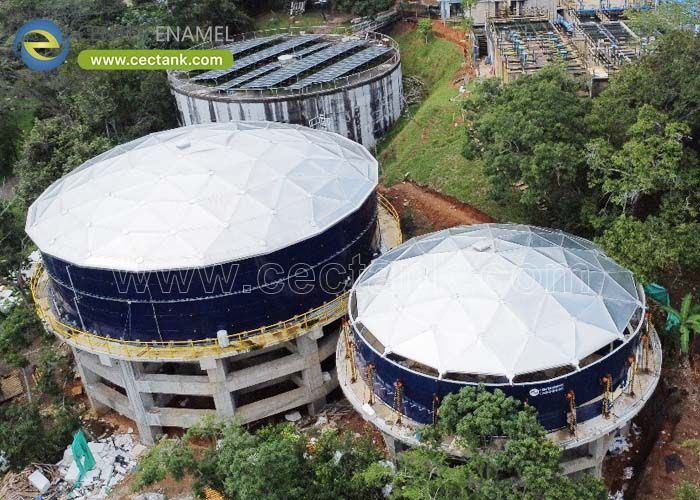
Zbiornik do przechowywania biogazu – stalowe blaszane zbiorniki śrubowane do fermentacji beztlenowej
Biogas plants across the world share one construction secret: their biggest vessels are not welded on site, they are assembled from factory-made steel plates. These plate-assembled — or bolted — tanks form the digesters that break down organic waste and the storage tanks that hold the biogas and digestate. The approach exists because biogas economics punish slow construction: every month of civil work is a month of lost energy revenue.
Plates biogas storage tanks from Shijiazhuang Zhengzhong Technology Co., Ltd (Center Enamel) are built from Glass-Fused-to-Steel panels — steel plates coated with glass fired at 820-930 degrees Celsius, then bolted together on site with gas-tight gaskets. The result is a corrosion-proof, gas-tight vessel erected in weeks rather than months. Center Enamel, China’s first GFS manufacturer with nearly 200 enameling patents, has delivered biogas tanks to more than 100 countries since 2008.
1. What Is a Bolted Biogas Storage Tank?
A plates biogas storage tank is a vessel assembled from factory-manufactured, glass-coated steel plates joined by high-strength bolts and sealing gaskets — used as a digester or biogas/digestate storage tank.
Factory-made plates: steel sheets are sheared, rolled, punched, coated with glass, and spark tested in the factory — moving quality control off the construction site.
Bolted assembly: 8.8-grade bolts and gasketed seams join plates into a liquid-tight and gas-tight shell, without a single field weld.
Two roles in one family: the same plate technology builds anaerobic digesters (mixed, heated) and biogas or digestate storage tanks (sealed, static).
Capacity range: from 200 m3 farm-scale digesters to 20,000 m3 municipal and industrial systems.
2. Why Are Plate-Assembled Tanks Preferred for Biogas?
Plate-assembled tanks win on the four factors that decide biogas project viability: corrosion resistance, gas tightness, speed, and cost.
Corrosion-proof interior: the fused glass surface resists slurry acids, ammonia, and H2S — the chemistry that destroys uncoated steel and cracks concrete.
Gas-tight sealing: engineered gaskets and bolted covers keep methane inside the system and air out, protecting both yield and safety.
Weeks-fast erection: plates bolt together with small crews and hand tools — no welding, no long concrete cures, no weather-dependent field coating.
Expandable and relocatable: plants can add rings or tanks as feedstock grows, and a bolted tank can be dismantled and moved — impossible for concrete.
3. Digester or Storage — Which Configuration Do You Need?
Choose the configuration by function: heated and mixed digesters for the biology, sealed static tanks for biogas and digestate storage.
Anaerobic digester: heated (35-38 degrees Celsius mesophilic or 50-55 degrees Celsius thermophilic), mixed with agitators, and covered with a gas-tight roof.
Biogas storage: gas-tight low-pressure tanks or covers that buffer gas production against utilization demand.
Digestate storage: sealed tanks holding the liquid residue until land application, with covers to control odor and emissions.
Feed and buffer tanks: pre-storage and mixing tanks for feedstock, sized to smooth the feeding schedule.
| Kryterium oceny | Plates Biogas Tank (Center Enamel) | Site-Welded Steel | Concrete Digester |
|---|---|---|---|
| Corrosion resistance | Superior — fused glass surface | Poor — H2S and slurry attack | Moderate — cracks, acid attack |
| Gas tightness | High — bolted covers and gaskets | Depends on weld quality | Challenging — joints leak |
| Prędkość budowy | Fast — weeks, bolted erection | Slow — welding and testing | Very slow — months of casting |
| Expandability | High — add rings or tanks | Moderate — rework needed | Brak |
| Cykl życia i konserwacja | 30-50 years, minimal | Recoat every 5-10 years | Repair and waterproofing |
Gwarancja inżynieryjna
Every Center Enamel plates biogas tank is FEA-verified to AWWA D103-09, manufactured under ISO 9001/45001, 100% high-voltage holiday spark tested, and certified to ISO 28765 — with biogas references in more than 100 countries.
Biogas plants are built by project financiers on a schedule. A plate-assembled tank compresses that schedule without compromising the two things biology needs: a corrosion-proof vessel and a gas-tight seal.
Często zadawane pytania (FAQ)
What is a plates biogas storage tank?
A plates biogas storage tank is a vessel assembled from factory-made, glass-coated steel plates joined by bolts and gaskets. It serves as an anaerobic digester or as sealed storage for biogas and digestate, with capacities from about 200 m3 to 20,000 m3.
Why are biogas tanks built from plates instead of welded?
Plate (bolted) construction moves coating and quality control into the factory, erects in weeks with small crews, avoids field welding and field painting, and can be expanded or relocated. Welded and concrete digesters take months and depend on site labor.
Can plate-assembled tanks hold biogas pressure?
Low-pressure biogas storage is supported with gas-tight bolted covers and engineered gaskets; the tank family is primarily used for digesters and low-pressure gas/digestate storage, with pressure-rated equipment sized per system design.
Can biogas tanks be customized?
Yes — capacity, diameter-to-height ratio, heating and mixing systems for digester duty, gas-tight cover type, insulation, and accessories such as manholes, platforms, and level instrumentation are engineered per feedstock and site.