
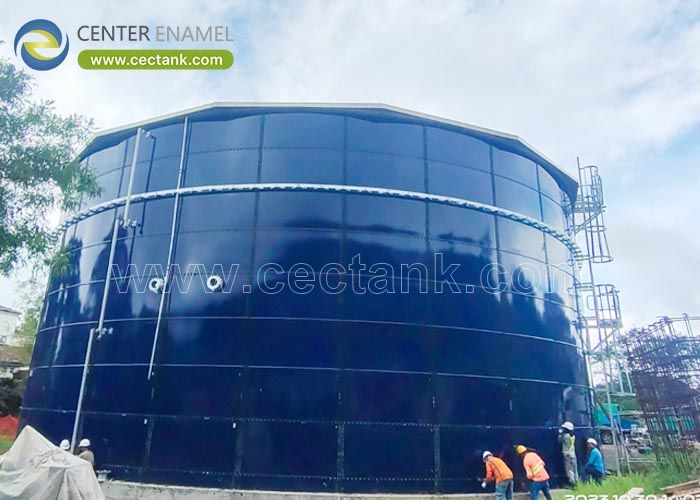
Glass-Fused-to-Steel UASB Tanks for Dairy Wastewater Treatment Projects
The dairy processing industry generates vast volumes of high-strength wastewater characterized by elevated concentrations of fats, proteins, lactose, and cleaning agents. Managing this effluent presents unique environmental and operational challenges due to fluctuating pH levels and massive organic loads. Glass-Fused-to-Steel (GFS) Upflow Anaerobic Sludge Blanket (UASB) tanks represent the pinnacle of high-rate biological wastewater treatment. By integrating the advanced biological performance of UASB anaerobic digestion with the impenetrable corrosion defense of GFS modular containment, Center Enamel delivers turn-key wastewater solutions that achieve exceptional Chemical Oxygen Demand (COD) reduction while capturing valuable renewable biogas.
The Core Challenges in Dairy Wastewater Treatment
Treating effluent from milk processing, cheese production, and yogurt manufacturing involves navigating severe environmental hurdles:
Extreme Organic Loading (High COD/BOD): Dairy wastewater exhibits very high COD and Biological Oxygen Demand (BOD) levels, which quickly overwhelm conventional aerobic treatment systems and drive up aeration energy costs.
Acidic Volatile Fatty Acid (VFA) Generation: Rapid acidification of dairy lactose creates volatile fatty acids that aggressively attack and corrode unprotected carbon steel and degrade standard concrete structures.
Strict Effluent Discharge and Methane Regulations: Environmental agencies worldwide enforce strict limits on nutrient discharge and fugitive greenhouse gas emissions, requiring completely airtight, reliable reactor vessels.
Engineering Advantages of Center Enamel’s GFS UASB Tanks
1. Superior Resistance to Acidic & Sulfide Corrosion
Center Enamel manufactures GFS tanks by fusing high-grade silicate glass frit onto structural steel plates at extreme temperatures between 820°C i 930°C. This creates a molecular bond that delivers total immunity to organic acids, sulfides, and dairy effluent chemicals across a wide pH range (1–14), preventing internal pitting and rust.
2. Optimized Three-Phase Separation and High COD Removal
Center Enamel’s GFS UASB reactors are engineered to house sophisticated internal three-phase separators (gas, solid, liquid). Wastewater flows upward through a dense, granular anaerobic sludge blanket, achieving 80% to 95% COD removal efficiency while converting complex organic pollutants into clean, renewable methane gas.
3. Modular Bolted Flexibility and Rapid Erection
Unlike cast-in-place concrete tanks that require months of weather-dependent curing, Center Enamel’s GFS UASB tanks arrive as pre-engineered modular panels. Assembled rapidly on-site using specialized structural bolting and elastomeric sealants, they minimize construction downtime and allow seamless future capacity expansion.
Comparative Matrix: Dairy Wastewater Treatment Tank Technologies
| Wskaźnik wydajności | Center Enamel GFS UASB Tank | Traditional Welded Steel Reactor | Cast-in-Place Concrete UASB Tank |
|---|---|---|---|
| Ochrona przed korozją | Superior (Inert glass enamel fused on both sides) | Low (Vulnerable to acidic VFA and sulfide attack) | Moderate (Prone to concrete spalling from acid attack) |
| COD Removal Efficiency | High (Optimized anaerobic granulation, 80%–95%) | Variable (Dependent on internal coating integrity) | Moderate to High (Requires heavy internal epoxy lining) |
| Szybkość instalacji | Fast (Prefabricated modular bolted panels) | Niskie (Rozległe spawanie i testowanie w terenie) | Bardzo powolny (Miesiące formowania i twardnienia betonu) |
| Okres eksploatacji projektu | 30–50+ lat | 15–20 lat | 20–25 lat |
Globalne spełnienie norm i zapewnienie jakości
To meet the stringent demands of international dairy processors and municipal environmental protection agencies, Center Enamel manufactures all UASB containment systems in strict accordance with recognized global standards:
AWWA D103-09: The international standard for bolted steel tank structural calculations.
ISO 28765: Governing the design and quality control of glass-lined steel tanks for liquid storage.
ISO 9001 & ISO 45001: Certified quality management and occupational health and safety systems.
EN1090 / CE Certification: Validating structural steel fabrication excellence for global export.
Często zadawane pytania (FAQ)
Q: Why are GFS UASB tanks ideal for dairy wastewater treatment?
Odpowiedź: Dairy wastewater has high organic content and forms acidic volatile fatty acids during digestion. GFS UASB tanks provide an inert, glass-hard interior surface that resists acid corrosion while maintaining the structural strength needed for high-rate anaerobic digestion.
Q: What COD removal efficiency can be expected from Center Enamel GFS UASB reactors?
Odpowiedź: Center Enamel’s GFS UASB reactors typically achieve a high COD removal efficiency ranging from 80% to 95%, significantly reducing organic pollutant loads prior to final discharge or secondary polishing.
Q: Can the biogas produced in dairy UASB reactors be recovered?
Odpowiedź: Yes. The top of the GFS UASB reactor integrates specialized gas-collection systems and can be paired with double membrane gasholders to capture methane-rich biogas for onsite thermal energy generation or electricity.
Q: What is the design lifespan of a Center Enamel Glass-Fused-to-Steel UASB tank?
Odpowiedź: Center Enamel GFS tanks are engineered for a long operating life exceeding 30 lat, requiring minimal routine maintenance compared to painted steel or concrete alternatives.