
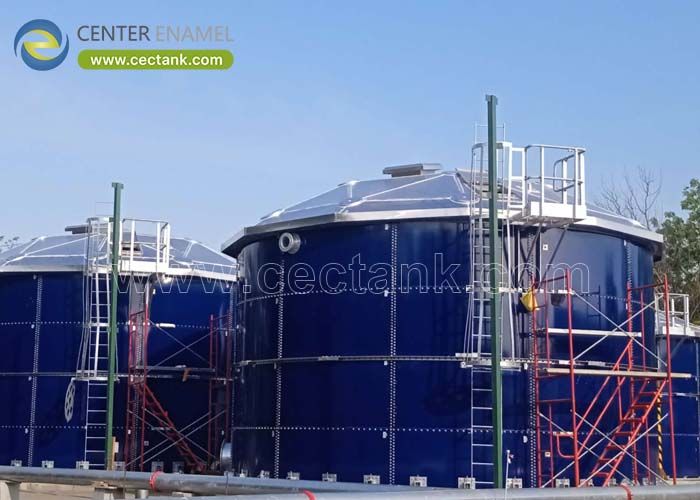
Zbiornik do przechowywania osadów o pojemności 10 300 m³ – zaprojektowany specjalnie dla osadów ściekowych
Wastewater treatment plants and industrial processors generate sludge continuously — and storing 10,300 m³ (about 2.72 million US gallons) of it demands a vessel that survives the most aggressive chemistry in the plant. Sludge is abrasive, sulfide-laden, oxygen-depleting, and temperature-variable; it attacks tank surfaces with hydrogen sulfide in the headspace and volatile fatty acids in the liquid phase. Concrete sludge tanks crack and corrode; field-coated welded steel loses its lining within years. A 10,300 m³ sludge storage tank is therefore an asset whose coating quality, structural design, and mixing interface decide its operating life.
Shijiazhuang Zhengzhong Technology Co., Ltd (Center Enamel) — the first Glass-Fused-to-Steel (GFS) tank manufacturer in China, with nearly 200 enameling patents and deliveries to more than 100 countries since 2008 — engineers large sludge storage tanks in GFS and fusion bonded epoxy (FBE) to AWWA D103-09, ISO 28765, and NSF/ANSI 61. Every panel is 100% high-voltage holiday spark tested under ISO 9001 control before shipment.
1. What Does a 10,300 m³ Sludge Storage Tank Need to Withstand?
Sludge storage combines corrosion, abrasion, and odor duty in one vessel. Material selection starts from the chemistry, not from the price.
Sulfide headspace attack: anaerobic conditions generate hydrogen sulfide that condenses on the shell and roof — the classic failure mode of coated steel sludge tanks. Fired glass (GFS) is chemically inert to H2S and cannot blister or peel.
Abrasive liquid phase: sludge at 2-8% solids abrades softer linings; the fired glass surface is hard and wear-resistant, validated across decades of installations.
Mixing and desludging forces: submersible mixers, recirculation nozzles, and desludging equipment impose local loads that FEA design resolves into reinforced panel and connection details.
Odor control interfaces: covered storage with sealed vents and connections to odor control systems requires gas-tight engineered roof-to-shell sealing.
2. Engineering Quality at the 10,300 m³ Scale
At this scale, quality is a documentation chain — structural calculations, coating records, and erection procedures that a plant auditor can follow panel by panel.
FEA-verified structure: hydrostatic head, wind, seismic, and equipment loads are resolved per AWWA D103-09 with 8.8 grade bolted connections and anchorage design supplied with every project.
Factory test records: each panel’s coating thickness and 100% high-voltage holiday spark test are recorded under ISO 9001 — a paper trail inspectors and insurers recognize.
GFS or FBE by duty: GFS for maximum chemical immunity and abrasion resistance; FBE where clients prefer an epoxy barrier — both factory-cured, both certified, both available up to 10,300 m³ and beyond.
Commissioning-ready delivery: supervisor dispatch, torque procedures, and hydrotest documentation support plant acceptance and operator handover.
3. Integrating a Large Sludge Tank into the Wastewater Plant
A 10,300 m³ sludge tank is a process vessel, not just storage: its interfaces with mixing, pumping, and gas handling must be engineered together.
Mixer and nozzle integration: flanges and brackets at engineered positions accept submersible mixers, recirculation nozzles, and level instruments without field drilling or coating damage.
Pumping and desludging: suction arrangements, anti-vortex details, and discharge piping interfaces are sized for plant hydraulics and desludging duty.
Gas-tight covers: GFS or aluminum geodesic dome roofs contain odor, vent to treatment, and withstand the sulfide atmosphere — a single manufacturer for tank and cover removes interface risk.
Expansion-ready geometry: diameter-to-height ratio is engineered for future solids loading, so the asset adapts as the plant grows.
| Kryterium oceny | Center Enamel GFS/FBE Sludge Tank | Beton wlewany na miejscu | Field-Coated Welded Steel |
|---|---|---|---|
| H2S and acid defense | Superior — inert fired glass / factory FBE, 100% spark tested | Poor — cracking, sulfide attack, leaching | Moderate — headspace coating failure |
| Abrasion resistance | High — hard fired-glass surface | Moderate — surface erosion over time | Low — coating damage under abrasion |
| Construction schedule (10,300 m³) | Fast — bolted modular erection | Very slow — multi-month cast works | Slow — welding plus field lining |
| Cykl życia i konserwacja | Minimalne — projektowana żywotność 30–50 lat | High — repair and relining programs | Wysoka — ponowne pokrycie co 5–10 lat |
| Quality documentation | Full — FEA, spark-test records, ISO 9001 | Site-dependent QA | Field inspection only |
Gwarancja inżynieryjna
Every 10,300 m³ sludge storage tank ships with AWWA D103-09 structural calculations, ISO 28765 coating verification, 100% holiday spark-test records, and ISO 9001/45001 manufacturing certification — the file that passes plant audits, insurer review, and lender due diligence.
Sludge tanks fail from the inside out — H2S above the liquid line, abrasion below it. Only a surface that is inert and hard at the same time survives both, which is exactly what fired glass delivers.
Często zadawane pytania (FAQ)
What is a sludge storage tank used for?
A sludge storage tank holds thickened or digested sludge from wastewater treatment between process stages — buffering plant operations, equalizing feed to dewatering, or storing biosolids prior to disposal or reuse. Large units like 10,300 m³ serve municipal-scale plants.
Why is GFS preferred for large sludge storage?
Glass-Fused-to-Steel is chemically inert to hydrogen sulfide and volatile fatty acids, hard enough to resist sludge abrasion, and delivers a 30-50 year life without recoating. Concrete cracks and leaches; coated welded steel fails in the sulfide headspace.
How long does it take to build a 10300m3 sludge tank?
Bolted GFS/FBE construction erects dramatically faster than concrete — from foundation readiness, a 10,300 m³ tank typically assembles in weeks with small crews, with no formwork, curing, or field coating.
Can the sludge tank be customized for my plant?
Yes — diameter-to-height ratio, roof type (GFS or aluminum geodesic dome), mixer and nozzle interfaces, pumping arrangements, and accessories are engineered per plant, with FEA design for site wind and seismic conditions.