
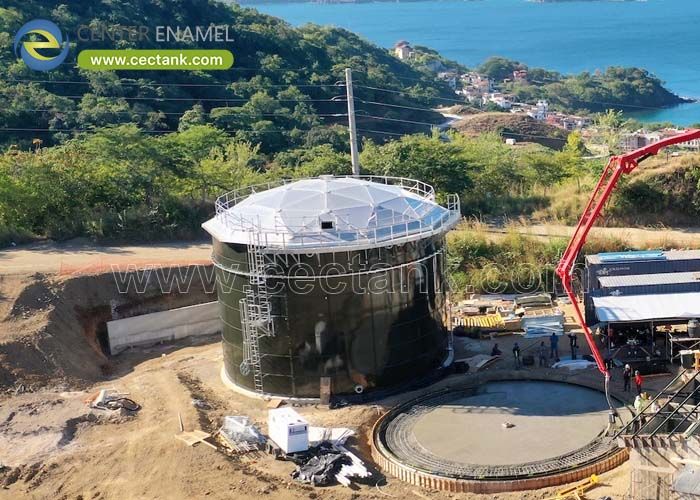
Przemysłowy zbiornik do oczyszczania ścieków – odporny na korozję, śrubowany zbiornik do przemysłowych odpadów ciekłych
Industrial effluent is the hardest test in wastewater engineering. Where municipal sewage is roughly predictable, industrial streams swing wildly: a paper mill’s effluent carries fibers and organic acids, a plating line adds chlorides and heavy metals, a food plant delivers high COD and fats, and a chemical facility can shift pH in minutes. The tank that holds these streams must survive chemistry that corrodes, erodes, and attacks every unprotected surface.
Industrial wastewater treatment tanks from Shijiazhuang Zhengzhong Technology Co., Ltd (Center Enamel) match the tank material to the effluent chemistry — Glass-Fused-to-Steel for aggressive and varying loads, Fusion Bonded Epoxy for pH-sensitive industrial duty, and stainless steel where purity or extreme chlorides demand it. Center Enamel, operating since 2008 with nearly 200 enameling patents, has delivered industrial wastewater tanks to more than 100 countries.
1. What Makes Industrial Wastewater Different from Municipal Sewage?
Industrial effluent varies by industry in chemistry, temperature, and solids — and the tank material must be selected against the specific stream, not a generic assumption.
pH swings: process discharges can shift from acid to alkaline within hours, defeating coatings tuned to a narrow range.
Organic and inorganic load: high COD streams (food, paper, chemicals) plus chlorides and sulfates demand an inert surface, not a sacrificial one.
Temperature and abrasion: hot streams accelerate corrosion, while fibers, grit, and solids erode tank bottoms and inlet zones.
Batch variability: industrial plants discharge in campaigns; storage and equalization tanks must tolerate idle periods with corrosive residues.
2. How Do You Match Tank Material to Effluent Chemistry?
Match the surface to the chemistry: GFS for broad and aggressive resistance, FBE for cost-effective pH duty, stainless for purity and extreme chloride.
Szklano-stalowe (GFS): the widest corrosion resistance (pH 3-11 standard) — the default for industrial equalization, reaction, and sludge tanks where chemistry varies.
Epoxy wiązane metodą spoiwa (FBE): factory-cured epoxy with strong chemical and pH resistance — a cost-effective choice for many industrial wastewater duties.
Stainless steel: 304/316/316L where product purity, food contact, or extreme chlorides make coated steel unsuitable.
Coating evidence: verify ISO 28765, NSF/ANSI 61, and 100% holiday spark test records — the corrosion barrier must be auditable.
3. What Process Tanks Can Be Bolted for Industrial Wastewater?
The entire industrial treatment train can be built in bolted steel — from equalization through biological treatment to sludge handling.
Equalization and storage: buffering tanks that absorb flow and load swings, with mixers and corrosion-proof interiors for aggressive streams.
Biological reactors: aerobic and anaerobic tanks (including CSTR and UASB-style duty) with gas-tight covers where biogas is captured.
Clarifiers and settling: lamella or center-feed clarifier configurations in coated bolted steel.
Sludge and chemical tanks: sludge holding, chemical dosing, and polymer preparation tanks with duty-matched surfaces.
| Kryterium oceny | GFS (Center Enamel) | FBE Coated Steel | Stal nierdzewna | Unlined Carbon Steel |
|---|---|---|---|---|
| pH and chemical resistance | Superior — pH 3-11 standard | Good — strong for many duties | Excellent in most streams | Poor — corrodes |
| Chloride resistance | Good — inert glass | Good — if coating intact | Excellent — 316/316L | Poor — pitting |
| Abrasion resistance | High — 6.0 Mohs | Średnie | Wysokie | Low — corrodes and erodes |
| Cost profile | Mid — 30-50 year life | Low-mid — best value for many duties | Wysokie | Low first cost, high lifecycle |
| Certification evidence | ISO 28765, NSF 61, spark test records | Coating thickness records | Material certs | None for corrosion |
Gwarancja inżynieryjna
Center Enamel industrial wastewater tanks are FEA-verified to AWWA D103-09, manufactured under ISO 9001/45001, 100% high-voltage holiday spark tested, and certified to ISO 28765 and NSF/ANSI 61 — with industrial references across more than 100 countries.
Industrial effluent does not read the coating data sheet — it attacks the weakest spot. That is why we select the surface from the stream chemistry first, then verify it with spark tests and certifications rather than assumptions.
Często zadawane pytania (FAQ)
What is an industrial wastewater treatment tank?
An industrial wastewater treatment tank is a storage or process vessel used in industrial effluent treatment — equalization, biological reaction, clarification, sludge, or chemical duty. Center Enamel supplies bolted tanks in GFS, FBE, and stainless steel, matched to the effluent chemistry.
Which tank material is best for industrial effluent?
It depends on the stream: GFS (fired glass) offers the widest corrosion resistance and is the default for aggressive, variable chemistry; FBE provides cost-effective resistance for many duties; stainless steel suits purity and extreme chloride cases. Selection should follow a water analysis.
How long do industrial wastewater tanks last?
GFS and stainless tanks offer 30-50 year design life with minimal maintenance. FBE tanks serve 20-30 years when the coating is factory-cured and intact. Unlined carbon steel requires recoating or replacement within 5-10 years in most industrial streams.
Can industrial tanks be customized?
Yes — material and coating (GFS, FBE, stainless), capacity, mixing, covers, heating, insulation, and accessories such as manholes, flanges, and platforms are engineered per effluent analysis, process duty, and site conditions.