
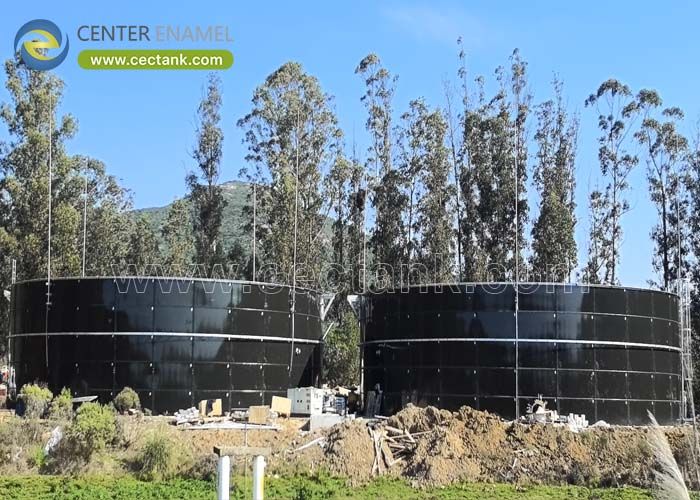
Podziemne zbiorniki stalowe – odporność na korozję, ukryte magazynowanie, zaprojektowane przez Center Enamel
Underground steel tanks store water, wastewater, fire suppression reserves, and leachate beneath the grade, freeing surface land and stabilizing liquid temperature year-round. Yet buried service is the most aggressive environment any steel vessel can face: constant soil moisture, chloride and sulfate attack, stray electrical currents, and differential settlement conspire against the coating. Field-applied paint systems and unprotected carbon steel routinely develop pinhole corrosion within 5 to 10 years, while cast-in-place concrete vaults crack, carbonate, and leak groundwater into the stored liquid.
Underground steel tanks from Shijiazhuang Zhengzhong Technology Co., Ltd (Center Enamel) solve the buried-service problem at the material level. As the first manufacturer of Glass-Fused-to-Steel (GFS) tanks in China and holder of nearly 200 enameling patents, Center Enamel fires every panel at 820-930 degrees Celsius, fusing an inert glass layer directly onto the steel substrate. The result is a factory-perfect, holiday-free barrier verified by 100% high-voltage spark testing, engineered and installed in accordance with AWWA D103-09, NSF/ANSI 61, and ISO 28765.
1. Why Do Underground Steel Tanks Corrode — and How Is It Prevented?
Soil-side corrosion, not structural overload, causes most buried tank failures. Center Enamel prevents it by specifying factory-baked coatings that leave no exposed steel and by verifying every panel electrically before shipment.
Four failure drivers: soil moisture and oxygen cells, chloride-rich or sulfate-rich backfill, stray-current corrosion from nearby utilities, and mechanical coating damage during backfill. Each driver attacks field-applied coatings first, where film thickness varies by operator.
Glass-Fused-to-Steel barrier: firing at 820-930 degrees Celsius chemically bonds a glass layer to the steel surface, creating a single, inert composite that cannot blister, peel, or under-creep the way liquid-applied paints do. GFS tanks deliver a 30-50 year design life even in aggressive soils.
Fusion bonded epoxy (FBE) option: for chemical and wastewater service, FBE coated panels cured in the factory provide a tough, flexible barrier suited to buried effluent and leachate applications.
100% holiday testing: every panel and every factory coating passes high-voltage spark detection before it ships, so no pinhole reaches the jobsite — the single most important quality gate for buried service.
2. Structural and Installation Engineering for Buried and Partially Buried Service
A buried tank must resist external soil pressure, water-table uplift, and seismic settlement simultaneously. Finite Element Analysis (FEA) and standardized bolted connections make this predictable.
FEA-verified structures: each tank diameter-to-burial-depth combination is modeled for external hydrostatic pressure, surcharge loads, and vehicle loading, in strict accordance with AWWA D103-09 and OSHA requirements.
Anti-flotation design: where groundwater is high, engineered anchorage and deadman systems counteract buoyancy — a calculation Center Enamel supplies with every buried or partially buried project.
Controlled backfill: graded, compacted granular backfill protects the coating and drains water away from the shell; sharp rock and uncontrolled compaction are the leading causes of field coating damage on lesser tanks.
Modular bolted erection: panels bolt together with 8.8 grade high-strength bolts inside an open excavation or berm, so no hot work, welding fumes, or field painting are required below grade.
3. Applications Where Underground Steel Tanks Outperform Alternatives
Buried bolted steel tanks are the preferred choice wherever land value, aesthetics, thermal stability, or freeze protection drives the design.
Municipal and fire water: buried reserves maintain uniform temperature, resist freezing, and keep surface land free for development, with NSF/ANSI 61 certified GFS surfaces for potable contact.
Wastewater equalization: buried equalization and retention tanks buffer storm flows while controlling odor and visual impact at treatment plants.
Landfill leachate: FBE and GFS panels withstand the acidic, chloride-rich chemistry of leachate, validated to ISO 28765 and decades of installations.
Rainwater and reclaimed water: compact buried harvesting tanks serve commercial campuses and industrial sites with zero visual footprint.
| Kryterium oceny | Center Enamel Coated Bolted Steel | Beton wlewany na miejscu | Field-Welded Coated Carbon Steel |
|---|---|---|---|
| Corrosion defense (buried service) | Superior — GFS fired 820-930°C / FBE, 100% spark tested | Poor — carbonation and micro-cracking admit chlorides | Moderate — field paint degrades in soil within 10-15 years |
| Prędkość budowy | Fast — modular panels, no in-situ curing | Very slow — formwork, pour, 28-day cure, waterproofing | Slow — welding, blasting, field coating in excavation |
| Leak tightness | High — gasketed bolted seams, holiday-free coating | Low — inherent cracking and joint leakage | Moderate — weld seams and coating holidays leak over time |
| Cykl życia i konserwacja | Minimal — 30-50 year GFS design life | High — periodic crack repair and re-waterproofing | High — recoating cycles every 5-10 years |
| Modularity and relocation | High — extendable, relocatable panels | None — permanent cast structure | None — welded monolith |
Gwarancja inżynieryjna
Every underground and partially buried tank project is delivered with FEA-calculated structural drawings, coating certificates, and installation supervision backed by ISO 9001 and ISO 45001 systems. As of 2023, Center Enamel bolted tanks operate in more than 100 countries, including the United States, Canada, Australia, and the UAE.
Często zadawane pytania (FAQ)
What is an underground steel tank used for?
Underground steel tanks store drinking water, fire suppression water, wastewater, rainwater, and landfill leachate beneath the grade. Burying the tank frees surface land, stabilizes liquid temperature, protects against freezing, and reduces visual and odor impact.
How long do underground steel tanks last?
A properly engineered Center Enamel GFS underground tank is designed for 30-50 years of buried service. The glass coating is fired at 820-930°C and cannot peel or blister, so the design life is set by the steel structure, not by recoating cycles common to field-painted tanks.
Are underground tanks safe for drinking water?
Yes. GFS panels certified to NSF/ANSI 61 and WRAS provide an inert, non-leaching glass contact surface that meets potable water standards, and every tank is engineered to AWWA D103-09 for structural integrity.
Can underground steel tanks be customized for my site?
Yes. Center Enamel engineers buried and partially buried configurations from 20 m³ to more than 20,000 m³, with site-specific FEA for soil loads, groundwater uplift, and seismic conditions, plus accessory options including manholes, flanges, ladders, and platforms.