
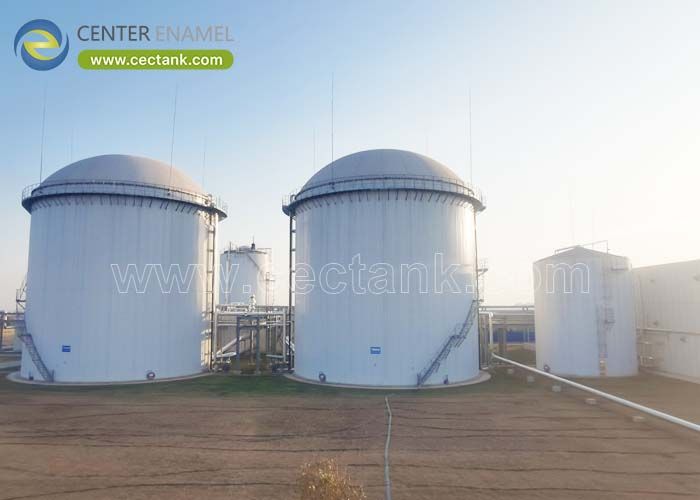
Tanques de Armazenamento Diversificados: O Guia Completo para Seleção de Soluções Multifuncionais de Armazenamento
Storage requirements change faster than facilities do. A farm adds aquaculture next to its livestock water. A municipality pairs a new drinking water reservoir with an anaerobic digester. An industrial site stores process water, effluent, and fire reserve on the same footprint. Buying a purpose-built tank for every duty multiplies cost, certification paperwork, and maintenance — and each new tank brings a new learning curve for the crew.
A diversified storage tank answers with one engineered platform: modular bolted steel panels that adapt across media by changing the surface material — Glass-Fused-to-Steel (GFS), fusion bonded epoxy (FBE), stainless steel, or galvanized steel. Shijiazhuang Zhengzhong Technology Co., Ltd (Center Enamel), China’s first GFS tank manufacturer, builds this platform from 20 m³ to 18,000 m³ and backs it with nearly 200 enameling patents and exports to more than 100 countries.
1. What Is a Diversified Storage Tank?
A diversified storage tank is a modular bolted-steel tank whose corrosion surface is selected per stored medium, so one tank platform serves many duties across a facility.
One platform, many surfaces: the same rolled steel panels are finished with fired glass (GFS), cured epoxy (FBE), stainless steel cladding, or hot-dip galvanizing — each surface matched to the stored liquid.
Bolted modular architecture: factory-manufactured panels bolt together on site with gasketed seams, so capacity, diameter, and height are configured per project without special tooling.
One certification family: the platform carries NSF/ANSI 61 and WRAS certification for potable contact, AWWA D103-09 structural compliance, and ISO 9001/45001 manufacturing — whichever surface you choose.
Engineered as a system: roofs, domes, flanges, ladders, and platforms are designed with the shell, so a diversified tank is a complete, code-compliant storage asset.
2. Which Liquids and Solids Can a Diversified Bolted Tank Store?
The platform covers the full facility storage map — water, waste, gas, chemicals, and grain — because the surface is matched to the medium.
Potable and process water: GFS or stainless surfaces certified to NSF/ANSI 61 keep drinking water and food-grade process water clean, from 20 m³ farm tanks to 18,000 m³ municipal reservoirs.
Wastewater and sludge: GFS and FBE surfaces resist the corrosive cocktail of sewage, sludge, H2S gas, and abrasive grit, with spark-tested coatings for long service.
Biogas and digestate: GFS tanks form anaerobic digesters and CSTR reactors with gas-tight aluminum domes or membrane roofs, handling 35-38°C mesophilic and 50-55°C thermophilic operation.
Chemicals and industrial liquids: FBE and stainless configurations handle acids, alkalis, brines, and process intermediates within their engineered chemical-compatibility envelopes.
Dry bulk — grain: the same bolted platform becomes flat-bottom or hopper-bottom grain silos with sealed, aeratable, temperature-monitored storage.
3. How Do You Select the Right Diversified Tank Configuration?
Selection follows a simple decision path: identify the medium, match the surface, then size the geometry to the site.
Medium drives surface: potable and food duty to GFS or stainless; corrosive wastewater to GFS or FBE; aggressive chemical duty to FBE or stainless per compatibility tables; cost-sensitive neutral water to galvanized steel.
Capacity drives geometry: diameter and height are engineered from volume, footprint, pump suction, and wind/seismic loads — with FEA verification for every configuration.
Duty drives accessories: manholes, flanges, vents, ladders, platforms, and roofs (cone, aluminum geodesic dome) are specified by the stored medium and operating regime.
Regulation drives compliance: potable duty demands NSF/ANSI 61 and WRAS surfaces; fire reserve demands NFPA/FM alignment; industrial duty demands local chemical and safety codes — all addressed in the same platform.
| Critério de avaliação | Diversified Bolted Tank (Center Enamel) | Single-Purpose Tanks |
|---|---|---|
| Multi-duty coverage | High — one platform, five surface families | Low — one tank per duty |
| Procurement & certification | One PO, one certification set | Multiple vendors, repeated paperwork |
| Interface compatibility | Engineered as one system | Field-fit issues between products |
| Capacity flexibility | 20-18,000 m³, modular expansion | Fixed by each design |
| Lifecycle & maintenance | Minimal — 30-50 year coated surfaces | Varies per product, often shorter |
| Spare parts & support | Unified inventory and training | Fragmented after-sales |
Garantia de engenharia
Every diversified storage tank from Center Enamel is FEA-verified to AWWA D103-09, manufactured under ISO 9001 and ISO 45001, with NSF/ANSI 61 and WRAS certified water-contact surfaces and 100% high-voltage holiday spark testing on coated panels.
Diversification is not about selling more products — it is about making the second and third tank on a site as easy to specify, certify, and maintain as the first. One platform, matched surfaces, and the same engineering file every time.
Perguntas Frequentes (FAQ)
What is a diversified storage tank?
A modular bolted-steel tank whose corrosion surface is selected per stored medium — glass-fused-to-steel, fusion bonded epoxy, stainless steel, or galvanized steel — so one tank platform serves drinking water, wastewater, biogas, chemicals, and grain storage.
Can one tank type really store different liquids?
Yes. The bolted shell is identical; the surface material changes with the medium. GFS handles potable and corrosive duty, FBE adds chemical compatibility, stainless serves hygiene-critical duty, and galvanized covers cost-sensitive neutral water.
How do I choose the right tank configuration?
Match the medium to the surface, the capacity to the geometry, the accessories to the duty, and the compliance to the regulation — NSF/ANSI 61 for potable, NFPA/FM for fire reserve, local codes for industrial chemicals. Center Enamel engineers all four steps per project.
Can a diversified tank be customized?
Yes — capacity from 20 to 18,000 m³, diameter and height per site, surface material per medium, and accessories including cone or aluminum geodesic dome roofs are all configured and FEA-verified per project.