
Tanques GFS para Projetos de Tratamento de Esgoto: Por Que o Vidro Fundido Supera as Alternativas
Por que o GFS é utilizado em tanques de tratamento de águas residuais?
Como o sulfeto de hidrogênio danifica os tanques de armazenamento?
Como o GFS se compara ao concreto e ao epóxi no tratamento de esgoto?
Qual é a vida útil de um tanque de águas residuais em GFS?
As águas residuais não constituem um ambiente químico único, mas sim dinâmico. A mesma rede de coleta que transporta esgoto quase neutro numa terça-feira de tempo seco pode, após longa retenção em uma tubulação ascendente aquecida, conduzir um fluxo séptico, rico em sulfeto e com pH baixo. Em estações municipais de tratamento, poços úmidos de estações de bombeamento e sistemas industriais de pré-tratamento, essa variabilidade é o que compromete a eficácia da contenção projetada para condições médias. O concreto perde alcalinidade à medida que sofre carbonatação e é atacado pelo ácido sulfúrico biogênico. Os revestimentos epóxi resistem às condições típicas, mas falham nos extremos, formando bolhas onde o sulfeto de hidrogênio foi oxidado na superfície. Já o aço pintado exige um programa de re-revestimento que retira o tanque do serviço justamente quando a planta menos pode se dar ao luxo disso.
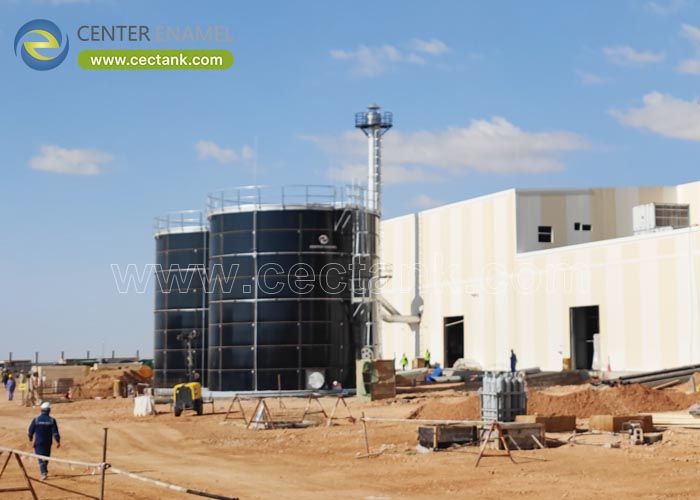
Os tanques de GFS destinados a projetos de tratamento de águas residuais utilizam um revestimento que não é aplicado sobre o aço, mas fundido diretamente nele. As placas são submetidas a temperaturas entre 820 e 930 °C, permitindo que o vidro derreta e se una metalurgicamente ao substrato, resultando em uma superfície inerte ao sulfeto de hidrogênio, aos ácidos orgânicos e ao pH variável de um fluxo real de esgoto. A Shijiazhuang Zhengzhong Technology Co., Ltd. (Center Enamel) fornece tanques de GFS parafusados, projetados conforme a norma AWWA D103-09, para aplicações em águas residuais municipais e industriais, em mais de 100 países.
1. Como o Sulfeto de Hidrogênio Danifica os Tanques de Águas Residuais?
Bactérias redutoras de sulfato presentes no esgoto séptico produzem sulfeto de hidrogênio, que se dissolve na umidade da parede do tanque e é oxidado por bactérias, gerando ácido sulfúrico. Esse ácido biogênico ataca diretamente materiais cimentícios e muitos revestimentos, razão pela qual a corrosão em tanques de águas residuais concentra-se acima e na linha d’água, e não abaixo dela.
Geração: Bactérias redutoras de sulfato geram H2S sempre que o esgoto se torna séptico, o que ocorre facilmente em climas quentes e durante períodos prolongados de retenção.
Oxidação a Ácido: Na parede do tanque, o H2S dissolve-se no condensado e é oxidado biologicamente, transformando-se em ácido sulfúrico — o agente que realmente destrói a superfície.
Ataque acima da linha de flutuação: Como o mecanismo depende da presença de oxigênio, a corrosão se concentra nas áreas próximas ao espaço de vapor e na parte inferior do teto — regiões menos protegidas pelo próprio líquido.
Vulnerabilidade do Concreto: O ácido sulfúrico biogênico dissolve a pasta de cimento, expõe o agregado e a armadura e inicia a deterioração estrutural, em vez de provocar apenas desgaste superficial.
Vulnerabilidade do Revestimento: Os revestimentos orgânicos amolecem, permeiam e formam bolhas sob exposição contínua a ácidos; uma vez que a aderência se rompe, a corrosão se espalha sob a película.
2. Por que um revestimento de vidro fundido resiste a esse mecanismo?
A resistência resulta tanto da química quanto do tipo de ligação. A superfície de vidro vitrificado é inorgânica e inerte, de modo que o ácido sulfúrico biogênico não encontra nada para dissolver; além disso, como o revestimento está fundido ao aço, não há interface pela qual o ácido possa atingir e descolar a camada. O resultado é uma superfície em estado de vapor que se comporta como a superfície em estado líquido durante toda a vida útil do tanque.
Inércia Química: O vidro vitrificado não é afetado pelo ácido sulfúrico, pelos ácidos orgânicos e pelas variações de pH típicos dos efluentes reais.
Sem Interface para Ataque: A fusão acima de 820 °C elimina a fronteira entre o revestimento e o substrato, impedindo que o ácido penetre sob a superfície e provoque delaminação.
Continuidade Verificada: Cada painel é testado com 1500 V, garantindo que o revestimento não apresente poros através dos quais o ácido poderia alcançar o substrato de aço.
Resistência à abrasão: Com dureza de 6,0 na escala de Mohs, a superfície resiste à abrasão causada por partículas sólidas e à ação erosiva de efluentes mistos e operações de limpeza.
Opção de Revestimento Triplo: Quando as descargas industriais tornam o efluente excepcionalmente agressivo, o revestimento 3C3F oferece espessura adicional e maior tolerância a defeitos.
3. Como os tanques GFS se adaptam ao cronograma de um projeto de tratamento de esgoto?
Além da química, os tanques GFS são adequados à execução do projeto porque são fabricados em fábrica e montados por parafusos. A capacidade não depende das condições climáticas do local, o cronograma é previsível e os tanques podem ser implantados em etapas, isolados ou realocados conforme a planta evolui — vantagens especialmente importantes em obras em operação, onde os períodos de parada são curtos.
Previsibilidade do Programa: Fabricação em fábrica dentro de um prazo padrão de 30 dias, independente das restrições de cura e das condições climáticas que regem a construção em concreto.
Capacidade Faseada: Instale para suportar a carga atual e acrescente novos reservatórios posteriormente, ajustando o investimento de capital ao crescimento populacional efetivo, em vez de a projeções.
Isolamento para manutenção: Vários tanques podem ser interligados de modo que um único equipamento seja esvaziado e inspecionado enquanto a planta continua em operação.
Ativo Removível: A construção parafusada permite desmontagem e realocação, o que é importante em locais alugados e em sistemas temporários de tratamento.
Escopo de Fornecedor Único: Tanques de equalização, anóxicos, de retenção de lodo e de buffer do efluente podem ser fornecidos com um único sistema de revestimento e um único padrão de conexão.
| Critério de avaliação | Tanques de águas residuais GFS com esmalte central | Concreto moldado no local | Aço Revestido com Epóxi (FBE) |
|---|---|---|---|
| Resistência ao ácido biogênico H2S | Superior — vidro fundido inerte, sem interface | Pobre — a pasta de cimento é dissolvida | Moderado — amolece e forma bolhas em condições extremas |
| Tolerância a pH Flutuante | Alto — ampla faixa de pH de operação | Baixo — ataque ácido em eventos de pH baixo | Moderado — faixa mais estreita |
| Velocidade de construção | Rápido — painéis aparafusados, entrega em 30 dias | Muito lento — cofragem e cura | Rápido — revestimento na fábrica, montagem moderada |
| Service life & maintenance | 30 a 50 anos, intervenção mínima | Variável — reparo de fissuras e relaminação | Mais curto — repintura periódica |
Center Enamel engineers GFS wastewater tanks for the full range of municipal and industrial duty: panels glass-fused at 820-930 °C with 2C2F coverage as standard and 3C3F available where the stream is unusually aggressive, every panel verified by 100% high-voltage holiday spark testing at 1500 V, adhesion measured at 3450 N/cm², and hardness at 6.0 Mohs. Shells are bolted with grade 8.8 fasteners, validated by finite element analysis to AWWA D103-09, produced to ISO 9001 with ISO 28765 and CE/EN 1090 coverage, and delivered to more than 100 countries on a standard 30-day schedule with a three-year warranty.
O esgoto corrói o espaço de vapor, não o fundo do tanque. Se o seu revestimento só resiste quando imerso, você especificou a parte errada do tanque. — Equipe de Engenharia de Água Municipal da Center Enamel
Perguntas Frequentes (FAQ)
Por que o GFS é utilizado em tanques de tratamento de águas residuais?
Como o esgoto gera sulfeto de hidrogênio, que se oxida em ácido sulfúrico junto à parede do tanque, e o vidro fundido é inerte a esse ácido, sem apresentar nenhuma interface de revestimento passível de ataque, o resultado é um tanque que mantém seu desempenho tanto no espaço de vapor quanto abaixo da linha d’água, ao longo de uma vida útil projetada de 30 a 50 anos.
Como o sulfeto de hidrogênio danifica os tanques de armazenamento?
Bactérias redutoras de sulfato produzem H2S em esgotos sépticos. Esse gás dissolve-se no condensado acumulado na parede e é oxidado biologicamente em ácido sulfúrico, que dissolve a pasta de cimento no concreto e amolece ou provoca bolhas em revestimentos orgânicos. Como requer oxigênio, os danos concentram-se acima da linha d’água e sob o teto.
Como o GFS se compara ao concreto e ao epóxi no tratamento de esgoto?
O concreto é dissolvido pelo ácido sulfúrico biogênico e necessita de reparos de fissuras e relaminação. O epóxi resiste a condições médias, mas amolece e forma bolhas em pH extremos e sob exposição contínua a ácidos. Já o GFS resiste a toda a gama, pois sua superfície fundida inerte não oferece nada que o ácido possa dissolver e não possui interface suscetível de ser atacada.
Os tanques de águas residuais GFS podem ser configurados de acordo com nosso projeto?
Sim. A Center Enamel ajusta a quantidade, capacidade, geometria, sistema de revestimento (2C2F ou 3C3F), tipo de cobertura, isolamento, bem como todos os acessos, flanges, escadas, plataformas e instrumentação, de acordo com o fluxograma do processo e o layout do local.
Principais conclusões
A corrosão causada por águas residuais concentra-se na zona de vapor, onde o H2S se oxida formando ácido sulfúrico — especificar revestimentos adequados para essa zona em particular.
O vidro fundido é inerte ao ácido biogênico e não apresenta interface que possa se soltar, portanto desempenha-se igualmente acima e abaixo da linha d'água.
Cada painel é submetido a teste de faísca a 1500 V, garantindo a ausência de microfuros pelos quais o ácido poderia atingir o aço.
A construção de GFS parafusada oferece prazo de entrega previsível de 30 dias, capacidade escalonada, isolamento para manutenção e possibilidade de realocação futura.