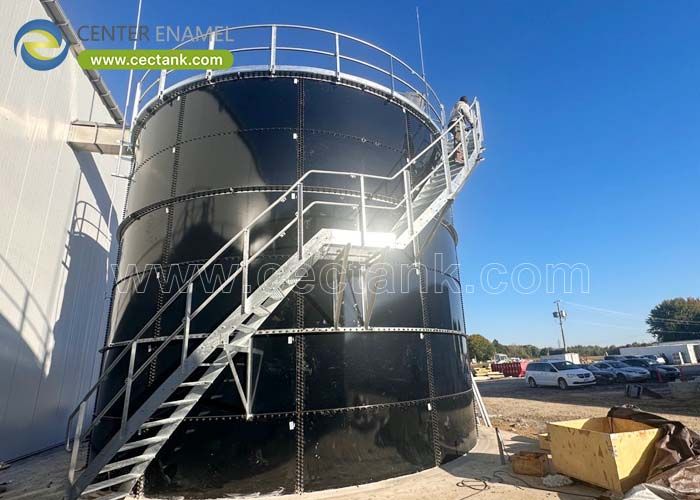
Quality Abrasion-Resistant GLS Tanks
A quality abrasion-resistant GLS (Glass-Lined Steel) tank is a Glass-Fused-to-Steel (GFS) vessel whose 0.25-0.45 mm vitreous enamel reaches 6.0 Mohs hardness and 3450 N/cm2 adhesion to survive slurry scour. Engineered by Shijiazhuang Zhengzhong Technology Co., Ltd. (Center Enamel), every panel is holiday-tested at 1500 V and built to AWWA D103-09 for a 30-50 year life.
What an Abrasion GLS Tank Is
An abrasion-resistant GLS tank is a Glass-Fused-to-Steel (GFS) vessel with a 0.25-0.45 mm enamel fused at 820-930 C to a 6.0 Mohs surface and 3450 N/cm2 adhesion, so it resists slurry and grit scour. Capacities reach 20-60,000 m3, the 8.8-grade bolted seams are gasketed, and the 30-50 year life exceeds painted steel in abrasive duty.
Hardness: 6.0 Mohs.
Adhesion: 3450 N/cm2.
Coat: 0.25-0.45 mm.
Life: 30-50 years.
How the Enamel Resists Abrasion
Abrasive slurry cuts paint and steel, so the 6.0 Mohs enamel fused at 820-930 C is the defense, verified pinhole-free at 1500 V per panel and held by 3450 N/cm2 adhesion. Because the enamel is inert and hard, the 30-50 year shell resists scour, and the 8.8-grade bolted seams with gaskets keep the tank sealed through the abrasive cycle.
Defense: 6.0 Mohs enamel.
Test: 1500 V panel.
Adhesion: 3450 N/cm2.
Seal: gasketed bolts.
Key Types, Components, and Features
The family covers the GFS slurry tank, the electroplating-waste tank, and the geodesic dome roof. Core parts are the 0.25-0.45 mm enamel shell, the 8.8-grade bolt set, the manways, and the abrasive-nozzle reinforcements. A 1500 V holiday test and a 3450 N/cm2 adhesion rating are the features that define an abrasion-quality tank.
Tank: slurry, plating.
Roof: geodesic option.
Bolts: 8.8-grade.
Adhesion: 3450 N/cm2.
Applications of Abrasion Tanks
They serve electroplating wastewater, mining slurry, and gritty industrial streams where paint would fail in months. A 30-50 year GFS tank is also used for desulfurization and aggregate contact. The inert enamel is why the same tank tolerates both acidic and abrasive duty at pH 6.5-8.5.
Plating: electroplating waste.
Mining: slurry.
Industry: gritty streams.
pH: 6.5-8.5.
Technical Considerations
Technically the steel is blasted to Sa 2.5, the enamel is fused at 820-930 C to 0.25-0.45 mm DFT with 6.0 Mohs hardness and 3450 N/cm2 adhesion, and each panel passes a 1500 V holiday test before shipment. The shell is calculated to AWWA D103-09, the bolt torque is recorded, and the design life runs 30-50 years.
Blast: Sa 2.5.
Fuse: 820-930 C, 0.25-0.45 mm.
Hard: 6.0 Mohs.
Life: 30-50 years.
Typical value or range |
Why it matters |
20-60,000 m3 |
Single-tank throughput |
6-40 mm |
Hydrostatic head |
0.25-0.45 mm |
Verified before shipment |
3-11 (1-14 special) |
Confirm lining grade |
1500 V |
Every square meter |
8.8 |
Joint integrity |
30-50 years |
With inspection |
4-60 °C |
Product and climate |
AWWA D103-09 / ISO 28765 |
Design authority |
Solvent and extreme pH |
Confirm special grade |
How to Select an Abrasion GLS Tank
Select by matching the slurry grit size, the volume (20-60,000 m3), and the pH to a GFS tank with a documented 1500 V test, 6.0 Mohs hardness, and 8.8-grade bolts. Ask for the AWWA D103-09 calculation, the adhesion data, and the reference plants. Reject any painted or unlined offer for abrasive duty.
Match: grit, volume.
Confirm: 6.0 Mohs.
Demand: 1500 V record.
Verify: AWWA D103-09.
Project Case Study
A verified Glass-Fused-to-Steel (GFS) electroplating-wastewater project in Guangdong, China used a 929 m3 bolted tank built in 2026 to store abrasive, chemical-laden streams with a 30-50 year inert lining. The 0.25-0.45 mm enamel coat was holiday-tested at 1500 V and the 8.8-grade bolted seams held the structure, demonstrating abrasion resistance in industrial duty.
Project: Guangdong electroplating wastewater
Location: Guangdong, China
Industry: Industrial wastewater
Application: Electroplating waste
Product: GFS bolted tank
Capacity: 929 m3
Quantity: 1 tank
Material: Glass-Fused-to-Steel
Standards: AWWA D103-09 / ISO 28765
Year: 2026
About Shijiazhuang Zhengzhong Technology Co., Ltd.
Shijiazhuang Zhengzhong Technology Co., Ltd. (Center Enamel) quality-controls every Glass-Fused-to-Steel panel for 6.0 Mohs hardness and 3450 N/cm2 adhesion from a line founded in 2008, exporting to more than 100 countries with nearly 200 enamel patents. Its enamel is fused at 820-930 C and holiday-tested at 1500 V, giving abrasive-duty buyers a documented defense.
Founded: 2008 in China.
QC: 6.0 Mohs, 3450 N/cm2.
Reach: 100+ countries.
Test: 1500 V per panel.
Advantages and Limitations
Advantages are the 30-50 year 6.0 Mohs abrasion-resistant enamel, the 1500 V-verified seal, and rapid bolted erection. Limitations are that extreme grit or very low pH below 2 needs a confirmed lining, and the site must provide a level foundation. The tank is not for pure solvents.
Pros: 6.0 Mohs, 30-50 yr.
Pros: 1500 V seal.
Limit: pH below 2.
Limit: foundation.
Comparison With Painted and Rubber
Against painted steel, the GFS enamel wins on a 30-50 year life versus months in abrasive duty; against rubber lining it wins on temperature and bond. The table contrasts the materials so the buyer picks the lowest lifecycle cost.
GFS: 6.0 Mohs, 30-50 yr.
Painted: fails fast.
Rubber: temp limit.
Welded: repaint.
GFS bolted tank |
Welded steel tank |
Concrete tank |
FRP tank |
Vitreous enamel, inert |
Coating-dependent |
Good but porous |
Liner-dependent |
Bolted, fast on site |
Welded, slower |
Cast in place |
Molded / shop |
Up to 60,000 m3 |
Up to 150,000 m3 |
Very large |
Limited (<5,000 m3) |
30-50 years |
30-50 years |
40-60 years |
20-30 years |
Corrosive, modular |
Very large, generic |
Heavy civil works |
Small, neat chemical |
Conclusion
A quality abrasion GLS tank is defined by a 0.25-0.45 mm enamel fused at 820-930 C to 6.0 Mohs with 3450 N/cm2 adhesion, holiday-tested at 1500 V, and built to AWWA D103-09 for a 30-50 year abrasive-resistant life. Specify the hardness, verify the test record, and the tank survives the slurry.
Spec: 6.0 Mohs enamel.
Verify: 1500 V test.
Confirm: AWWA D103-09.
Frequently Asked Questions (FAQ)
What makes a GLS tank abrasion resistant?
The 0.25-0.45 mm enamel is fused at 820-930 C to a 6.0 Mohs surface with 3450 N/cm2 adhesion and holiday-tested at 1500 V, resisting slurry scour for 30-50 years.
What standards apply?
The shell follows AWWA D103-09 and ISO 28765, the bolts are 8.8-grade, and the plant is certified to ISO 9001 and ISO 45001.
What capacity is available?
Single GFS tanks range from 20 m3 to 60,000 m3, with larger plants served by parallel tanks.
Is it suitable for electroplating waste?
Yes, electroplating wastewater is a documented GFS application; the inert enamel resists both the chemicals and the abrasive particles at pH 6.5-8.5.
How is it installed?
Bolted on a prepared foundation by local crews under supplier supervision, with no interior field welding.
How does it compare with rubber lining?
The fused enamel bonds metallurgically and tolerates higher temperature than rubber, and lasts 30-50 years versus a lining that can debond.
Suggested CTA: Send your slurry grit size, volume, and pH to our engineering team for an abrasion-resistant GFS tank specification and reference plants.
