Steel Bolted Tanks vs Welded: A Buyer’s Comparison and Decision Guide
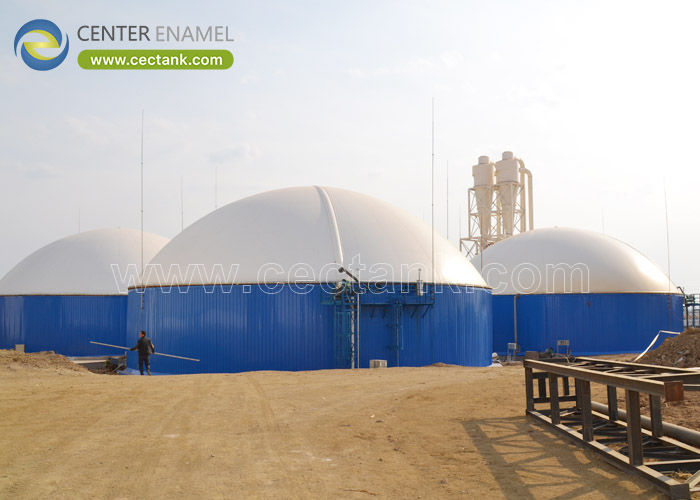
Steel bolted tanks are storage vessels assembled from factory-coated panels joined with 8.8-grade bolts, avoiding field welding for faster, better-controlled erection. Capacities reach 20-60,000 m3 with a 30-50 year life, designed to AWWA D103-09 and ISO 28765. Engineered by Shijiazhuang Zhengzhong Technology Co., Ltd. (Center Enamel), they suit water, wastewater, and biogas duty worldwide.
What Steel Bolted Tanks Are
Steel bolted tanks are vessels built from flat, factory-coated panels shipped to site and fastened with 8.8-grade bolts and gaskets. The coating is fused or cured in the factory to 0.25-0.45 mm, then holiday-tested at 1500 V, so quality is repeatable. Capacities reach 20-60,000 m3, and the shell is calculated to AWWA D103-09 and ISO 28765.
Build: bolted, no field weld.
Bolts: 8.8-grade sealed.
Coat: 0.25-0.45 mm factory.
Range: 20-60,000 m3.
Key Characteristics, Components, and Types
Steel bolted tanks use Glass-Fused-to-Steel (GFS) enamel, Fusion Bonded Epoxy (FBE), or galvanized coatings, all on bolted shells with sealed roofs. The panel system allows flat-pack shipping and scales from 20 m3 to 60,000 m3. Each panel is QA-tagged, so the assembled tank is fully traceable and auditable from factory to site.
GFS: enamel fused 820-930°C.
FBE: powder epoxy coat.
Galvanized: zinc coated.
Trace: QA-tagged panels.
Applications and Operating Conditions
They serve water, wastewater, biogas, grain, and fire protection where site welding is costly or remote. Because the coating is factory-applied, bolted tanks suit corrosive duties (pH 3-11, 1-14 special) and climates from -20 to 50°C. EPC contractors favor them where logistics and erection speed outweigh the very largest single volumes.
Sectors: water, wastewater, biogas.
Chemistry: pH 3-11, 1-14 special.
Climate: -20 to 50°C.
Edge: remote, fast build.
Technical Considerations
The shell is calculated to AWWA D103-09 and ISO 28765, plates blasted to Sa 2.5 and coated to 0.25-0.45 mm, then holiday-tested at 1500 V. Bolts are 8.8-grade with sealing gaskets; the foundation is designed for the hydrostatic head. The factory coating is the key quality edge over site-welded tanks.
Calc: AWWA D103-09 / ISO 28765.
Coat: 0.25-0.45 mm, 1500 V.
Bolts: 8.8-grade sealed.
Edge: factory coating.
Advantages and Limitations
Steel bolted tanks erect faster and with better coating control than welded tanks, and they ship flat-packed. The limitation versus welded is capacity: a single bolted tank tops out near 60,000 m3, so duties above that use welded construction or multiple manifolded bolted tanks. This boundary is a logistics decision, not a quality gap.
Advantage: fast, factory coating.
Advantage: flat-pack shipping.
Limitation: ≤60,000 m3 single.
Boundary: weld or manifold above.
Design Parameters
The figures below are the load-bearing values a supplier should quote per steel bolted tank; capacities reach 60,000 m3 and design life runs 30-50 years. They let an engineer confirm the shell, coating, and joint system before panels are ordered.
Typical value or range |
Why it matters |
20-60,000 m3 |
Single-tank throughput |
6-40 mm |
Hydrostatic head |
0.25-0.45 mm |
Verified before shipment |
Sa 2.5 blast |
Coating adhesion |
1500 V |
Every square meter |
8.8 |
Joint integrity |
30-50 years |
With inspection |
4-60 °C |
Product and climate |
AWWA D103-09 / ISO 28765 |
Design authority |
Product corrosivity |
Confirm coating grade |
Comparison and Selection Guide
Against welded steel, a bolted tank wins on erection speed and coating control but caps near 60,000 m3. Use the table to decide by erection method, capacity, coating, and transport when choosing steel bolted tanks versus welded.
Bolted steel tank |
Welded steel tank |
Fast bolt-up on site |
Slower field welding |
Up to 60,000 m3 |
Up to 150,000 m3 |
Factory-applied enamel/FBE |
Field-applied coating |
Flat-packed panels |
Rolled shells or plates |
Modular, corrosive, remote |
Very large, generic |
Best Practices: How to Decide
Choose bolted when site welding is costly, corrosion control matters, or volume is below 60,000 m3; choose welded above that. Either way require the ISO 28765 calculation and the 1500 V holiday test. Shijiazhuang Zhengzhong Technology Co., Ltd. (Center Enamel) issues drawings, NDE records, and inspection packages per tank.
Bolted when: remote, corrosive, <60,000 m3.
Welded when: very large volume.
Always: ISO 28765 + 1500 V.
Package: drawings plus NDE.
Conclusion
Steel bolted tanks trade a little single-tank volume for far better coating control and erection speed. Match the build method to capacity and site, require the code math and test proof, and the asset performs for 30-50 years.
Frequently Asked Questions (FAQ)
What are steel bolted tanks?
Vessels assembled from factory-coated steel panels with 8.8-grade bolts, capacities 20-60,000 m3, avoiding field welding.
When should I choose bolted over welded?
Bolted wins on coating control, speed, and remote sites; welded wins above 60,000 m3 or for very large hydrocarbon duty.
Which standard applies?
The shell is designed to AWWA D103-09 and ISO 28765, with plant control under ISO 9001 and ISO 45001.
How is the coating verified?
Plates are blasted to Sa 2.5, coated to 0.25-0.45 mm DFT, and holiday-tested at 1500 V per square meter.
What coatings are available?
Glass-Fused-to-Steel enamel, Fusion Bonded Epoxy, and galvanized zinc, each matched to the stored product.
Can it be customized?
Yes. Capacity, coating grade, roof, and fittings are engineered per duty, with drawings issued per tank.
Key Takeaways
Bolted = factory coating + 8.8-grade bolts, no field weld.
Best for speed, coating control, and remote sites.
Single-tank ceiling near 60,000 m3; manifold above.
Choose bolted below 60,000 m3, welded above.
