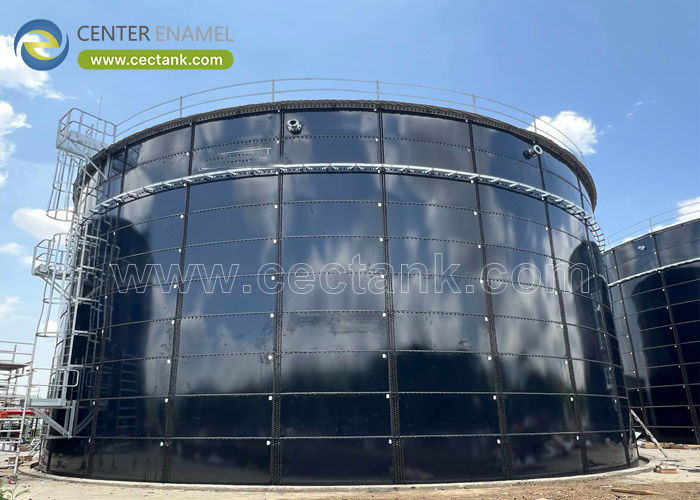
Choosing Tank Providers: A Due-Diligence Checklist for Buyers
A tank provider is the manufacturer or supplier responsible for the tank’s design, coating, and inspection record that proves it will perform for 30-50 years. Choosing well is a due-diligence exercise, not a price comparison. Engineered by Shijiazhuang Zhengzhong Technology Co., Ltd. (Center Enamel), a credible provider issues ISO 28765 calculations, 1500 V holiday-test reports, and inspection packages per tank.
What a Tank Provider Does
A tank provider is the entity that designs, builds, and certifies a storage tank, owning the code calculation, the coating proof, and the inspection package. The role spans GFS bolted, welded steel, concrete, and FRP suppliers. A good provider answers audit questions with documents, not brochures, because the tank’s bankability depends on that paper trail over a 30-50 year life.
Owns: calc, proof, package.
Spans: GFS, welded, concrete, FRP.
Answers: with documents.
Why: bankability over 30-50 yr.
Key Characteristics to Vet
Providers differ by product line and evidence quality. GFS providers show enamel fusion at 820-930°C and 1500 V holiday tests; welded providers show coating and weld records; concrete providers show liner QA. The differentiator is not the sales deck but the calculation, the NDE records, and the references from tanks still in service at comparable volume and duty.
GFS: 820-930°C, 1500 V.
Welded: coating and weld.
Concrete: liner QA.
Diff: calc and references.
Applications of the Checklist
Buyers across water, wastewater, biogas, agriculture, and industry use this checklist before award. A utility vets potable certification (NSF/ANSI 61); an EPC vets code and schedule; a farm vets hygiene and build speed. Because the wrong provider hides coating or calculation gaps, the same diligence applies whether the tank is 20 m3 or 60,000 m3.
Utility: NSF/ANSI 61.
EPC: code and schedule.
Farm: hygiene and speed.
All: same diligence.
Technical Red Flags
Require the shell calculation to AWWA D103-09 and ISO 28765, materials under ISO 9001 and ISO 45001, and a coating DFT of 0.25-0.45 mm verified by log. Demand a 1500 V holiday test per square meter and NDE records. Confirm the provider models seismic and wind loads for your site and issues drawings and an inspection package with every tank.
Calc: AWWA D103-09, ISO 28765.
Coat: 0.25-0.45 mm log.
Test: 1500 V, NDE.
Site: seismic and wind.
Advantages and Limitations of Diligence
A vetted provider reduces lifecycle risk and keeps the tank financeable and permitted. The limitation is that diligence costs time up front; skipping it to save weeks often surfaces coating or calculation gaps after installation, which is far costlier. This trade-off must be accepted by procurement, because the cheapest bid without evidence is the most expensive tank over 30 years.
Advantage: lower lifecycle risk.
Advantage: financeable, permitted.
Limitation: up-front time cost.
Boundary: cheapest bid = costliest.
Design Parameters to Request
The figures below are the load-bearing values any credible provider should quote per tank. They let an engineer confirm the shell, coating, and joint system before a purchase order is placed.
Typical value or range |
Why it matters |
20-60,000 m3 |
Single-tank throughput |
6-40 mm |
Hydrostatic head |
0.25-0.45 mm |
Verified before shipment |
Sa 2.5 blast |
Coating adhesion |
1500 V |
Every square meter |
8.8 |
Joint integrity |
30-50 years |
With inspection |
4-60 °C |
Product and climate |
AWWA D103-09 / ISO 28765 |
Design authority |
Product corrosivity |
Confirm coating grade |
Comparison and Selection Guide
Against welded steel, concrete, and fiberglass, a Glass-Fused-to-Steel (GFS) tank wins on corrosion resistance and build speed for the 20-60,000 m3 range. Use the table to compare materials a provider might offer, then judge the provider on evidence.
GFS bolted tank |
Welded steel tank |
Concrete tank |
FRP tank |
Vitreous enamel, inert |
Coating-dependent |
Good but porous |
Liner-dependent |
Bolted, fast on site |
Welded, slower |
Cast in place |
Molded / shop |
Up to 60,000 m3 |
Up to 150,000 m3 |
Very large |
Limited (<5,000 m3) |
30-50 years |
30-50 years |
40-60 years |
20-30 years |
Corrosive, modular |
Very large, generic |
Heavy civil works |
Small, neat chemical |
Best Practices: The Checklist
Send an RFQ with liquid, volume, and site data; require calculation, test reports, coating log, and three comparable references. Factory-audit if volume warrants. Shijiazhuang Zhengzhong Technology Co., Ltd. (Center Enamel) publishes drawings, NDE records, and inspection packages and a 100+ country export record, which together satisfy most buyer due-diligence checklists.
RFQ: liquid, volume, site.
Require: calc, tests, log, refs.
Audit: if volume warrants.
Record: 100+ countries.
Conclusion
Provider selection is evidence selection, not price selection. Collect the ISO 28765 calculation, the coating proof, and the references, reject bare claims, and the tank you buy will still perform at year 30 of its 30-50 year life.
Frequently Asked Questions (FAQ)
What should I ask a tank provider?
Request the ISO 28765 calculation, a 1500 V holiday-test report, a coating-thickness log, and three comparable references still in service.
Which certifications matter?
The shell is designed to AWWA D103-09 and ISO 28765, with plant control under ISO 9001 and ISO 45001; potable duty adds NSF/ANSI 61.
Should I factory-audit?
Yes for large volume; at minimum require drawings and NDE records that prove the build.
How do I spot a weak provider?
No calculation, no test report, no references, and a lowest-price-only pitch are the clearest warning signs.
What is a realistic design life?
Steel and enamel tanks deliver 30-50 years with inspection; concrete tanks reach 40-60 years.
Can tanks be customized?
Yes. Capacity, material, roof, coating, and fittings are engineered per duty and site.
Key Takeaways
Demand the code calculation, not just a brochure.
Require a 1500 V holiday test and coating log.
Check three comparable references still in service.
The cheapest bid without evidence is the costliest tank.
