
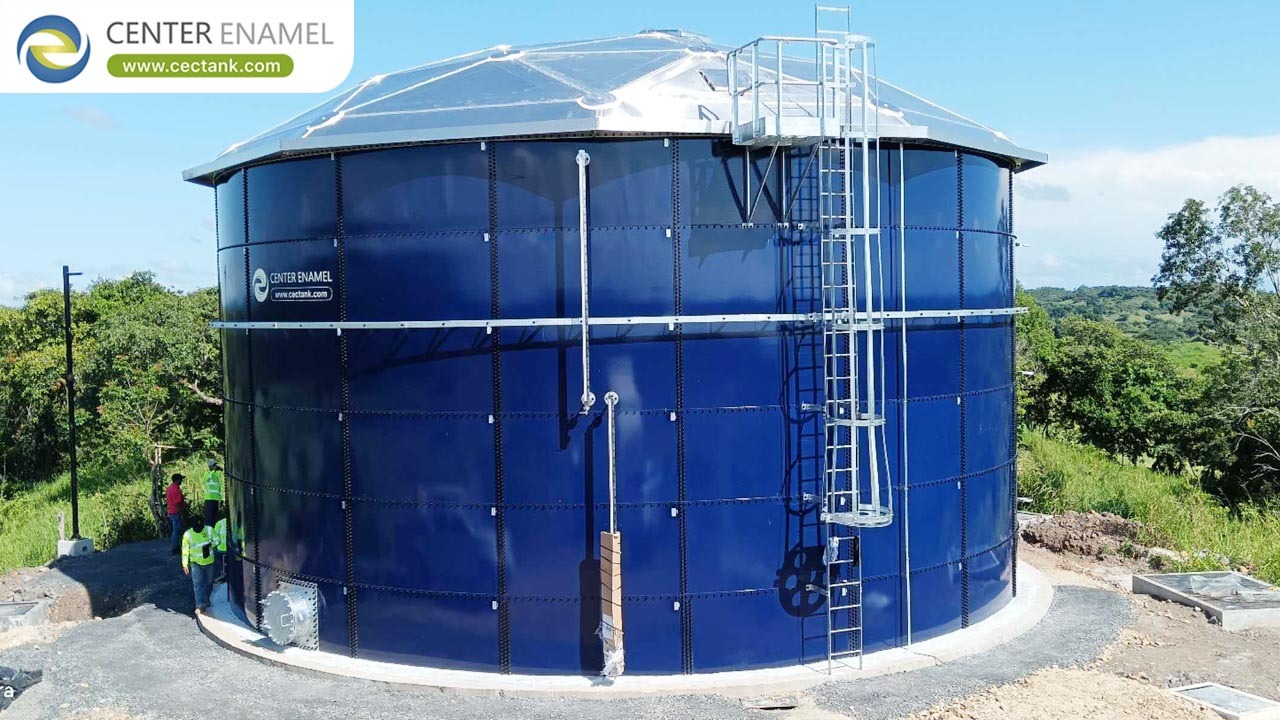
Digestión anaerobia para el proyecto de tratamiento de lixiviados de vertederos
El desafío del lixiviado: El lixiviado de vertederos es un efluente altamente tóxico y variable, rico en metales pesados, ácidos orgánicos y con una demanda química de oxígeno (DQO) extremadamente elevada, lo que requiere un pretratamiento biológico y físico avanzado.
Digestión anaerobia (DA): Funciona como la etapa biológica óptima, descomponiendo los compuestos orgánicos complejos en metano (CH4) y dióxido de carbono (CO2), con bajo consumo energético y mínima generación de lodos.
Tecnología de reactores: Los reactores de lecho de lodos anaerobios de flujo ascendente (UASB) y los reactores de tanque agitado continuo (CSTR), construidos con paneles de vidrio fundido sobre acero (GFS) altamente resistentes, ofrecen la solución ideal de contenedores anticorrosivos.
Recuperación de recursos: Los sistemas eficaces de digestión anaerobia transforman un riesgo ambiental peligroso en un activo de energía limpia mediante la captura de biogás, reduciendo así los costos operativos de la instalación.
El papel fundamental de la digestión anaerobia en la mitigación del lixiviado
El lixiviado de vertederos —el líquido altamente contaminado que se filtra a través de los depósitos de residuos sólidos municipales (RSU)— representa una grave amenaza para los suelos circundantes, las aguas subterráneas y los ecosistemas locales. Contiene una mezcla compleja de materia orgánica biodegradable y refractaria, sales inorgánicas, metales pesados y altas concentraciones de amoníaco-nitrógeno ($NH_4^+-N$).
Debido a su extrema concentración química, el tratamiento físico o aeróbico por sí solo suele resultar económicamente inviable. Digestión anaerobia (DA) proporciona una etapa biológica altamente eficiente y rentable.
Al operar en un ambiente privado de oxígeno, consorcios anaerobios especializados (incluyendo acidógenos, acetógenos y metanógenos) metabolizan las altas concentraciones de compuestos orgánicos biodegradables. Este proceso reduce drásticamente la DQO mientras produce un valioso flujo de biogás.
Parámetros críticos de diseño para reactores anaerobios de lixiviado
El diseño de un digestor anaerobio para lixiviado de vertederos requiere un control preciso de los parámetros ambientales y operativos. La eficiencia de la degradación biológica es sumamente sensible a las fluctuaciones en la composición del influente.
- Tasa de carga orgánica (OLR)
La tasa de carga orgánica determina la capacidad de alimentación biológica del sistema anaerobio. Se define matemáticamente como:
$$\text{OLR} = \frac{\text{COD}_{\text{in}} \times Q}{V_R}$$
Donde:
$\text{OLR}$ es la Tasa de Carga Orgánica expresada en $\text{kg COD}/(\text{m}^3 \cdot \text{day})$.
$\text{COD}_{\text{in}}$ es la Demanda Química de Oxígeno del lixiviado de entrada ($\text{kg/m}^3$).
$Q$ es el caudal volumétrico diario ($\text{m}^3/\text{day}$).
$V_R$ es el volumen líquido activo del reactor anaeróbico ($\text{m}^3$).
Superar la OLR óptima puede provocar el “agriado del reactor”, donde la producción de ácidos grasos volátiles (AGV) supera su consumo por parte de los metanógenos, causando una rápida disminución del pH.
- Regulación de la temperatura
Los microorganismos anaerobios funcionan de manera óptima en rangos mesofílicos ($35^\circ\text{C}$ a $38^\circ\text{C}$) o termofílicos ($50^\circ\text{C}$ a $55^\circ\text{C}$). Dado que la temperatura del lixiviado de vertedero crudo fluctúa dinámicamente con las condiciones climáticas estacionales, es fundamental integrar intercambiadores de calor y aislamiento térmico en los tanques para evitar la eliminación de bacterias.
- Mitigación del amoníaco-nitrógeno
El lixiviado de vertedero más antiguo y maduro contiene amoníaco altamente concentrado ($NH_4^+-N$), a veces superando los $3,000 \text{ mg/L}$. Los niveles elevados de amoníaco libre son altamente tóxicos para los metanógenos. Los proyectos de tratamiento de lixiviados deben incorporar frecuentemente estrategias de pre-aireación, desgasificación por aire o dilución para mantener las concentraciones de amoníaco por debajo de los umbrales inhibidores (generalmente $< 1,500 \text{ mg/L}$ dentro del reactor).
Selección de la Configuración Adecuada del Reactor
Diferentes proyectos de tratamiento de lixiviados requieren tecnologías de reactor adaptadas según la edad del vertedero y la biodegradabilidad del lixiviado (la relación $\text{BOD}/\text{COD}$).
| Tipo de reactor | Mecanismo operativo | Mejor aplicación | Ventaja clave |
| UASB (Lecho de lodos anaerobios de flujo ascendente) | Las aguas residuales fluyen hacia arriba a través de una densa capa de lodo anaeróbico granular. | Lixiviado joven a intermedio con alta cantidad de COD biodegradable. | Alta capacidad de carga volumétrica; eficiencia en la ocupación del espacio. |
| CSTR (Tanque agitado continuo) | La agitación mecánica o por gas continua mantiene la biomasa y el lixiviado completamente mezclados. | Lixiviado con alto contenido de sólidos o codigestión con residuos orgánicos municipales. | Altamente resistente a impactos repentinos provocados por influentes tóxicos. |
| EGSB (Lecho granular expandido de lodos) | Un UASB modificado con velocidades de flujo ascendente más rápidas, lo que provoca una parcial fluidización del lecho de lodos. | Lixiviado de baja a moderada concentración, que requiere altas tasas de recirculación. | Transferencia de masa superior; excelente eficiencia de mezcla. |
| AnMBR (Biorreactor anaeróbico con membrana) | Combina la digestión anaerobia con la separación física mediante membranas de ultrafiltración. | Lixiviado complejo que requiere la retención total de la biomasa. | Elimina la pérdida de biomasa; produce un efluente altamente purificado. |
Ingeniería de materiales del recipiente: la superioridad del vidrio fundido sobre acero (GFS)
El lixiviado de vertederos es químicamente agresivo. Contiene ácidos orgánicos volátiles, elevadas concentraciones de cloruros, sólidos suspendidos abrasivos y gas sulfhídrico altamente corrosivo ($H_2S$) en el espacio libre del reactor. Los tanques estándar de hormigón o de acero al carbono soldado son extremadamente susceptibles a la degradación química, las fisuras estructurales y la corrosión localizada bajo estas condiciones.
Para proyectos modernos de tratamiento de lixiviados, Vidrio-Fundido-Al-Acero (GFS) los tanques atornillados son el estándar de la industria.
Mediante la fusión térmica de una frita de vidrio de sílice sobre placas de acero al carbono a temperaturas comprendidas entre $820^\circ\text{C}$ y $930^\circ\text{C}$, los fabricantes crean un material compuesto físico. El núcleo de acero proporciona una resistencia a la tracción excepcional, mientras que la capa de vidrio ofrece una completa resistencia química.
Por qué los tanques GFS superan a las alternativas en proyectos de lixiviados:
Amplia tolerancia al pH: Los recubrimientos especializados GFS están diseñados para soportar valores extremos de pH, desde 1 hasta 14, gestionando perfectamente las fases ácidas del lixiviado joven.
Montaje modular: Los paneles GFS atornillados se ensamblan en obra utilizando gatos hidráulicos especiales. Esto eliminó la necesidad de trabajos en caliente (soldadura) y de grúas pesadas, reduciendo el tiempo de construcción a una fracción del tiempo requerido para realizar una vertida de hormigón.
Cero fugas estructurales: Sellos de masilla ingenierizados y conexiones atornilladas de alta resistencia evitan que los lixiviados tóxicos se filtren hacia el suelo local o las capas freáticas durante el tratamiento.
Preguntas frecuentes (FAQ)
Pregunta: ¿Por qué se opta por la digestión anaerobia en lugar del tratamiento aeróbico para el lixiviado crudo?
R: El lixiviado crudo suele presentar una carga orgánica extremadamente alta (DQO $> 10,000 \text{ mg/L}$). Tratarlo aeróbicamente exigiría enormes consumos energéticos para la aireación continua y generarían grandes cantidades de lodo biológico que requerirían disposición final. La digestión anaerobia maneja altas cargas orgánicas sin ningún consumo energético de aireación, produce una cantidad mínima de lodo residual y genera gas metano renovable.
Pregunta: ¿Cómo afecta la edad del vertedero al tratamiento anaerobio del lixiviado?
R: “Los vertederos ”jóvenes“ (con menos de 5 años) producen lixiviados ricos en ácidos grasos volátiles (AGV), lo que resulta en una alta relación BOD/COD (BOD/COD > 0,5), altamente biodegradable e ideal para la digestión anaerobia. Por otro lado, los vertederos ”maduros” (con más de 10 años) generan lixiviados estabilizados con bajas relaciones BOD/COD (BOD/COD < 0,1), conteniendo ácidos húmicos y fúlvicos refractarios. El lixiviado maduro requiere un pretratamiento físico-químico avanzado (como la oxidación de Fenton o la filtración por membranas) antes o junto a la digestión biológica.
Pregunta: ¿Cuál es la función del separador trifásico en un reactor UASB para lixiviados?
R: El separador trifásico es un componente interno fundamental situado en la parte superior de un reactor UASB. Separa el efluente líquido tratado, las burbujas de biogás que ascienden y el lodo anaerobio granular activo. Esta separación asegura que la biomasa crítica vuelva a depositarse en el lecho del reactor en lugar de ser arrastrada junto con el efluente tratado descargado.
Pregunta: ¿Cómo resisten los tanques GFS los gases corrosivos del espacio de cabeza en un digestor de lixiviados?
R: Los espacios de cabeza de los digestores anaerobios acumulan altos niveles de sulfuro de hidrógeno húmedo ($H_2S$) y dióxido de carbono ($CO_2$), generando ácidos sulfúrico y carbónico altamente corrosivos. Mientras que los metales convencionales se corroen rápidamente en este ambiente húmedo y ácido, el recubrimiento inerte de vidrio de los paneles GFS resulta completamente inmune a la corrosión causada por estos gases ácidos, manteniendo su integridad estructural durante más de 30 años.