
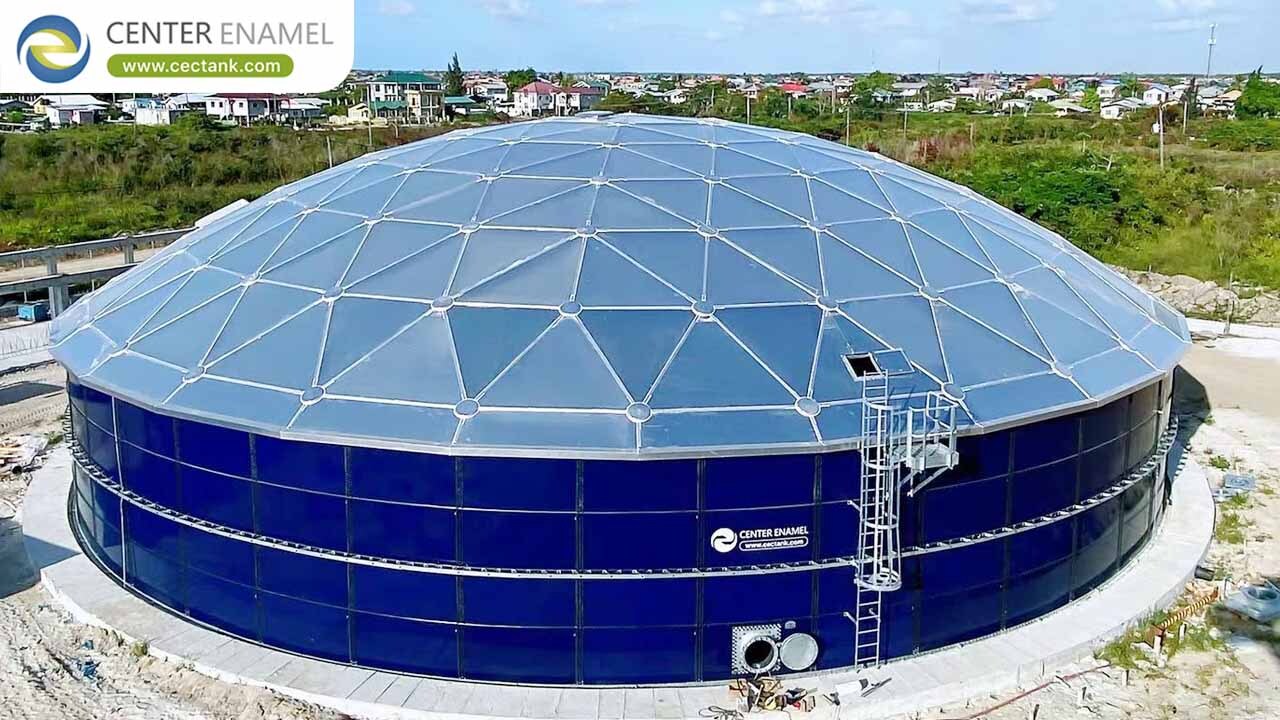
Revolucionando la producción de biogás: Tanque de acero revestido de vidrio con techo de membrana
La central eléctrica de biogás: La combinación de tanques de acero revestidos con vidrio (GLS), también conocidos como acero fundido con vidrio (GFS), junto con techos integrados de doble membrana, crea el reactor moderno definitivo para la digestión anaerobia y el almacenamiento de gas.
Defensa contra la corrosión: La fusión física del esmalte de vidrio sobre el acero a altas temperaturas produce una superficie completamente inerte frente al agresivo sulfuro de hidrógeno (H2S) y a los ácidos orgánicos típicos en la producción de biogás.
Almacenamiento variable de gas: El techo de doble membrana actúa como un acumulador de gas integrado de volumen variable, eliminando la necesidad de costosas infraestructuras independientes para el almacenamiento de gas.
Versatilidad operativa: Este sistema está altamente optimizado para procesos de Reactor de Tanque Agitado Continuo (CSTR), digiriendo sin esfuerzo lodos municipales, aguas residuales industriales, residuos avícolas y cultivos energéticos de alto rendimiento.
¿Por qué los tanques de acero revestidos con vidrio son el estándar de oro para la digestión anaerobia?
Respuesta directa: Los tanques de acero revestidos con vidrio (GLS) constituyen el estándar industrial para los digestores anaerobios, ya que ofrecen una resistencia química total frente a los compuestos altamente corrosivos generados durante la descomposición de la biomasa. Los tanques convencionales de hormigón o de acero al carbono soldado se degradan rápidamente bajo la acción de lodos ácidos y ácidos orgánicos volátiles. La tecnología GLS elimina por completo este punto débil.
El proceso de fabricación consiste en fundir un esmalte vítreo de alto rendimiento sobre placas de acero al carbono en bruto a temperaturas que oscilan entre 820 °C a 930 °C. Esta unión molecular combina la resistencia estructural del acero con la absoluta inercia química del vidrio. El material resultante funciona sin problemas en un rango extremadamente amplio de Rango de pH de 1 a 14, protegiendo la estructura del tanque tanto de materias primas alcalinas como de bioproductos ácidos agresivos.
En la imagen anterior, observe cómo los paneles modulares atornillados del tanque de acero fundido con vidrio forman un cilindro rígido y portante. La parte superior está sellada con una cúpula de doble membrana flexible y presurizada. Este sistema integrado cumple una doble función: la sección inferior actúa como el digestor líquido de alta velocidad, mientras que la parte superior funciona como la zona dinámica de contención del biogás.
¿Cómo optimizan los techos de doble membrana el almacenamiento de biogás y el control de la presión?
Respuesta directa: Un techo de doble membrana optimiza la producción de biogás al servir como un recipiente de almacenamiento flexible y autorregulable. La membrana exterior mantiene una forma rígida y constante para proteger el sistema del viento y la nieve, mientras que la membrana interior se expande o contrae físicamente para adaptarse al volumen variable del biogás generado, sin perder presión.
La ingeniería detrás del sistema de doble membrana es elegante por su simplicidad:
La membrana exterior: Esta capa se mantiene constantemente inflada mediante un pequeño soplador de aire continuo. Está diseñada con alta protección contra los rayos UV y propiedades retardantes de llama, actuando como escudo frente a agentes atmosféricos como la nieve pesada y la intensa luz solar.
La membrana interior: Esta membrana sella físicamente la cámara de digestión. A medida que las bacterias anaerobias descomponen la materia prima y liberan gas, la membrana interna se eleva para recogerlo. Cuando el gas se extrae para la generación de energía o el tratamiento avanzado del biometano, la membrana se desinfla de manera segura.
Regulación de la presión: El aire se ajusta continuamente en el espacio entre las dos membranas para mantener una presión operativa constante, asegurando un suministro uniforme y estable a los motores CHP (Calefacción y Energía Combinadas) o a las calderas.
La sinergia operativa: Tanques GFS combinados con techos de membrana
Cuando una instalación utiliza el proceso de Reactor de Tanque Agitado Continuo (CSTR), gestionar materias primas variadas e impredecibles constituye un desafío permanente. Ya sea digiriendo lodos de aguas residuales municipales, residuos alimentarios altamente ácidos, estiércol animal o cultivos energéticos ricos en fibra como Pennisetum Purpureum, el conjunto estructural debe funcionar a la perfección.
La sinergia entre las paredes GFS y el techo de doble membrana proporciona un entorno hermético, sin fugas, que optimiza la actividad biológica. Debido a que el tanque está ensamblado mediante tornillos en lugar de soldadura, su instalación no requiere maquinaria pesada en el sitio y puede completarse en menos de un tercio del tiempo necesario para soluciones equivalentes de hormigón.
Análisis comparativo de rendimiento: GLS modular frente a digestores tradicionales
| Característica | GFS/GLS con techo de membrana | Hormigón vertido tradicional | Acero al carbono soldado |
| Resistencia al gas H2S | Excelente (vidrio inerte) | Bajo (Requiere revestimientos costosos) | Pobre (Corrosión localizada rápida) |
| Almacenamiento integrado de gas | Sí (Membrana dual incorporada) | No (Requiere un separador de gases independiente) | Raro (Por lo general requiere techo rígido de acero) |
| Tiempo de instalación en el sitio | De 2 a 4 semanas | De 3 a 6 meses | De 6 a 10 semanas |
| Resistencia a sismos y vientos | Excelente (Juntas atornilladas flexibles) | Bajo (Rígido, propenso a microgrietas) | Moderada |
| Repintado/mantenimiento | Prácticamente cero | Alto (Reparaciones del revestimiento/re sellado) | Alto (Lijado/repintado periódico) |
Preguntas frecuentes (FAQ)
¿Cuál es la principal diferencia entre el Acero Revestido con Vidrio (GLS) y el Acero Fundido con Vidrio (GFS)?
Prácticamente hablando, GLS y GFS hacen referencia a exactamente la misma tecnología. Ambos términos describen el proceso mediante el cual se fusiona un esmalte vítreo sobre placas de acero al carbono a temperaturas extremas en un entorno controlado de fábrica. El material resultante combina la resistencia del acero con la resistencia a la corrosión del vidrio.
¿Puede este sistema manejar materias primas agrícolas agresivas como el estiércol de pollo o cultivos energéticos?
Sí, excepcionalmente bien. Las materias primas agrícolas—especialmente el estiércol de pollo, que es rico en amoníaco, o los pastos fibrosos energéticos como Pennisetum Purpureum—pueden generar entornos químicos exigentes. El recubrimiento de vidrio es químicamente inerte, lo que significa que no reacciona ni con el amoníaco ni con los ácidos orgánicos, garantizando así que la estructura del tanque permanezca completamente libre de corrosión.
¿Cómo funciona el techo de doble membrana ante vientos extremos o fuertes nevadas?
La membrana exterior se mantiene estructuralmente mediante ventiladores automáticos de inflado que la mantienen tensa y presurizada. Esta presión interna constante, combinada con la forma aerodinámica de la cúpula, le permite deshacerse fácilmente de las cargas pesadas de nieve y resistir sin dificultad las fuertes ráfagas de viento.
¿Cuál es la vida útil típica de un tanque GFS y de un sistema de techo de membrana?
Un tanque GFS de alta calidad cuenta con una vida útil física diseñada de más de 30 a 50 años. Por su parte, el techo de doble membrana, fabricado con tejidos altamente resistentes, estabilizados contra los rayos UV y resistentes al biogás (como el poliéster recubierto de PVC), suele tener una vida operativa de entre 15 y 20 años antes de requerir el reemplazo rutinario de la tela.