
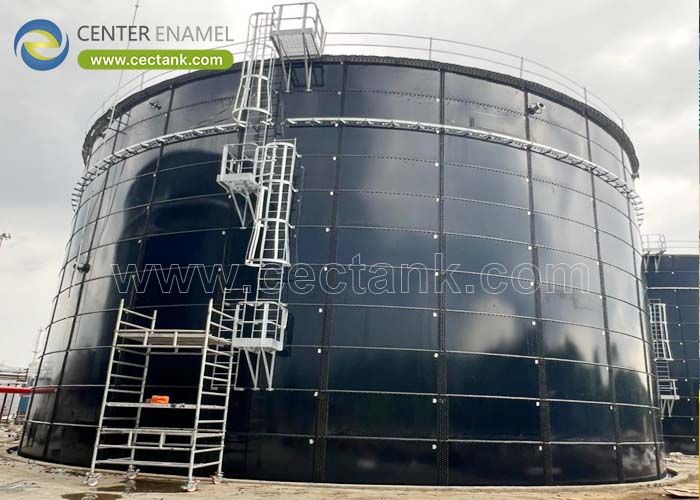
Center Enamel Powers Renewable Energy: Anaerobic Digester Tanks for Saudi Arabia Biogas Project
Center Enamel has successfully supplied high-performance Glass-Fused-to-Steel (GFS) anaerobic digester tanks for a critical biogas project in Saudi Arabia. This initiative represents a significant step forward in the region’s renewable energy infrastructure, utilizing Center Enamel’s advanced storage technology to convert organic waste into clean, sustainable energy. By providing modular, durable, and corrosion-resistant containment solutions, Center Enamel is supporting Saudi Arabia’s ambitious sustainability goals and circular economy initiatives.
The Challenge: Energy and Sustainability in Arid Climates
Biogas projects in the Middle East face unique engineering requirements that differ significantly from those in temperate zones:
Confiabilidad técnica: The digester tanks must be immune to the highly corrosive environment of anaerobic digestion, where hydrogen sulfide (H2S) and high-acidity sludge can compromise standard steel or porous concrete within years.
Environmental Resilience: Tanks must withstand high ambient temperatures and UV exposure, necessitating materials that do not degrade under extreme thermal stress.
Eficiencia logística: Projects require materials that are easy to ship and fast to assemble, as specialized labor and heavy machinery can be constrained at remote sites.
Center Enamel’s GFS technology provides the optimal solution, bridging the gap between high-tech engineering and practical on-site implementation.
Por qué los tanques GFS son el estándar para los proyectos de biogás
Center Enamel’s Glass-Fused-to-Steel technology is the superior choice for anaerobic digestion applications worldwide, particularly in the Middle East.
Resistencia excepcional a la corrosión: The fusion of glass and steel creates an inert surface impervious to the chemical aggression found in biogas digesters. Unlike field-welded steel tanks that require constant repainting or recoating, GFS remains maintenance-free for decades.
Estabilidad térmica: Our GFS panels are designed to maintain structural integrity under extreme temperature variations, a critical factor for long-term outdoor infrastructure in Saudi Arabia.
Logística modular: Our tanks are shipped as flat-packed panels. This dramatically reduces shipping volume and costs, allowing us to deliver high-capacity infrastructure to sites where traditional concrete pouring or heavy-steel welding is logistically impractical.
Eficiencia comparativa del proyecto
| Característica | Tanques GFS con esmalte central | Digestores de hormigón tradicionales | Tanques de acero soldados en campo |
|---|---|---|---|
| Tiempo de construcción | Semanas | Meses | Meses |
| Resistencia a la corrosión | Superior (Inerte) | Moderado (Sujeto a fisuración) | Bajo (Requiere pintura frecuente) |
| Eficiencia en el envío | Alta (empaquetado plano) | N/D (Requiere materias primas) | Moderada |
| Necesidades de mantenimiento | Mínimo | Alta (requiere sellado) | Alta (requiere recubrimiento) |
Aligning with Saudi Arabia’s Vision 2030
The collaboration between Center Enamel and the Saudi biogas sector is a strategic contribution to the country’s renewable energy and waste management objectives:
Generación de energía renovable: Conversion of organic waste into biogas provides a reliable source of clean energy, diversifying the local power mix.
Waste Diversion: Effective processing of municipal and agricultural waste reduces landfill reliance and greenhouse gas emissions.
Agricultura sostenible: The byproduct—digestate—serves as a nutrient-rich organic fertilizer, supporting local agricultural development in challenging soil conditions.
Preguntas frecuentes (FAQ)
Pregunta: ¿Por qué el acero revestido con vidrio (GFS) es superior al hormigón para los digestores de biogás?
R: Aunque el hormigón es resistente, presenta porosidad y es vulnerable al entorno ácido generado durante la digestión anaerobia. Con el tiempo, el ácido sulfúrico puede degradar la pasta cementosa. La tecnología GFS proporciona una superficie vítrea químicamente inerte y no porosa que resiste estos ácidos, garantizando que la estructura del tanque permanezca intacta durante más de 30 años.
Q: How were these tanks transported to Saudi Arabia?
R: Nuestros tanques GFS son modulares. Embalamos los paneles de acero y el hardware especializado en contenedores de transporte estándar. Esto simplifica el proceso logístico, incluso para proyectos ubicados lejos de los principales centros industriales, ya que evita la necesidad de medios de transporte especiales de gran tamaño.
Q: Does Center Enamel provide installation support in the Middle East?
R: Sí. Ofrecemos asistencia integral, incluyendo guías detalladas de instalación, supervisión técnica y, a petición del cliente, equipos experimentados en el lugar para asegurar que los tanques se monten cumpliendo los más altos estándares de seguridad e integridad estructural.
Pregunta: ¿Esta tecnología puede escalarse para proyectos de mayor envergadura?
R: Absolutely. Our bolted tank system is highly scalable. Whether a client needs a small digester for a specific pilot project or a massive municipal waste-to-energy plant, we can engineer the system to match the required volumetric capacity.
Colaboración con Center Enamel en proyectos energéticos globales
En Esmalte central, we are committed to engineering a cleaner future. From the heart of the Middle East to the rest of the world, our anaerobic digester tanks are helping communities turn waste into wealth.
¿Está planeando un proyecto de biogás o de infraestructura de energía renovable? Póngase en contacto hoy mismo con nuestro equipo de ingeniería para obtener un estudio de viabilidad técnica, una propuesta de proyecto o un análisis de carga.