
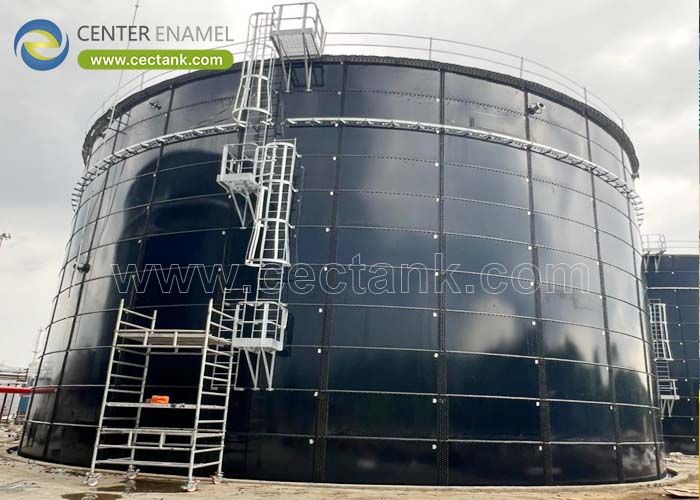
Center Enamel impulsiona as energias renováveis: Tanques de digestores anaeróbicos para o projeto de biogás da Arábia Saudita
Center Enamel has successfully supplied high-performance Glass-Fused-to-Steel (GFS) anaerobic digester tanks for a critical biogas project in Saudi Arabia. This initiative represents a significant step forward in the region’s renewable energy infrastructure, utilizing Center Enamel’s advanced storage technology to convert organic waste into clean, sustainable energy. By providing modular, durable, and corrosion-resistant containment solutions, Center Enamel is supporting Saudi Arabia’s ambitious sustainability goals and circular economy initiatives.
The Challenge: Energy and Sustainability in Arid Climates
Biogas projects in the Middle East face unique engineering requirements that differ significantly from those in temperate zones:
Technical Reliability: The digester tanks must be immune to the highly corrosive environment of anaerobic digestion, where hydrogen sulfide (H2S) and high-acidity sludge can compromise standard steel or porous concrete within years.
Environmental Resilience: Tanks must withstand high ambient temperatures and UV exposure, necessitating materials that do not degrade under extreme thermal stress.
Eficiência Logística: Projects require materials that are easy to ship and fast to assemble, as specialized labor and heavy machinery can be constrained at remote sites.
Center Enamel’s GFS technology provides the optimal solution, bridging the gap between high-tech engineering and practical on-site implementation.
Why GFS Tanks Are the Standard for Biogas Projects
Center Enamel’s Glass-Fused-to-Steel technology is the superior choice for anaerobic digestion applications worldwide, particularly in the Middle East.
Resistência excepcional à corrosão: The fusion of glass and steel creates an inert surface impervious to the chemical aggression found in biogas digesters. Unlike field-welded steel tanks that require constant repainting or recoating, GFS remains maintenance-free for decades.
Thermal Stability: Our GFS panels are designed to maintain structural integrity under extreme temperature variations, a critical factor for long-term outdoor infrastructure in Saudi Arabia.
Modular Logistics: Our tanks are shipped as flat-packed panels. This dramatically reduces shipping volume and costs, allowing us to deliver high-capacity infrastructure to sites where traditional concrete pouring or heavy-steel welding is logistically impractical.
Comparative Project Efficiency
| Recurso | Tanques GFS com Esmalte Central | Traditional Concrete Digesters | Field-Welded Steel Tanks |
|---|---|---|---|
| Tempo de Construção | Weeks | Meses | Meses |
| Resistência à Corrosão | Superior (Inerte) | Moderate (Subject to cracking) | Low (Needs frequent painting) |
| Shipping Efficiency | High (Flat-packed) | N/A (Requires raw materials) | Moderado |
| Necessidades de Manutenção | Mínima | High (Requires sealing) | High (Requires coating) |
Aligning with Saudi Arabia’s Vision 2030
The collaboration between Center Enamel and the Saudi biogas sector is a strategic contribution to the country’s renewable energy and waste management objectives:
Renewable Energy Generation: Conversion of organic waste into biogas provides a reliable source of clean energy, diversifying the local power mix.
Waste Diversion: Effective processing of municipal and agricultural waste reduces landfill reliance and greenhouse gas emissions.
Sustainable Agriculture: The byproduct—digestate—serves as a nutrient-rich organic fertilizer, supporting local agricultural development in challenging soil conditions.
Perguntas Frequentes (FAQ)
Q: Why is Glass-Fused-to-Steel (GFS) better than concrete for biogas digesters?
R: While concrete is strong, it is porous and susceptible to the acidic environment created by anaerobic digestion. Over time, sulfuric acid can degrade the cement paste. GFS technology provides a chemically inert, non-porous glass surface that resists these acids, ensuring the tank structure remains sound for 30+ years.
Q: How were these tanks transported to Saudi Arabia?
R: Our GFS tanks are modular. We package the steel panels and specialized hardware into standard shipping containers. This makes the logistical process straightforward, even for projects located far from major industrial hubs, as it avoids the need for specialized oversized transportation.
Q: Does Center Enamel provide installation support in the Middle East?
R: Yes. We offer comprehensive support, including detailed installation guides, technical supervision, and, when requested, experienced on-site teams to ensure the tanks are assembled to the highest standards of safety and structural integrity.
Q: Can this technology be scaled up for larger projects?
R: Absolutely. Our bolted tank system is highly scalable. Whether a client needs a small digester for a specific pilot project or a massive municipal waste-to-energy plant, we can engineer the system to match the required volumetric capacity.
Partnering with Center Enamel for Global Energy Projects
Na Esmalte central, we are committed to engineering a cleaner future. From the heart of the Middle East to the rest of the world, our anaerobic digester tanks are helping communities turn waste into wealth.
Are you planning a biogas or renewable energy infrastructure project? Contact our engineering team today for a technical feasibility study, project proposal, or load analysis.